
The online language learning platform is very well thought and organized and puts both learners and teachers in the best position to start interactive language lessons.
No other sector is experiencing a transformation quite like the eLearning and online tutoring industry. Driven by adaptive learning algorithms, automated feedback loops, and intelligent tutoring systems, modern education platforms are completely reshaping how knowledge is shared. Moreover, for tutors and educators, this transformation introduces powerful automation tools that streamline operations; for businesses, it unlocks massive scalability and optimized operational efficiency.
Highlighting the immense financial scale of this shift, the tutoring industry is growing at a CAGR of 15.58% (2025-2031), estimated to reach a staggering market valuation of USD 26.03 billion by 2031. While market profitability is undeniable, the initial capital required to launch a custom tutoring marketplace varies heavily based on scale, feature complexity, and technology choices.
Therefore, whether you are a solopreneur or a startup founder launching a Minimum Viable Product (MVP), a traditional tutoring enterprise, a mid-sized educational institute scaling your services, or an enterprise organization building a highly secure, AI-driven educational platform, investing in tutoring app development will offer large profitability prospects.
This comprehensive guide breaks down the core costs, essential features, and strategic engineering decisions involved in building a modern tutoring application. It explores how optimizing your development spend is crucial in securing a high Return on Investment (ROI). Hence, by aligning your budget with your specific business scale, you can navigate the development lifecycle efficiently and capture your share of this multi-billion-dollar industry.
Table of Contents
- Online Tutoring Marketplace- Insights into the Tutoring Industry
- Factors that Define the Cost of Online Tutoring App Development
- Key Features that affect the cost of Tutoring App Development
- Steps to Develop the Tutoring App With Cost Breakdown
- Maximizing Profitability: How to Monetize an Online Tutoring Marketplace
- Hidden Costs You Should Budget to Launch an Online Tutoring Marketplace
- Build V/S Buy- What Is Ideal for Your Online Tutoring Platform?
- Power your Online Tutoring Platform with Adept Team of FATbit and Yo!Coach
- Concluding Remarks: Attain Tutoring Industry Success
- Frequently Asked Questions
Online Tutoring Marketplace- Insights into the Tutoring Industry
The tutoring marketplace is an online platform that connects teachers in varied industry domains with students virtually, teaching through the newest technology such as interactive whiteboards, AI-driven personalization, and immersive technologies like virtual reality (VR). Moreover, platforms are increasingly merging real-time availability with sequenced lesson plans, signalling a hybrid future.
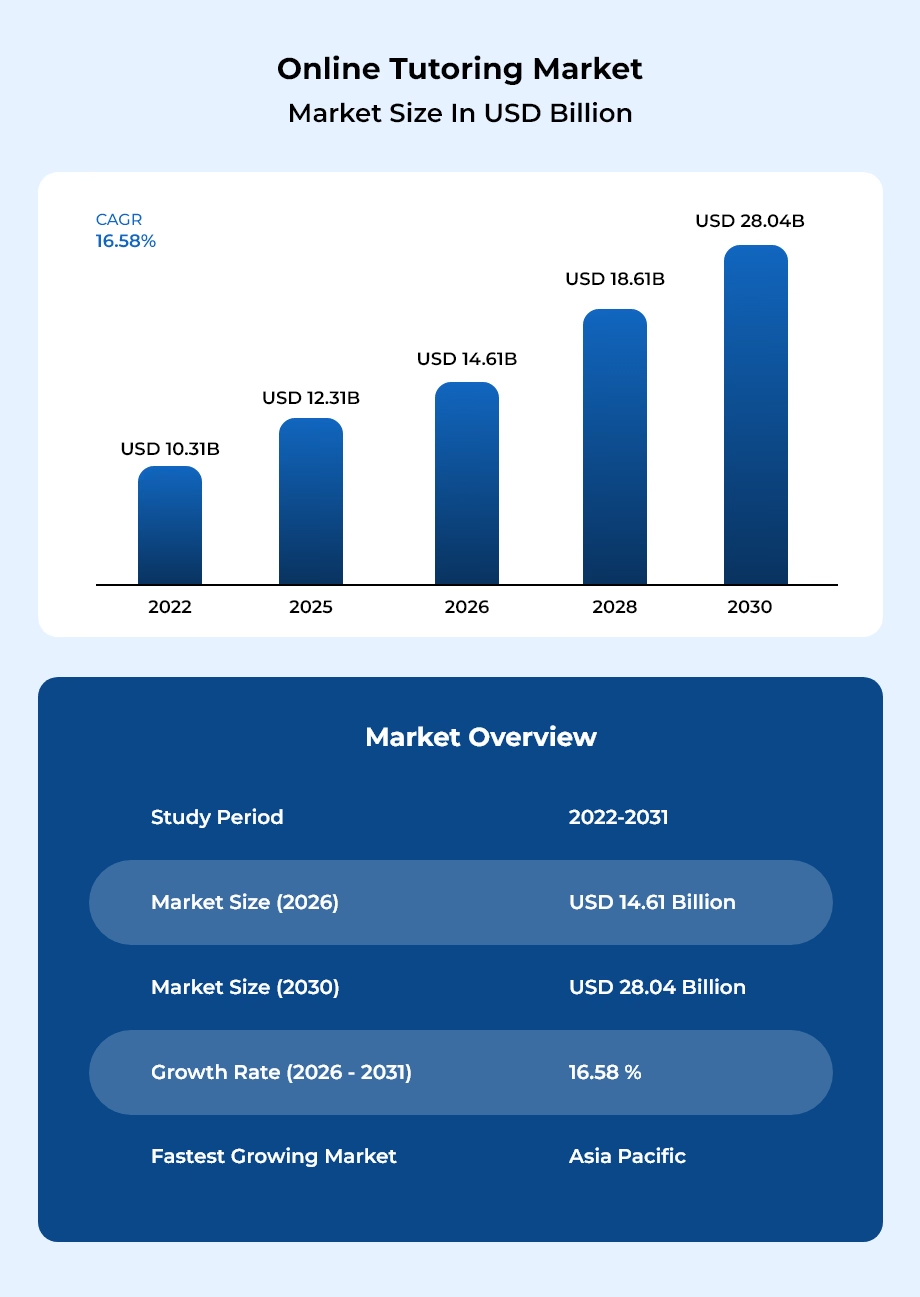
Overall, this transition has led to an increase in the number of students who enroll on these platforms to leverage the technology for homework help, test preparation, and last-minute concept reviews, at a lower per-hour price.
Given below are the business domain -based stats that define overall online tutoring industry trends.
| Segment / Region | Market Share (%) |
|---|---|
| On-demand Tutoring | 73.88% |
| Structured Tutoring | 61.00% |
| Short-term Programs | 57.72% |
| K-12 Segment | 54.05% |
| Professional & Adult Learning | 34.00% |
| North America | 35.12% |
| Asia | 42.4% |
Evolution of the Tutoring Industry- Navigating the Shift to EdTech
The online tutoring app industry is growing over time at a remarkable rate, and it is also experiencing a rapid evolution in trends. Simultaneously, as the industry moves toward 2027-28, the biggest risk for tutors is not a lack of demand but failing to adapt.
Administrative friction across scheduling, payments, and communication can compound quickly and therefore requires robust systems to stay competitive.
1. Specialisation from the Broad-based Tutoring Marketplace
Initially, online tutoring marketplaces would offer tutoring services in every subject, under the umbrella of homework help. These are now being overtaken by specialized platforms focusing on verticals such as STEM-focused, which makes up 42% of total market revenue. Platforms now focus exclusively on high-stakes domains like coding, data science, specialized test prep (MCAT, LSAT), or language acquisition.
Moreover, there is a surge in specialized tutoring designed for students with ADHD, dyslexia, and autism, requiring educators trained in specific pedagogical frameworks.
2. Shift from Hourly to Structured Tutoring Models
There is a visible shift from the 'pay-per-hour' transactional model to a structured, long-term, module-based, long term learning and subscription model. Today, the subscription-based tutoring model accounts for more than 35% of digital tutoring platform revenue. Moreover, this structured model is driving a 20-25% increase in customer lifetime value (LTV) compared to the traditional hourly billing model.
3. AI & IoT-Assisted Tutoring Marketplace
The online tutoring platforms in 2027 are moving from human-only models to hybrid or autonomous setups. Artificial Intelligence (AI), the Internet of Things (IoT), and Machine Learning (ML) are driving modern technology adoption, leading to hyper-personalized learning pathways. These tutoring methods are supported by technology such as curriculum development, interactive learning, and intelligent systems, driving increased interest in remote learning and corporate e-learning.
Looking for Performance-Driven Online Tutoring Marketplace Software
Get In Touch4. Noticeable Shift to Private Tutoring
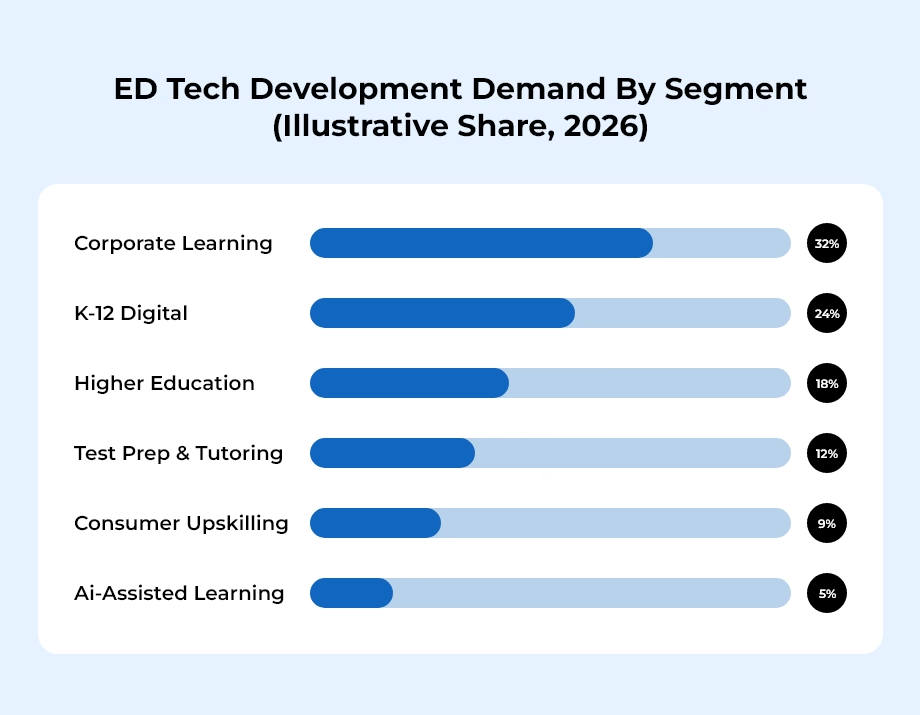
The private tutoring industry has adopted technological advancements, which are still a far cry from offline and traditional education. While large classrooms often struggle to address individual learning gaps, the demand for hyper-focused attention, micro-classrooms, and small-group tutoring is at an all-time high. This shift towards hyper-personalization is powered by the need to reduce learning gaps, address crowded traditional classrooms, and focus on competition in entrance exams, and more. Moreover, the stats present the shift in the K-12 educational sector, with a dominant share of 80% of the total market.
5. Upskilling and Lifelong Learning
The adult tutoring segment is expanding rapidly due to an evolving corporate landscape. The industry has observed a shift from K-12 to lifelong learning, heavily driven by adult upskilling. Working professionals are increasingly turning to 1-on-1 mentors for career transitions, executive language fluency, coding bootcamps, and professional certifications. The industry is evolving to support diverse learning models, from quick, modular crash courses to professional certifications for adult learners. This fast-growing sector already accounts for 15% of the overall market, backed by an impressive CAGR of 8.4%.
6. Quick Glance at the Trendy Tutoring Shifts Trends
Finally, the modern trends that are shaping the tutoring industry alongside the mentioned transitions are, hereby, listed below are the online tutoring industry dominating innovations.
Gamification & Edutainment: Today, the tutoring industry is embedded with game mechanics to grab attention and increase learner retention on the platform. These can be in the form of leaderboards, badges, and digital rewards to keep younger learners engaged and combat screen fatigue.
Phygital or Hybrid Model: With the amalgamation of physical and digital, the online tutoring industry is giving way to hybrid approaches. This model enables the brick-and-mortar tutoring centers to leverage digital platforms for multiple organisational and administrative tasks.
Data Privacy & Safety Regulation: Finally, data privacy and safety regulation is an ever-evolving sector that will always remain in high demand in the digital arena. As younger children spend more time on digital tutoring platforms, strict compliance with data privacy laws like COPPA and GDPR. Therefore, rigorous background checks for tutors have become critical selling points for competitive brands.
What are the Different Types of Online Tutoring Platforms?
The modern tutoring ecosystem has introduced multiple types of tutoring platforms to cater to the diverse requirements of the learning industry marketplace owners and contemporary students. These platforms can be categorized based on their business models, delivery methods, and target audiences.
1. Solo Tutor Marketplace
Primarily, a solo tutoring marketplace is a one-sided virtual platform that connects students with a single teacher. It may also be two-sided, where students can browse and book multiple tutors. Tutors can easily register on the marketplace, manage their own calendar, and earn secure payments.
This two-sided marketplace adds to the features of a tutoring marketplace; these can be easy search filters, calendar booking, reviews & ratings, and rigorous vetting workflows, which further affects the cost to build an online tutoring platform.
Cost of Development: USD 1500- USD 8000
2. Small & Medium Tutoring Marketplace
The small and medium tutoring marketplace registers tutoring agencies with around 3-15 tutors; this can be a private agency listing their tutors or an open marketplace that enables individual tutors to create profiles for students to search for them directly.
These small or medium tutoring marketplaces include 12-25 pages, which include the home page, each tutor's profile, FAQs, blog pages, multiple subject pages, and more.
Cost of Development: USD 4,000- USD 15,000
3. Two-sided Tutor Marketplace
The two-sided aggregate tutor marketplace is an open platform that enables tutors to register their services and connect with students from all over the world. Overall, it is an online platform that directly connects students or parents looking for instruction with a large, independent pool of educators.
The platform serves both the demand side, students and parents, and the supply side, including independent tutors or small coaching agencies. It bundles tutor discovery, profile browsing, scheduling, messaging, and payment processing into a single ecosystem.
Cost of Development: USD 20,000- USD 100,000
4. Test-Prep or Language Learning Marketplace
Test-prep and language learning marketplaces are structured online platforms that connect learners with branded training programs, certified tutors, and standardized study materials. These platforms specialize in preparing users for high-stakes examinations or helping them achieve fluency in a new language.
Enrolled institutions and language teachers can easily host their own courses, track student progress, and manage large groups of learners on one centralized hub. These marketplaces have key features such as course authoring tools, assignment tracking, automated grading, and enterprise security.
Cost of Development: USD 30,000- USD 200,000
For detailed insights and an increased number of types of online tutoring marketplaces, here is a suggested read: Different Types of Online Tutoring Business Models: Benefits And Challenges
Factors that Define the Cost of Online Tutoring App Development
The cost of online tutoring app development depends on several factors and can range from $10,000 to more than $150,000, depending on whether you are building a simple MVP or a complex, feature-rich ecosystem. Further, this section of the guide introduces the factors that are responsible for affecting the overall cost to build an online tutoring platform in 2026-27.
1. Cost-Affecting Features & Business Model Complexity
Building a scalable online tutoring app marketplace requires balancing user experience with development costs. The final cost of your online tutoring app depends heavily on the complexity of your chosen business model and the depth of its core features.
Below is a comprehensive breakdown of the features that directly impact development costs, categorized by complexity. Some of the features recognised to affect the cost of your online tutoring app are listed below.
- Interactive Courses & Quizzes
- AI-Powered Recommendations
- Live Classes & Video Streaming
- Gamification & Rewards
- Progress Tracking & Analytics
- Secure Payment Gateways
- AI & Smart Matching
- Push Notifications & Reminders
2. Third-party Integration
The third-party integration is subject to the requirements of a tutoring marketplace's business. To support and scale our tutoring marketplace operations, we integrate with industry-leading third-party services.
These integrations ensure seamless payment processing, secure video communications, robust database management, and reliable automated notifications. Listed below is the pricing model for the following integrations.
| Feature Requirement | Primary Cost Model | Common Providers |
|---|---|---|
| Social Logins APIs | Freemium | Google, Facebook, Apple, etc. |
| Payment Processing APIs | Transaction-Based | Stripe, PayPal, Razorpay |
| Communication APIs | Usage-Based (Per unit) | Twilio, SendGrid, Mailgun |
| Geolocation APIs | Credit-Based | Google Maps API, Mapbox |
| Video Streaming APIs | Live Minute | Cloudflare Stream, Zoom API, AWS |
| Data & Analytics | Tiered Subscription | Google Analytics, Mixpanel, Segment |
| Marketing APIs | Tiered Subscription | Mailchimp, HubSpot, etc. |
3. Responsive UI/UX Design
The UI/UX designs are one of the main aspects of creating a responsive and intuitive online tutoring app, and are estimated to make up 15-25% of the total budget. This factor comprises prototyping and wireframing, animations, custom graphics, and more. Consequently, the cost of developing an online tutoring marketplace is affected by the requirements of your business, with respect to the user flows and experience, and the choice of custom or standard design, multi-device responsiveness, and more.
Moreover, the complex interactive elements, gamification screens, and smooth micro-interactions require extra prototyping effort, raising overall design expenses.
4. Choice of Tech Stack
The technology stack you select directly dictates your platform's performance, scalability, and long-term viability, making it a primary cost driver to build an online tutoring platform in 2026-27. For better understanding, given below is an insight into how the tech stack shapes total expenses.
- Basic Tech Stack:Utilizing standard frameworks like Node.js, React Native, and Firebase keeps initial deployment lean, costing roughly $20,000 - $40,000.
- Advanced Tech Stack:High-concurrency setups, custom video streaming integration, and multi-region database replication push expenses to $40,000 - $80,000+.
- AI-Driven & Enterprise Tech Stack:Adding machine learning models for personalized student-tutor matching or automated assessments requires specialized AI libraries and larger cloud footprints, scaling total costs past $100,000.
5. AI-Powered Tutoring App Features
AI integration into your tutoring platform transforms it from a static platform into a dynamic and personalised learning environment that aligns with contemporary industry requirements. These modern applications affect the overall cost of online tutoring app development. These features include AI tutor matching, personalized learning paths, AI-generated quizzes, automated feedback, chatbot assistance, student performance analysis, recommendation engines, and AI-powered content generation.
AI-powered apps can affect the cost of your tutoring app development, with data infrastructure and preparation being one of the largest expenses, taking around 30-50% of the total AI budget.
Get Free Custom Cost Breakdown for Your Online Tutoring App & Platform
Request an EstimateKey Features that Affect the Cost of Tutoring App Development
A modernised and user-aligned online tutoring app is fully integrated with industry-specific features that assist in end-to-end user satisfaction, further resulting in assisted and increased customer acquisition and retention. Find the feature list for a tutoring marketplace listed below.
| Essential Features | Advanced Features | Enterprise Features |
|---|---|---|
| Student registration/login | Live video tutoring | AI-powered tutor matching |
| Tutor profiles | Virtual whiteboards | Adaptive learning |
| Search and filters | Screen sharing | Advanced analytics |
| Payment processing | Recorded classes | Multi-language support |
| In-app messaging | Learning management system | Multiple currencies |
| Ratings and reviews | Progress tracking | Institutional accounts |
| Scheduling/calendar | Quizzes and assessments | Role-based access |
| Push Notifications | Subscription plans | Third-party LMS/CRM integrations |
As discussed, the cost to build an online tutoring app & platform is highly affected by the features integrated into the marketplace. Therefore, a business owner looking to launch their foresighted and success-oriented marketplace needs to carefully list and curate their marketplace workflow.
Suggested Read: Must-Have Features for Building a Scalable Coaching Marketplace
Steps to Develop the Tutoring App With Cost Breakdown
Building a successful online tutoring marketplace requires a structured approach. Business owners looking to expand their services in the education industry can initiate operations across five distinct phases, spanning from initial market research to app and web deployment.
Phase 01: Discovery & Ideation
The first step in building an online tutoring platform is to define your business model and conduct industry research to gather customer feedback that assists you in developing a unique value proposition for your business. This market research must include a strategic roadmap with no stone left unturned, analysing industry competitors, consumer pain points, finalising the target audience, ranging from K-12 to professional certification, competitive exams, and college prep, and offering maximum operational convenience.
Businesses can leverage research tools such as PESTLE analysis, Porter's 5 forces for competitive analysis, and SWOT for mitigating potential risks, and establish feature prioritization and technical architecture for a viable business mapping. Moreover, create detailed buyer personas for all user types with special attention to their diversified requirements. This ideation process, with research-oriented assistance, prevents scope creep and assists in protecting your budget. Therefore, early conceptualisation and cost planning set clear expectations and keep the projects on track.
Estimated Cost: $2,000 - $5,000
Estimated Time: 1 - 3 weeks
Phase 02: UI/UX Design & Wireframing
The UI/UX design and online tutoring app & platform wireframing and prototyping must align with delivering an enhanced user experience. This step plays a critical role in transforming your intangible business idea into a tangible business success. Designers map out intuitive user flows for students, tutors, and administrators to identify and eliminate friction points during navigation, booking, and checkout.
Design for accessibility and enhancement: henceforth, this phase focuses heavily on designing for accessibility (WCAG compliance), ensuring high legibility, intuitive dashboards, and responsive layouts across all mobile and web devices. High-fidelity prototypes are created and user-tested to validate the interface before coding begins, significantly reducing development rework.
Estimated Cost: $3,500 - $7,5000
Estimated Time: 2 - 4 weeks
Phase 03: Core Development & Coding
The core development and coding phase is the technical buildout of the platform; it is split into building an intuitive, responsive, accessible frontend. Furthermore, structuring a secure database, user authentication protocols, overall backend development, and third-party API integrations. This phase accounts for around 50-60% of your total budget and 3-6 months of dedicated development. This phase includes student- and tutor-facing interfaces while establishing a robust server, database, and application logic to handle data securely. Finally, the marketplace app's scalability and security are prioritised to ensure that the architecture can handle the growing user traffic. Hence, writing clean, modular code and implementing end-to-end data encryption to safeguard user privacy and accommodate rapid user growth.
Ultimately, it is essential to choose your online tutoring marketplace development team after carefully examining their products and services, as the coding quality directly impacts your platform's long-term viability, security, and performance.
Estimated Cost: $15,000 - $35,000+
Estimated Time: 8 - 16 weeks
Phase 04: Quality Assurance & Testing
Quality assurance assists in high-quality customer acquisition and retention,while also ensuring that the app is secure, handles traffic smoothly, and provides a bug-free experience for students and tutors. This phase includes comprehensive QA testing to ensure stability, speed, and safety. Overall, this phase includes security audits, pen testing, load & stress testing, functional and automated testing, cross-platform & device testing, and finally user acceptance testing (UAT) with a small group of real tutors and students to gather effective feedback on usability.
Furthermore, special emphasis is placed on security audits to protect user data, such as COPPA/GDPR, and load testing to guarantee that live video streams, whiteboards, and chat rooms remain stable when thousands of concurrent users are active.
Estimated Cost: $3,000 - $6,000
Estimated Time: 2 - 4 weeks
Phase 05: Deployment & Launch
Finally, after the online tutoring app & platform have been meticulously designed and developed, aligning with business requirements, the final phase involves launching or deploying the tutoring apps to the Apple App Store and Google Play Store. This phase focuses on meeting strict store guidelines, optimizing your listings for maximum visibility (ASO), and deploying your production builds.
After deployment, marketing the tutoring marketplace is of utmost importance. A few methods include leveraging B2B/ institutional outreach by partnering with local schools, colleges, and student organizations, running targeted campaigns, hyper-localized social media marketing, followed by post-launch monitoring and analysis.
Estimated Cost: $1,500 - $3,000
Estimated Time: 1 - 2 weeks
Launch Your Marketplace & Accelerate Your Business Operations with an Expert Team
Get Started TodayMaximizing Profitability: How to Monetize an Online Tutoring App & Platform
In the contemporary digitalized ecosystem, an online tutoring app & platform can be launched to leverage the lucrative industry in exchange for valuable products & services through a seamless and intuitive user interface. Henceforth, to effectively capitalize on the global market with your online tutoring marketplace, the following are popular revenue streams that can monetize your marketplace.
1. Charge Per Hour or Session
The charge per hour or session revenue model can also be known as commission or service fees. It is one of the most traditional and straightforward monetization strategies in an online tutoring platform. Under this model, the platform takes a percentage or a flat fee from every transaction completed between a tutor and a student.
| Pros | Cons |
|---|---|
| High Initial Revenue | Off- Marketplace Deals |
| Low Friction for Tutors | Inconsistent Cash Flow |
| Scales with Marketplace Volume | High Customer Acquisition Costs (CAC) |
2. Subscription-based Model
The subscription-based revenue model enables business owners to charge monthly recurring fees from the tutoring platform on a monthly, quarterly, or annual basis to access the marketplace. This model enables the business owner to nurture long-term customer relationships over the one-time transactional sale. Overall, this revenue stream offers a predictable and stable income model for a business owner.
| Pros | Cons |
|---|---|
| Predictable Cash Flow | Constant Value Deadline |
| Higher Customer Lifetime Value | High Initial Churn |
| Compounding Growth | Onboarding Drag |
3. Freemium Model
The freemium model in an online tutoring platform offers premium features in exchange for a certain fee. These features may include featured ads, profiles, verification badges, and expanded listings for tutors. For learners or students, features may include recorded lessons, aided homework help, exclusive group classes, and ad-free experiences. This strategy focuses on lowering the barrier to entry to rapidly build a massive user base of tutors and students, and then converting a percentage of them into paying users.
| Pros | Cons |
|---|---|
| Rapid User Acquisition | Low Conversion Rates |
| Network Effects | High Server & Support Costs |
| Product-led Growth | Finding the Value Balanc |
4. Selling Courses or Learning
An online tutoring platform can be seamlessly equipped with tiered and digital lessons and courses for sale. It is considered one of the most effective ways to monetize the marketplace, as it allows educators to sell pre-recorded courses or digital learning materials. Furthermore, this model enables the business owner to leverage dual revenue methods, and its offered autonomy and shift from a time-based model to a scalable product-based model seamlessly.
| Pros | Cons |
|---|---|
| Lower Price Barrier for Students | Lower Completion Rates |
| Lead Generation for Live Sessions | High Upfront Content Effort |
| Flexible Learning | Fierce Competition |
5. Corporate Partnership
Corporate partnership involves an overall collaborative ecosystem with an online tutoring platform owner. The tutoring business transitions from a purely B2C business-to-consumer framework into a lucrative B2B business-to-business or B2B2C business-to-business-to-consumer framework. This revenue model assists in collaborating with businesses, organizations, or institutions to provide tutoring services to their employees, members, or clients.
| Pros | Cons |
|---|---|
| Predictable High-Volume Revenue | Long and Complex Sales Cycles |
| Low Customer Acquisition Cost (CAC) | Demanding Enterprise Requirements |
| High Customer Lifetime Value (LTV) | Customization and Feature Creep |
6. Ads and Affiliate Marketing Marketplace
Introducing ads and affiliate marketing opens up a high-margin, dependable, and scalable revenue channel that allows the platform owner to expand their revenue streams. Therefore, ads and affiliate marketing can assist in maximizing the profitability of an online tutoring marketplace, beyond simple commissions on lessons, as expansion is crucial.
| Pros | Cons |
|---|---|
| Immediate Revenue Potential | Degrades User Experience |
| Empowers Tutors | Complex Tracking |
| High Relevance | Delayed Revenue |
Suggested Read: How to Start an Online Tutoring Business and Make $20K Per Month?
Build V/S Buy- What Is Ideal for Your Online Tutoring Platform?
Building vs. Buying is the very first critical decision you will make on your online tutoring platform journey. While both development methods have distinct pros and cons, the right choice heavily depends on your specific business requirements.
A business owner must carefully consider their workflow, core features, third-party integrations, and any Unique Selling Proposition (USP)- focused or visionary prerequisites that assist in standing out in a saturated industry.
To help you decide, we have analyzed the key factors for the three primary approaches: building from scratch, buying a turnkey solution, or launching an MVP (Minimum Viable Product) with custom modifications.
Direct Comparison Overview
| Key Metrics | Custom Development | Readymade Solution | Hybrid (MVP + Custom) |
|---|---|---|---|
| Time-to-Market | Very Slow (Months to Years) | Very Fast (Days to Weeks) | Moderate (Weeks to Months) |
| Upfront Cost | High | Low | Moderate |
| Customization | Unlimited | Low to None | Moderate to High |
| Tech Expertise | Requires a full dev team | None required | Requires moderate dev support |
| USP Flexibility | Maximum | Low | Moderate to High |
1. Custom Development Method or Build From Scratch
Definition: Custom development requires you to design your online tutoring platform from scratch and create a fully bespoke platform tailored exactly to your vision. Find the major listed pros and cons of the development method.
| Pros | Cons |
|---|---|
| Complete Customisation | High Initial Cost |
| Maximum Scalability | Longer Time-To-Market |
| - | Ongoing Maintenance & Technical Overhead |
Best For: Large enterprises or visionaries with substantial capital and unique technical requirements that off-the-shelf software cannot support.
2. Ready-made Development Method or Turnkey Solution
Definition: A ready-made solution is a pre-built online tutoring software that enables a business owner to launch their aggregate marketplace that connects tutors with learners in a week. The customizability and scalability of these solutions depend on the software provider. Get insights into the pros and cons of this method below.
| Pros | Cons |
|---|---|
| Rapid Deployment | Limited Customization: Provider-dependent |
| Lower Upfront cost | Limited scalability: Provider-dependent |
| Pre-Integrated APIs and Latest Features | Potential Difficulty Standing Out |
Best For: Startups and individual entrepreneurs who want to test market viability quickly with a low initial investment.
3. Hybrid Development Method (MVP + Custom Development)
The hybrid development method combines both approaches by launching a ready-made Minimum Viable Product (MVP) and adding custom modifications over time. This method is an overall best development method for business owners and can accommodate visionary or unique business ideas of an aspiring entrepreneur. A business owner can easily iterate their marketplace based on customer feedback to launch a marketplace that is customer-oriented and fills industry gaps to generate high ROI.
| Pros | Cons |
|---|---|
| Less Time to Market | Basic Feature and Functionalities |
| Lower Financial Risk | Requires development cycles post-launch. |
| Add custom workflow or advanced features | - |
Power your Online Tutoring Platform with Adept Team of FATbit and Yo!Coach
Yo!Coach is one of the flagship products of FATbit Technologies, meticulously designed and developed after years of exhaustive market research and technical innovation. As a premier online tutoring and consultation software, it comes built-in with powerful features such as one-on-one and group virtual classes, comprehensive course management, an advanced admin dashboard, interactive digital classrooms, and secure payment gateways, alongside robust multilingual and multi-currency support.
With its highly versatile architecture, Yo!Coach serves as the ideal turnkey solution for launching online tutoring marketplaces. Its flexible framework easily accommodates deep customizability to match unique brand identities, while its enterprise-grade scalability ensures that your platform grows seamlessly alongside your user base without ever compromising on performance.
Whether you are a startup launching your first educational portal or an established enterprise scaling global operations, Yo!Coach provides the reliability, security, and cutting-edge tools needed to dominate the modern eLearning landscape.
Why Choose Yo!Coach?
- White-Label and Self-Hosted Solution
- Fully Customisable & Scalable Architecture
- One-time Cost for Lifetime License
- Supports Multiple Business Models & Industry Niches
- 25+ Pre-Integrated APIs
Get Hands-On Experience of the Advanced Yo!Coach Features With Experts
Yo!Coach Powered Tutoring Marketplaces and Web Apps
Get insights into the multiple aggregate and niche-based tutoring platforms powered by Yo!Coach. Find a few of the case studies listed below.
WTutors: A Hong Kong-based international online tutoring marketplace connecting thousands of learners and hundreds of qualified teachers across Southeast Asia with live video tools and automated time-zone adjustments.
Stethonurse: A specialized US-based NCLEX tutoring and nursing exam preparation platform built using Yo!Coach to connect nursing aspirants with clinical experts via targeted sessions and digital resources.
SabiTech: A dynamic educational platform connecting hundreds of learners across Nigeria with qualified local instructors, tailored with localized workflows and real-time communication tools.
Primary Tutor Project: Similar specialized K-12 and general academic coaching portals leverage Yo!Coach to deliver interactive whiteboard sessions, assignment tracking, and seamless scheduling.
Concluding Remarks: Attain Tutoring Industry Success
The tutoring industry is undergoing a profound transformation, driven by technological evolution and a growing global demand for personalized education. A business owner who wants to establish their name in the tutoring industry must analyse the competitive landscape, develop strategic frameworks, and understand the market to attain long-term success.
In the modern ecosystem, a business owner who offers value as a transformative educational experience automatically stands out and can pursue sustainable growth in the saturated industry. Finally, to secure a market-leading position and ensure enduring success, industry participants must focus on three core pillars, which are student-centric personalization, tutor empowerment & quality, and technology integration- all included in the robust and reliable tutoring software-Yo!Coach.
Ultimately, sustained growth in the tutoring market demands agility, clear results, and user expansion. Therefore, a business owner must build a scalable foundation on trust and innovation to ensure their organization doesn't just survive industry shifts, but defines the future of education.
Frequently Asked Questions
-
Is it cheaper to use a white-label solution or build from scratch
White-label solutions are significantly cheaper upfront and allow you to launch your online tutoring platform within weeks. However, custom development gives you unique branding, unlimited scalability, and zero ongoing licensing fees.
Ultimately, the best custom and ready-made amalgamation- the hybrid method as powered by Yo!Coach, can be considered the most value-driven development method.
-
How long does it take to build an online tutoring app & platform?
Ideally, it takes anywhere from 1 week to 12 months to build and launch an online tutoring platform, depending entirely on the chosen development method and the additional customisation requirements of a business owner.
While a custom-developed marketplace takes around 6-12 months (longest) to launch, a ready-made software solution enables a marketplace owner to launch within a week to a month(fastest), and a hybrid development method takes around a few weeks to months (moderate).
-
How does location affect the cost of online tutoring app development?
The geographical location of your development team is one of the biggest drivers of total online tutoring app development costs. Given below are the onshore, nearshore, and offshore development approximate costs.
Region Approx. Hourly Development Rate North America $80-$150/hour Western Europe $60-$120/hour Eastern Europe $35- $80/hour Latin America $30-$75/hour Asia $25- $50/hour -
How can I reduce the cost of tutoring mobile app development?
Reduce your tutoring mobile app development costs by prioritizing a cross-platform framework and launching an essential feature set first. Listed are tips to reduce the overall costs of building an online tutoring platform in 2026.
- Start with an MVP Solution
- Outsource to reliable cross-platform developers.
- Utilize pre-built APIs for standard features
- Initially prioritize the essential features
- Invest in a highly scalable and customizable solution
-
What is the best online tutoring solution in 2026 to launch my platform?
The best solution to launch your online tutoring platform in 2026 is Yo!Coach. It is one of the best-aligned solutions, with a powerful, versatile infrastructure that is fully customizable and scales as your business grows.
The solution can be molded according to your unique business model, while also offering one year of free technical support, with its client-centric and reliable team of experienced professionals.