The global tutoring industry has evolved far beyond traditional classrooms and standardized learning models. With the rise of remote learning, flexible work culture, and growing preference for personalized education, online tutoring marketplaces have emerged as one of the fastest-growing digital business models worldwide. Learners now expect on-demand access to expert tutors, while educators seek flexible platforms that allow them to teach independently and reach global audiences.
Among hundreds of platforms operating today, Cambly, Preply, and Superprof stand out as market leaders. These platforms have not only scaled across continents but have also built sustainable tutoring ecosystems that connect millions of learners with independent tutors every day. Their continued growth naturally raises an important question for entrepreneurs and education businesses: how do these platforms grow so effectively while competing in the same industry?
The answer lies in their distinct marketplace blueprints. Cambly focuses on subscription-based conversational English, Preply emphasizes personalized learning through AI-driven tutor matching, and Superprof scales through a classifieds-style model with massive subject and geographic coverage. While their strategies differ, all three platforms are built on a shared foundation, a robust tutoring marketplace that balances tutor engagement, learner experience, monetization, and scalable global expansion.
Table of Contents
- The Rise of Online Tutoring Marketplaces
- What Is Cambly Famous For? Definition, History, and Success
- What Is Preply Known For? Definition, History, and Platform Success
- What Is Superprof Known For? Definition, History, and Growth Story
- Comparing the Marketplace Blueprints of Cambly, Preply, and Superprof
- The Distinct Growth Strategies of Cambly, Preply, and Superprof
- How to Build a Tutoring Marketplace Like Cambly, Preply, or Superprof
- Build a Marketplace Like Cambly, Preply, or Superprof with Yo!Coach
- How Yo!Coach Mirrors the Business Models of Leading Tutoring Platforms
- Advantages of Choosing Yo!Coach for Your Tutoring Marketplace
- Yo!Coach Case Studies: Real-World Tutoring Marketplaces
- Final Thoughts
- Frequently Asked Questions (FAQs)
The Rise of Online Tutoring Marketplaces
Online tutoring marketplaces sit at the intersection of education, technology, and the gig economy. Unlike traditional eLearning platforms that rely on pre-recorded content, tutoring marketplaces thrive on human expertise and real-time interaction. Learners gain direct access to tutors who can adapt lessons in real time, while educators benefit from flexible work opportunities and global reach.
As demand for personalized education grows and remote work becomes the norm, tutoring marketplaces offer a scalable, cost-efficient way to connect learners and tutors without the limitations of physical classrooms. Platforms like Cambly, Preply, and Superprof each capitalize on these advantages, but apply them through different marketplace strategies and growth models.
Why the Tutoring Marketplace Model Works
- Growing demand for personalized, one-on-one learning
- Increased adoption of remote work and flexible schedules
- Global access to tutors across regions and time zones
- Lower operational costs compared to offline institutes
- Faster scalability due to user-generated tutor supply
Cambly, Preply, and Superprof each leverage these advantages, but in very different ways.
Turn Your Tutoring Vision Into a Global Platform
What Is Cambly Famous For? Definition, History, and Success
Instead of positioning itself as a traditional language-learning platform, Cambly carved out a clear niche in conversational English, making real-time speaking practice accessible, flexible, and stress-free for learners around the world. This focused approach has been central to its growth and long-term success.
Understanding Cambly’s Core Concept
Cambly is best known for its on-demand English conversation tutoring. The platform connects learners with native English speakers through instant or scheduled video calls. Rather than following structured curricula or grammar-heavy lessons, Cambly emphasizes natural conversation, fluency, and confidence building.
This approach appeals strongly to learners who already have basic English knowledge but want to improve pronunciation, listening skills, and everyday communication without the pressure of formal coursework.
The Origin and Evolution of Cambly
Founded in 2012 in the United States, Cambly began as a simple experiment to help non-native speakers practice English. From the start, the platform challenged traditional language-learning models by removing rigid lesson structures and focusing instead on flexible, learner-driven conversations.
Over time, Cambly evolved into a global tutoring marketplace by:
- Expanded its presence across multiple countries and regions
- Launching mobile-first experiences to support on-the-go learning
- Introduced Cambly Kids for younger learners with age-appropriate content
- Built subscription-based learning plans to encourage consistent practice and long-term retention
What Makes Cambly Stand Out?
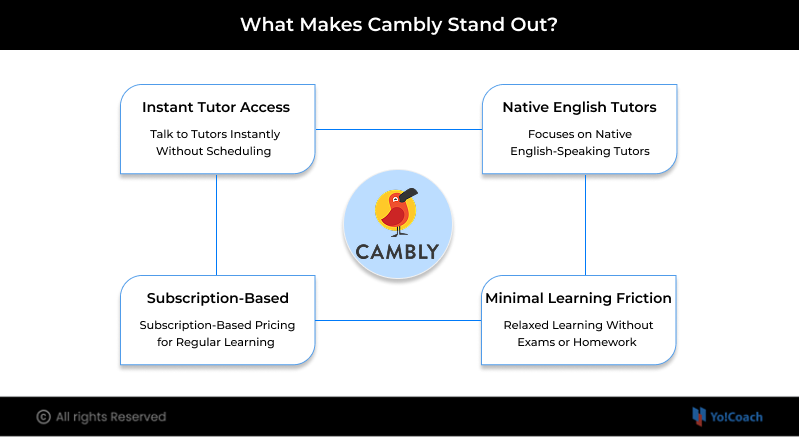
1. Instant Tutor Access
Cambly allows learners to start conversations with tutors almost immediately, eliminating lengthy scheduling processes and making learning fit naturally into daily routines.
2. Native English Tutors
The platform prioritizes tutors from English-speaking countries, reinforcing a strong perception of authenticity and language quality.
3. Subscription-Based Simplicity
Learners pay monthly or annual fees rather than per-lesson charges. This predictable pricing model supports regular usage and improves retention.
4. Minimal Learning Friction
There are no exams, assignments, or heavy homework requirements. The experience is centered around relaxed, confidence-building conversations rather than formal assessments.
Cambly’s Marketplace Strength
Cambly’s success comes from owning a single, clearly defined niche: spoken English fluency. By focusing narrowly on conversation rather than broad language education, the platform simplified its marketing and delivered a consistent user experience. This clarity allowed Cambly to scale globally while maintaining strong engagement and brand recognition.
Suggested Read: Key Features & Steps to Build a Tutoring Platform Like Cambly
What Is Preply Known For? Definition, History, and Platform Success
While many platforms focus on instant access or broad discovery, Preply differentiates itself by guiding learners through tailored learning journeys that align with their goals, schedules, and budgets. This balance between scale and personalization has been a key driver of the platform’s global success.
What Is Preply?
Preply is a global tutoring marketplace that offers one-on-one lessons across languages, academics, and professional skills. Unlike Cambly, Preply emphasizes personalized learning journeys, matching each learner with tutors based on specific objectives, learning preferences, and availability.
Preply’s Background and Growth Journey
Founded in 2012, Preply started as a language-learning platform before expanding into a broader tutoring ecosystem. Over time, it evolved into one of the largest online tutoring marketplaces by investing heavily in technology, content, and global discoverability.
Key milestones include:
- Expansion into more than 180 countries
- AI-driven tutor matching and recommendations
- Strong reliance on SEO to attract high-intent learners organically
- Millions of lessons delivered annually across multiple subjects
Why Preply Is So Popular
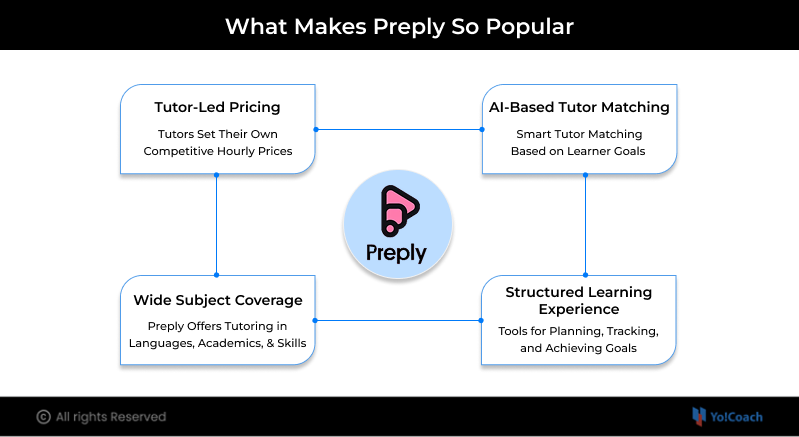
1. Tutor-Led Pricing
Preply allows tutors to set their own hourly rates, giving learners a wide range of pricing options and enabling tutors to position themselves competitively.
2. AI-Based Tutor Matching
Preply uses learner goals, subject preferences, availability, and behavior data to recommend the most suitable tutors, improving lesson success and retention.
3. Wide Subject Coverage
Beyond languages, Preply supports tutoring in test preparation, academic subjects, and professional skills, attracting diverse learner segments.
4. Structured Learning Experience
Lesson planning tools, progress tracking, and goal-oriented workflows help learners stay engaged and committed over time.
Preply’s Marketplace Advantage
Preply’s strength lies in its ability to scale globally without sacrificing personalization. By combining data-driven matching, tutor flexibility, and structured learning tools, the platform appeals to both casual learners and students seeking long-term, results-focused tutoring experiences.
Suggested Read: Cost to Build A Language Learning Platform Like Preply
What Is Superprof Known For? Definition, History, and Growth Story
Rather than focusing on structured lessons or managed sessions, Superprof positions itself as a tutor discovery marketplace, giving learners the freedom to find and contact tutors directly. This lightweight, classifieds-style approach has been central to Superprof’s rapid global expansion.
Understanding Superprof’s Marketplace Model
Superprof operates as a classified-style tutoring marketplace. Tutors create listings, and students search and contact them directly. The platform supports both online and offline tutoring, making it suitable for learners who prefer remote sessions as well as those seeking in-person instruction in their local area.
The Origins of Superprof
Founded in France in 2013, Superprof expanded aggressively across Europe, Latin America, and Asia. The platform localized its experience for different regions by adapting language, currency, and search behavior to local markets.
What Sets Superprof Apart?
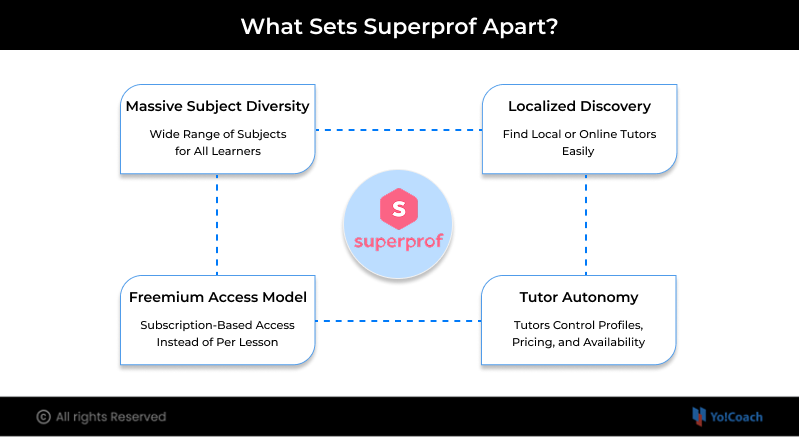
1. Massive Subject Diversity
Superprof covers an exceptionally wide range of subjects, including:
- Academic subjects
- Music & arts
- Sports & fitness
- Professional skills
- Hobbies and creative fields
This breadth allows the platform to serve learners at every stage and interest level.
2. Localized Discovery
Students can search for tutors near their location, making it easy to find in-person instructors while still offering online learning options.
3. Freemium Access Model
Rather than charging per lesson, Superprof uses a subscription-based access model where students pay to contact tutors. This simplifies monetization and works efficiently at scale.
4. Tutor Autonomy
Tutors maintain full control over their profiles, pricing, availability, and teaching approach, encouraging participation and long-term engagement.
Superprof’s Key Strength
Superprof’s strength lies in horizontal scalability. By supporting endless subjects, regions, and tutor profiles with minimal platform intervention, it can expand continuously while keeping operations lean and adaptable.
Suggested Read: How to Create a Website Like Superprof
Comparing the Marketplace Blueprints of Cambly, Preply, and Superprof
While Cambly, Preply, and Superprof all operate within the online tutoring space, their marketplace blueprints are fundamentally different. Each platform has optimized its model around a specific learning experience, monetization strategy, and level of tutor involvement. The table below breaks down the core marketplace elements of Cambly, Preply, and Superprof, helping you evaluate which model best fits your tutoring business goals:
| Factor | Cambly | Preply | Superprof |
| Core Focus/Niche | English conversation | Personalized tutoring | Tutor classifieds |
| Pricing Model | Subscription | Commission-based | Freemium |
| Subject Range | Narrow | Medium | Very broad |
| Tutor Control | Limited | High | Very high |
| Learning Structure | Casual | Structured | Flexible |
Build a Marketplace Inspired by Proven Models
The Distinct Growth Strategies of Cambly, Preply, and Superprof
Although Cambly, Preply, and Superprof operate in the same online tutoring ecosystem, their growth trajectories are fundamentally different. Rather than trying to serve every learner, each platform has scaled by solving a specific market problem exceptionally well. This focused approach allowed them to grow efficiently without the complexity and cost of feature overload.
Their success highlights that tutoring marketplaces grow not by feature overload, but by strategic focus, smart positioning, and scalable acquisition models. Let’s break down how each platform approached growth and what made their strategies work:
Cambly’s Growth Strategy: Niche Dominance Through Simplicity and Subscriptions
Cambly’s growth is built on the principle of owning a single, high-demand niche before expanding. This narrow focus allowed the platform to design a simple, intuitive experience that resonates strongly with its target audience.
1. Laser-Focused Market Positioning
Cambly did not try to become a full-fledged tutoring marketplace. Instead, it positioned itself as:
- A spoken English practice platform
- Designed primarily for non-native English speakers
- Focused on real-time conversation, not rigid curricula
This clarity made Cambly easy to understand, market, and adopt.
2. Subscription-Driven User Retention
Unlike transaction-based platforms, Cambly relies heavily on monthly and annual subscriptions. This strategy:
- Ensures predictable recurring revenue
- Encourages long-term learner commitment
- Reduces churn through usage-based value delivery
By selling access rather than individual lessons, Cambly optimized for lifetime customer value.
3. Mobile-First and On-Demand Experience
Cambly heavily invested in mobile usability and instant tutor access. Learners can:
- Start conversations without long scheduling cycles
- Practice English in short, frequent sessions
- Learn casually without pressure
This approach made Cambly ideal for busy professionals and international users.
4. Content and Influencer-Led Acquisition
Cambly leveraged:
- YouTube creators
- Language-learning influencers
- Educational content marketing
This helped the brand gain trust and visibility in global markets quickly.
Key Growth Takeaway from Cambly: Focus deeply on one problem, monetize through subscriptions, and optimize for convenience and retention.
Preply’s Growth Strategy: Personalization at Scale Powered by SEO and Data
Preply followed a very different growth path, one built on breadth, personalization, and organic discovery. Rather than limiting itself to one niche, Preply positioned its platform as a destination for structured, goal-oriented learning across multiple subjects.
1. SEO-Led Global Expansion
Preply invested heavily in search engine optimization by creating:
- Language-specific landing pages
- Tutor profile pages optimized for long-tail keywords
- Educational content aligned with learner intent
This strategy helped Preply capture high-intent organic traffic across multiple countries and subjects.
2. AI-Driven Tutor Matching
A major growth lever for Preply is its personalized learning experience. Using data and AI, the platform:
- Matches learners with tutors based on goals, availability, budget, and preferences
- Improves lesson success rates
- Increases repeat bookings and long-term retention
This personalization differentiates Preply in a crowded marketplace.
3. Tutor Empowerment as a Growth Engine
Preply allows tutors to:
- Set their own prices
- Define teaching styles
- Build long-term student relationships
Empowered tutors are more engaged, better marketers of their own profiles, and more likely to stay on the platform, creating a self-reinforcing growth loop.
4. Performance-Based Monetization
By charging higher commissions on initial lessons and lower commissions on repeat sessions, Preply:
- Incentivizes tutors to convert trial learners into long-term students
- Aligns platform revenue with learner success
Key Growth Takeaway from Preply: Scale through personalization, organic acquisition, and tutor-driven retention rather than aggressive paid marketing.
Superprof’s Growth Strategy: Horizontal Scaling Through Localization and Volume
Superprof took a radically different approach, focusing on massive scale through listings, localization, and subject diversity. By operating as a discovery-first, classified-style marketplace, Superprof achieved rapid expansion while keeping platform operations lightweight and highly scalable.
1. Classified Marketplace Model
Superprof operates more like a tutor directory or classified marketplace, where:
- Tutors create listings
- Students search and contact tutors
- The platform facilitates discovery rather than lesson management
This low-friction model allowed Superprof to scale rapidly.
2. Aggressive Localization Strategy
One of Superprof’s strongest growth drivers is its hyper-local SEO approach:
- Country-specific domains
- City-level tutor listings
- Local language interfaces
This strategy enabled Superprof to dominate search results in multiple regions simultaneously.
3. Expansion Beyond Academics
Unlike Cambly and Preply, Superprof expanded aggressively into:
- Music and arts
- Sports and fitness
- Hobbies and creative skills
- Professional and lifestyle coaching
This horizontal expansion unlocked entirely new learner segments.
4. Freemium Access Model
Superprof lets users browse the platform for free, but places a paywall at the point of interaction. Superprof charges learners a subscription fee to contact tutors, rather than per lesson. This model:
- Reduces platform operational complexity
- Generates high-margin revenue
- Works exceptionally well at scale
Key Growth Takeaway from Superprof: Grow fast by maximizing listings, local presence, and subject diversity while keeping platform operations lightweight.
How to Build a Tutoring Marketplace Like Cambly, Preply, or Superprof
Building a successful tutoring marketplace like Cambly, Preply, or Superprof is not just a technical project. It is a strategic business decision that shapes how your platform attracts users, generates revenue, and scales over time. These platforms did not grow overnight, nor did they rely solely on video conferencing and basic booking features. Their success lies in how they designed, positioned, and scaled their marketplaces from the ground up.
If you are planning to build a tutoring platform today, understanding how these leaders structured their marketplaces will help you avoid costly mistakes and accelerate growth. Let’s begin:
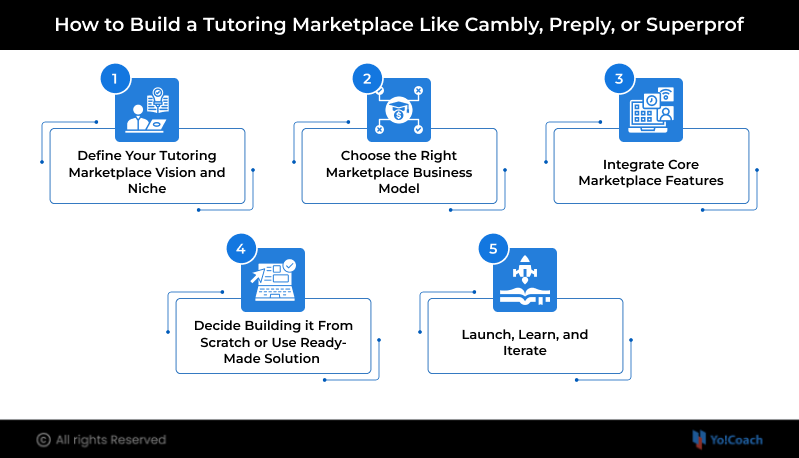
Step 1: Define Your Tutoring Marketplace Vision and Niche
Every successful tutoring marketplace begins with a clear vision. Cambly, Preply, and Superprof each chose a different starting point:
- Cambly focused narrowly on spoken English and fluency
- Preply targeted personalized learning across languages and skills
- Superprof built a broad tutor discovery platform covering thousands of subjects
Hence, before starting the development, it is essential to answer a few foundational questions:
- Who is your primary audience?
- What learning problem are you solving?
- Are you going niche-first or broad-first?
A focused niche makes it easier to acquire users, build trust, and stand out in a crowded market. Expansion can always come later, just as these platforms expanded after establishing a strong core.
Step 2: Choose the Right Marketplace Business Model
Your business model determines how money flows through the platform and directly impacts scalability. Some of the most common tutoring marketplace models include:
- Subscription-Based Model (Cambly-style)
Learners pay a recurring fee for access to tutors. This model offers predictable revenue, encourages consistent usage, and works well for conversational or ongoing learning. - Commission-Based Model (Preply-style)
The platform takes a percentage from each lesson. This performance-driven approach scales naturally with transaction volume and aligns platform revenue with tutor success. - Freemium or Access-Based Model (Superprof-style)
Learners pay to contact tutors, not per lesson. This model keeps operations lightweight, delivers strong margins at scale, and suits classified-style marketplaces.
Many platforms also adopt a hybrid model, combining subscriptions, commissions, and premium features to diversify revenue streams.
Step 3: Integrate Core Marketplace Features
At a minimum, your tutoring marketplace must support essential functionality such as:
- One-on-one and group tutoring
- Real-time video conferencing
- Calendar and time-zone management
- Multi-currency payment processing
- Messaging and notifications
- Admin control panel and analytics
However, to compete with platforms like Cambly, Preply, and Superprof, you must go beyond basics. Hence, integrate advanced features, such as:
- AI-based tutor recommendations
- Subscription and package management
- Lesson history and progress tracking
- Promotional tools for tutors
- Dispute management and moderation
Create a Feature-Packed Online Tutoring Business
Step 4: Decide Whether to Build from Scratch or Use a Ready-Made Solution
Building a tutoring marketplace from scratch often involves:
- High upfront costs
- Long development timelines
- Ongoing technical maintenance
- Scalability risks.
As a result, many entrepreneurs opt for ready-made tutoring marketplace solutions that already include proven features and workflows.
That’s why many entrepreneurs choose ready-made tutoring marketplace software that already includes proven workflows and features.
This approach allows you to:
- Launch faster
- Reduce technical risk
- Focus on growth and marketing
- Iterate based on real user feedback
Step 5: Launch, Learn, and Iterate
Cambly, Preply, and Superprof did not launch as perfect products. They started with a core offering, observed how users behaved, refined their features, and expanded strategically over time.
Your marketplace should follow the same approach:
- Launch with an MVP
- Measure performance and user engagement
- Improve features incrementally
- Scale gradually and intentionally
Sustainable growth comes from learning fast and adapting, not from trying to build everything at once.
Build a Marketplace Like Cambly, Preply, or Superprof with Yo!Coach
After understanding how Cambly, Preply, and Superprof structured and scaled their tutoring marketplaces, the next logical question is how to apply those lessons without investing years of development time or large custom budgets. Replicating their success does not require rebuilding everything from scratch. It requires the right marketplace foundation.
This is where Yo!Coach becomes a strategic enabler. It is a ready-made, white-label tutoring marketplace software designed specifically for businesses looking to launch scalable, feature-rich tutoring platforms, similar to Cambly, Preply, or Superprof, without starting from scratch. It allows you to focus on growth, tutors, and learners while the core marketplace functionality is already in place.
How Yo!Coach Mirrors the Business Models of Leading Tutoring Platforms
Yo!Coach is designed to support multiple tutoring marketplace blueprints rather than locking you into a single model. This flexibility makes it well suited for entrepreneurs who want to build platforms aligned with proven strategies while retaining the freedom to evolve over time.

1. Build a Cambly-Style Tutoring Platform
With Yo!Coach, you can launch conversation-focused tutoring platforms that rely on:
- Subscription-based tutoring plans
- On-demand and scheduled sessions
- One-on-one video tutoring
- Native or verified tutor onboarding
- Usage-based access controls
This makes Yo!Coach well-suited for language learning and conversational tutoring platforms.
2. Build a Preply-Style Tutoring Marketplace
Yo!Coach also supports personalized, goal-oriented tutoring platforms by enabling:
- Tutor-led pricing
- Commission-based monetization
- Personalized tutor discovery
- Long-term tutor–learner relationships
- Repeat booking workflows
This structure works well for subject-based, academic, and professional tutoring marketplaces.
3. Build a Superprof-Style Classified Tutoring Platform
For discovery-first platforms, Yo!Coach allows you to create:
- Tutor listing and discovery platforms
- Online and offline tutoring options
- Flexible pricing and availability
- Location-based tutor search
- Freemium or access-based monetization
This model works well for broad, multi-category tutoring marketplaces that emphasize scale and local reach.
By supporting these diverse models within a single platform, Yo!Coach gives you the flexibility to launch with a clear strategy and adapt as your marketplace grows.
Advantages of Choosing Yo!Coach for Your Tutoring Marketplace
Choosing the right technology partner is one of the most critical decisions when building a tutoring marketplace. While strategy and positioning define what you want to build, the platform you choose determines how efficiently you can execute and scale that vision.
Yo!Coach is designed specifically to address the real-world challenges faced by tutoring marketplace owners, combining flexibility, scalability, and long-term cost efficiency. Below are the key advantages that make Yo!Coach a preferred choice for building platforms inspired by Cambly, Preply, and Superprof:
1. Purpose-Built for Tutoring Marketplaces
Unlike generic marketplace or video-conferencing tools, Yo!Coach is built exclusively for tutoring and coaching platforms. This means every workflow, from tutor onboarding to lesson delivery, has been thoughtfully designed around education use cases.
It supports one-on-one sessions, group classes, subject-based or language learning, and online, offline, or hybrid models without heavy customization. This reduces time-to-market and operational complexity.
2. White-Label and Self-Hosted Ownership
Yo!Coach is a 100% white-label, self-hosted solution that gives you complete control over branding, user experience, data, and feature roadmap.
Unlike SaaS platforms that lock you into recurring fees or revenue sharing, Yo!Coach allows you to build a long-term business asset that you fully own, similar to how Cambly, Preply, and Superprof operate independently.
3. Flexible Monetization Models
- Yo!Coach supports multiple monetization models within a single platform, including subscriptions, commissions, freemium access, and hybrid combinations.
This flexibility allows you to experiment, optimize, and scale revenue without being constrained by the software.
4. Built-In Video Conferencing and Scheduling
- Yo!Coach includes integrated video conferencing built specifically for tutoring. Advanced scheduling features support time-zone-aware bookings, calendar sync, and automated reminders.
This eliminates the need to rely heavily on third-party tools, improving reliability and user experience.
Suggested Read: Explore Yo!Coach API Integrations
5. Scalable Architecture for Long-Term Growth
- Yo!Coach is built to scale from day one. It supports multi-language interfaces, multi-currency payments, localization, high user concurrency, and modular expansion.
This makes Yo!Coach suitable not just for startups, but also for enterprises and fast-scaling education businesses.
6. SEO-Friendly Marketplace Structure
Organic growth is a major driver behind platforms like Preply and Superprof. Yo!Coach supports SEO-friendly URLs, indexable tutor profiles, subject and location-based listings, and clean site architecture.
This enables you to attract high-intent organic traffic and reduce long-term dependency on paid acquisition.
7. Advanced Admin Control and Analytics
- Yo!Coach provides a powerful admin dashboard to manage tutor approvals, commissions, subscriptions, user activity, revenue analytics, and dispute handling.
These tools allow you to make data-driven decisions and continuously optimize platform performance.
8. One-Time Investment with Lifetime License
Yo!Coach follows a one-time license model rather than recurring SaaS subscriptions. This lowers operating costs, improves margins, and eliminates revenue-sharing obligations as you scale.
9. Proven Success Across Global Tutoring Platforms
- Yo!Coach has been used to build tutoring platforms across language learning, academics, corporate training, and professional coaching worldwide.
This proven track record reduces risk and increases confidence for new marketplace founders.
See Yo!Coach In Action
Yo!Coach Case Studies: Real-World Tutoring Marketplaces
A strong tutoring marketplace is best evaluated not just by its features, but by how successfully it performs in real-world scenarios. One of the biggest indicators of Yo!Coach’s reliability and scalability are the diverse range of tutoring platforms that have already been built using it.
Across different regions, niches, and business models, Yo!Coach has powered tutoring marketplaces. Let’s have a look at them:
1. WTutors
WTutors is a global online tutoring marketplace that connects learners with qualified teachers. Built with Yo!Coach, it supports multilingual and multi-currency tutoring, live video sessions, whiteboard collaboration, and flexible scheduling, enabling the rapid onboarding of thousands of students and hundreds of tutors worldwide.
2. Read With Us
Read With Us is an interactive tutoring platform focused on improving children’s reading skills. It offers one-on-one and group sessions with features like audio/video chat, multilingual support, automated scheduling, and payment integration, providing a customizable learning experience for young learners.
3. Smart Tutoria
Smart Tutoria is an academic learning platform built with Yo!Coach that serves students in curricula such as IGCSE, IB, and A-Levels. It combines live tutoring, subscription plans, hidden tutor listings, and multi-currency support to deliver structured academic support globally.
4. Bloom Learning
Bloom Learning is an online academic tutoring platform focused on affordable one-to-one lessons. Yo!Coach enabled custom features like offline payments, wallet credits, manual tutor assignment, and session packages, helping Bloom Learning serve hundreds of users with personalized learning options.
5. Astra Tutors
Astra Tutors is a UK-based online tutoring platform that uses Yo!Coach to deliver tailored one-on-one sessions. The site emphasizes critical thinking and personalized attention, leveraging user-friendly interfaces and interactive tools to support students across subjects.
Final Thoughts
The success of Cambly, Preply, and Superprof proves that online tutoring marketplaces are not just a trend. They represent a sustainable and scalable business model with long-term potential. At the same time, their growth stories highlight an important reality: there is no single formula for success in this space.
Each platform identified a clear market opportunity, selected the marketplace blueprint that best fit their vision, built trust with both tutors and learners, monetized strategically, and invested in technology that could support growth. Cambly achieved traction through niche dominance and subscription-led retention, Preply scaled by pairing personalization with SEO-driven acquisition, and Superprof expanded globally through localization and high-volume tutor listings.
For entrepreneurs and education businesses, the key lesson is clear: Success depends less on copying features and more on adopting the right strategy supported by the right technology. Hence, by leveraging a purpose-built solution like Yo!Coach, you can shorten the learning curve, reduce technical risks, and focus on growing a tutoring marketplace that aligns with your long-term vision.
Frequently Asked Questions (FAQs)
Q 1. How do Cambly, Preply, and Superprof grow their tutoring business?
Ans. Cambly, Preply, and Superprof grow by solving different learning needs. Cambly focuses on subscription-based conversational English, Preply scales through personalized learning and SEO-driven discovery, while Superprof expands rapidly using high-volume tutor listings and strong localization across regions and subjects.
Q 2. What is the best tutoring marketplace business model?
Ans. There is no single best tutoring marketplace model. Subscription-based, commission-based, and freemium models all work. The best choice depends on your target audience, learning format, pricing expectations, and how you plan to scale and retain users.
Q 3. How much does it cost to build a tutoring marketplace?
Ans. The cost of building a tutoring marketplace varies widely. Custom development can be expensive and time-consuming, while ready-made solutions significantly lower costs. Using platforms like Yo!Coach reduces development effort, speeds up launch, and helps control long-term operational expenses.
Q 4. Can I build a tutoring marketplace without technical expertise?
Ans. Yes, you can build a tutoring marketplace without deep technical expertise. With ready-made, white-label software like Yo!Coach handles core features, hosting setup, and workflows, allowing entrepreneurs to focus on tutors, learners, and growth instead of complex development and ongoing technical maintenance.
Q 5. Does Yo!Coach support both online and offline tutoring?
Ans. Yes, Yo!Coach supports online, offline, and hybrid tutoring models. You can offer video-based sessions, in-person classes, or a mix of both. This flexibility makes it suitable for online-first platforms as well as marketplaces that support local, location-based tutoring services.
Q 6. How long does it take to launch a tutoring marketplace with Yo!Coach?
Ans. Launching a tutoring marketplace with Yo!Coach typically takes weeks instead of months. Since core features are already built, the timeline mainly depends on branding, configuration, and minor customizations rather than full-scale development from scratch.
Q 7. Is Yo!Coach scalable for global tutoring platforms?
Ans. Yes, Yo!Coach is designed for global scalability. It supports multiple languages, currencies, time zones, and localized workflows. This allows tutoring marketplaces to expand across countries and regions while maintaining a consistent user experience for tutors and learners worldwide.
Q 8. Can Yo!Coach support subscription-based tutoring like Cambly?
Ans. Yes, Yo!Coach fully supports subscription-based tutoring models. You can create recurring plans, control session usage, and manage billing cycles. This makes it possible to build platforms similar to Cambly that focus on ongoing learning and long-term user retention.
Q 9. Can I customize Yo!Coach to match my business model?
Ans. Yes, Yo!Coach is highly customizable. You can modify workflows, monetization logic, and user experiences to match your vision, whether you are building a niche tutoring platform or a large, multi-category learning marketplace.
Q 10. Is Yo!Coach suitable for long-term tutoring businesses?
Ans. Yes, Yo!Coach is well-suited for long-term tutoring businesses. Its one-time license model, full platform ownership, and scalable architecture help reduce recurring costs and support sustainable growth as your marketplace evolves and expands over time.
Turn Your EdTech Idea Into a Marketplace
Get Started