

The online tutoring industry has witnessed consistent and accelerated growth over the past decade, and this momentum continues to strengthen as we move into 2026. What was once viewed as a niche segment has now evolved into a core part of the global education ecosystem. Learners of almost every age group are increasingly embracing online tutoring for its flexibility, accessibility, and ability to deliver personalized learning experiences at scale.
According to recent market research by Grand View Research, the global online tutoring market is projected to reach $23.73 billion by 2030, growing at a CAGR of 14.5% from 2025 to 2030
This remarkable growth is being driven by several powerful forces, such asincreased adoption of digital and mobile learning solutions, rising demand for personalized education, emergence of AI-enhanced tools and immersive technologies, and Greater accessibility and flexibility for learners worldwide.
In this comprehensive blog, you will walk through everything you need to know about how to start an online tutoring business in 2026, from market trends and legal requirements to practical steps for building your platform and avoiding common pitfalls.
Table of Contents
- Future Trends in the Online Tutoring Industry
- Legal Requirements for Starting an Online Tutoring Business
- Why the Marketplace Business Model Is Ideal for Starting an Online Tutoring Business
- Steps to Start an Online Tutoring Business
- Mistakes to Avoid While Starting an Online Tutoring Business
- How Yo!Coach Can Help Your Online Tutoring Business Thrive
- Conclusion
Future Trends in the Online Tutoring Industry
As you plan your online tutoring business strategy, it’s critical to understand where the market is headed. Learner expectations, technology adoption, and education delivery models are evolving rapidly. The following are the key trends that are shaping the online tutoring landscape in 2026 and will continue to influence growth in the years ahead:
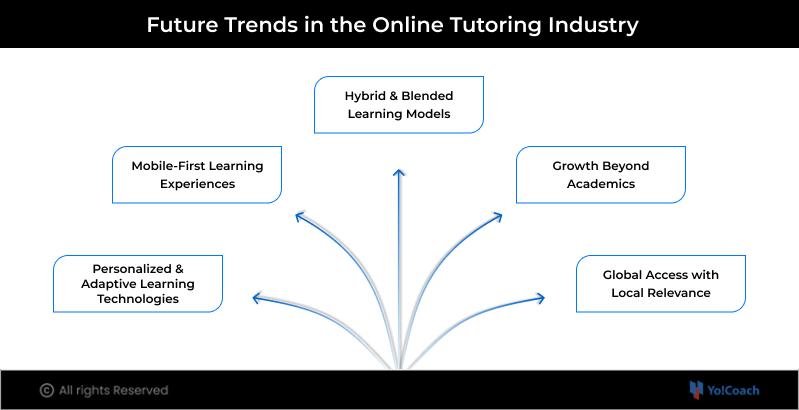
1. Personalized and Adaptive Learning Technologies
Online tutoring platforms are increasingly integrating artificial intelligence (AI) and machine learning (ML) to deliver tailored learning experiences. These technologies analyze each student’s pace, style, and performance to provide a seamless learner experience.
AI-driven tutoring systems are expected to dramatically improve engagement and outcomes, moving beyond traditional one-size-fits-all models.
2. Mobile-First Learning Experiences
Learners today expect education to be accessible anytime and anywhere. With rising smartphone penetration, platforms that offer seamless mobile experiences via apps, push notifications, and offline access are gaining a competitive edge and higher user retention.
3. Hybrid and Blended Learning Models
While fully virtual tutoring continues to grow, hybrid learning models that combine online and in-person elements are gaining traction. This blended approach offers learners the benefit of flexibility and human interaction, making it especially appealing for skill-based training, test preparation, and professional development.
4. Growth Beyond Academics
Online tutoring is no longer limited to school and college subjects. The market is expanding from core school subjects to high-demand areas, such as:
- Test preparation for exams like SAT, ACT, and GRE
- Professional skills and certification training
- Language learning and soft skills coaching
- Vocational and career development courses
This diversification allows platforms to reach broader audiences and unlock new revenue streams.
5. Global Access with Local Relevance
Modern tutoring platforms are increasingly localizing content, catering to regional curricula and languages, while facilitating connections between tutors and students across borders without compromising learning quality. Further, localization helps build trust, improves learning outcomes, and expands market reach.
These evolving trends not only reflect where demand is heading but also present strategic opportunities for new entrepreneurs looking to build a future-ready online tutoring business in 2026 and beyond.
Legal Requirements for Starting an Online Tutoring Business
Starting an online tutoring business typically requires less capital than opening a traditional brick-and-mortar institution, but it still demands careful attention to legal and regulatory compliance. However, addressing these legal aspects early helps you avoid future risks, operate smoothly across regions, and build trust with students, tutors, and stakeholders. Let’s explore some of the necessary legal requirements:
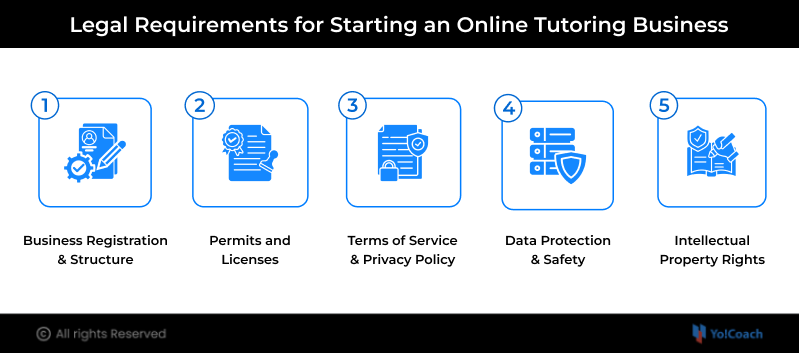
1. Business Registration and Structure
Choosing the right business structure is the foundation of your online tutoring business. This decision impacts taxation, liability, ownership, and how easily your business can scale in the future.
Common business structures include:
- A sole proprietorship, which is simple to set up and ideal for individual tutors or early-stage entrepreneurs, but it offers no separation between personal and business liabilities.
- A limited liability company (LLC), which protects personal assets while offering flexibility in management and taxation.
- A private limited company, which is suitable for those planning to build a scalable online tutoring marketplace, raise investment, or expand internationally, though it involves higher compliance requirements.
- Other legal entities, depending on local regulations and long-term business goals.
Selecting the right structure ensures legal protection and smoother growth as your online tutoring business expands.
2. Permits and Licenses
In most regions, online tutoring businesses do not require specialized educational licenses. However, legal requirements can vary depending on your country, state, and the type of tutoring services you offer.
Depending upon your jurisdiction, you may need:
- Local or regional business licenses to legally operate
- GST or VAT registration for billing and invoicing students or tutors
- Educational or compliance certificates if you offer regulated courses, certifications, or accredited programs
Since regulations differ across locations, consulting a local legal or tax expert ensures full compliance and helps you avoid operational disruptions.
3. Terms of Service & Privacy Policy
Clear and well-drafted legal documents are essential for defining user responsibilities and protecting your platform from disputes.
Key policies typically include:
- Terms of Service, defining platform usage, tutor and student responsibilities, and dispute resolution processes
- Privacy Policy, explaining how user data is collected, stored, and processed
- Refund Policy, detailing cancellation, rescheduling, and refund conditions
- Tutor-Student Agreements, specifying session guidelines, payments, content ownership, and acceptable conduct
These policies help create transparency, build user trust, and reduce legal risks for your online tutoring marketplace.
4. Data Protection and Safety
An online tutoring platform handles sensitive information, including personal details, payment information, and communication records. Ensuring data protection is both a legal obligation and a trust-building measure.
Your platform must comply with data privacy regulations, such as:
- GDPR for users in the European Union
- CCPA for California-based users
- Local data protection laws in your operating regions
Implementing security measures such as encrypted data storage, secure payment gateways, and protected login systems helps safeguard user information and prevent data breaches.
5. Intellectual Property Rights
If your platform offers original educational content such as recorded sessions, study materials, assessments, or courses, protecting intellectual property is critical.
To safeguard your content, ensure that you:
- Clearly define content ownership between tutors and the platform
- Obtain licenses for any third-party content used
- Protect your original materials through copyright laws
- Prevent unauthorised duplication or redistribution of content
Proper intellectual property management protects your educational assets and ensures long-term value for your online tutoring business.
Create a Legally Sound Tutoring Platform
Why the Marketplace Business Model is Ideal for Starting an Online Tutoring Business
If you are planning to start an online tutoring business, one of the most critical decisions is choosing between operating as a solo tutor or building a full-fledged online tutoring marketplace. While one-on-one tutoring may seem easier to start, it often limits long-term growth and revenue potential. In contrast, a marketplace model creates a scalable, sustainable, and future-ready education business.
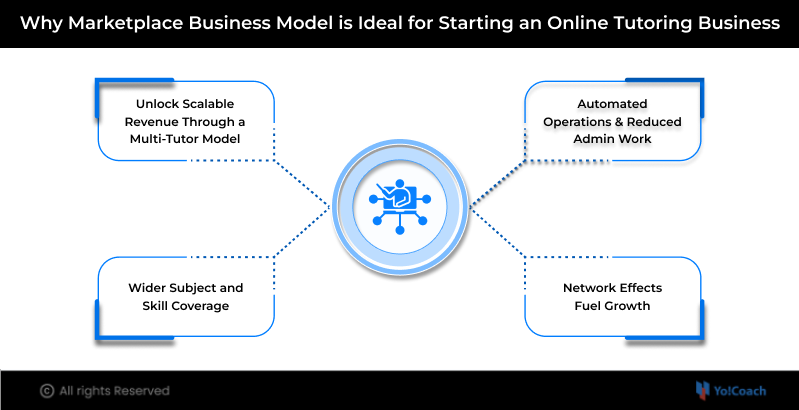
Below are the key reasons why an online tutoring marketplace model consistently outperforms the traditional one-on-one tutoring approach:
1. Unlock Scalable Revenue Through a Multi-Tutor Model
As an individual tutor, your earning potential is directly tied to the number of hours you can teach. Once your schedule is full, growth effectively stops. A marketplace removes this limitation by allowing multiple tutors to offer services simultaneously.
With a tutoring marketplace, revenue can be generated through:
- Commissions on tutoring sessions
- Subscription or membership fees
- Featured tutor listings
- Premium services or platforms add-ons
This model allows your income to scale without increasing your personal workload, transforming your online tutoring business into a true revenue-generating platform rather than a time-bound service.
2. Wider Subject and Skill Coverage
A marketplace brings together tutors from diverse backgrounds, qualifications, and specializations under one platform. This diversity significantly enhances the value proposition for students.
Students benefit from:
- Access to multiple subjects and skill categories
- A variety of teaching styles and methodologies to suit individual learning preferences
- Flexible pricing options based on tutor experience and specialization
As a result, learners are more likely to find the right tutor for their specific needs, leading to higher satisfaction, stronger retention, and repeat usage of your platform.
3. Automated Operations and Reduced Admin Work
Managing a one-on-one tutoring setup often involves manual scheduling, payment tracking, and communication. As demand increases, these tasks quickly become time-consuming and difficult to manage.
A marketplace powered by the right online tutoring software automates critical operations, including:
- Session scheduling and availability management
- Billing, invoicing, and commission handling
- Secure payments and tutor payouts
- In-platform messaging and notifications
- Ratings, reviews, and performance tracking
Automation significantly reduces operational overhead and allows you to focus on growth, partnerships, and platform improvement.
4. Network Effects Fuel Growth
One of the strongest advantages of a marketplace business model is the network effect. As more tutors join the platform, students gain access to more choices. As more students enroll, tutors see increased earning potential, creating a self-reinforcing growth loop.
As your marketplace grows:
- Platform value increases for both tutors and students
- Word-of-mouth referrals grow organically
- User engagement and activity improve
These network effects make it easier to scale sustainably and establish a long-term competitive advantage.
In essence, transitioning from a solo tutoring model to a marketplace transforms your role entirely. Instead of trading time for money, you build a system that generates ongoing value for tutors, students, and your business.
This shift not only increases revenue potential but also positions your online tutoring business for long-term growth, scalability, and market leadership in the evolving online education landscape.
Steps to Start an Online Tutoring Business
Starting an online tutoring business requires a thoughtful combination of market understanding, strategic planning, and the right technology foundation. Whether you aim to begin as a niche platform or build a scalable online tutoring marketplace, the steps below provide a practical roadmap to help you launch and grow successfully in 2026.
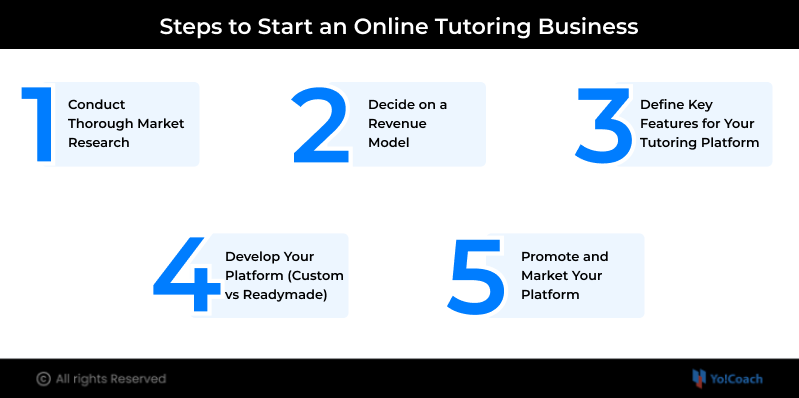
Step 1: Conduct Thorough Market Research
Before investing time or capital, it is essential to validate demand and understand your market landscape. Strong market research minimizes risk and ensures your platform is built around real user needs rather than assumptions. Therefore, first you should:
- Define Your Target Audience Clearly: Determine who your learners are based on age group, learning goals, subject requirements, geography, and preferred learning formats to ensure precise positioning.
- Analyze Existing Tutoring Platforms and Competitors: Study competitors to understand their offerings, pricing strategies, user experience, and limitations. This helps identify gaps and opportunities for differentiation.
- Identify and Validate a Profitable Niche: Narrow your focus to high-demand areas such as STEM, language learning, exam preparation, or skill-based education to strengthen branding and improve student retention.
Step 2: Decide on a Revenue Model
Your revenue model determines how your online tutoring business will generate income and sustain growth. Therefore, choosing the right mix is crucial for long-term viability.
Common monetization models include:
- Commission-based model, where you earn a percentage of each tutoring session
- Subscription model, offering learners access to ongoing lessons or premium features
- Pay-per-session bookings, allowing students to book classes as needed
- Package plans, where sessions are sold in bundles
- Premium features, such as verified tutor badges or promoted listings
Selecting a flexible and scalable revenue model ensures steady cash flow while appealing to both tutors and learners.
Step 3: Define Key Features for Your Tutoring Platform
Your platform must cater to the needs of all stakeholders, including students, tutors, and admin/s, to function smoothly as a marketplace. Hence, it should include:
| Students | Tutors | Admins |
| Easy registration and profile management | Simple onboarding and profile setup | User and content management |
| Tutor search and filtering | Availability and calendar management | Platform-wide availability controls |
| Session booking and scheduling | Session history and management | Session oversight and moderation |
| Video conferencing and messaging | Communication and session tools | Communication monitoring |
| Secure payments | Earnings and payout tracking | Commission and revenue tracking |
| Ratings and reviews | Performance insights | Platform analytics and reporting |
A feature-rich yet intuitive platform enhances user experience and encourages long-term engagement.
Launch a Feature-Packed Online Tutoring Marketplace
Step 4: Develop Your Platform (Custom vs Readymade)
Choosing the right platform development approach is one of the most critical decisions when starting an online tutoring business. It directly affects your launch timeline, upfront investment, operational complexity, and ability to scale in the future. However, primarily, there are two popular development approaches:
1. Custom Development
This approach involves hiring a team of developers to build your online tutoring platform from scratch. It gives you complete control over the platform’s design, features, and architecture.
Pros
- Full control over platform design, features, and architecture
- Ability to build customized workflows aligned with your business vision
- Flexibility for complex or unique requirements
Cons
- Significantly higher development and infrastructure costs
- Longer development and launch timelines
- Ongoing maintenance, updates, and security require continuous technical support.
- Higher dependency on in-house or outsourced development teams.
2. Readymade Solutions
Readymade online tutoring solutions are pre-built platforms designed specifically for tutoring and education marketplaces. These solutions come equipped with essential features such as tutor onboarding, scheduling, payments, live classes, and admin controls already in place.
Pros
- Faster time to market, allowing you to launch quickly
- Lower upfront development and infrastructure costs
- No need to manage technical complexities or maintenance
- Built-in features designed specifically for tutoring marketplaces
- Suitable for early-stage and growth-focused businesses
Cons
- Feature changes depend on the platform’s available configuration options
Which Approach Is Best?
For most startups and entrepreneurs entering the online tutoring space, a readymade online tutoring software is the smarter and more practical choice. It reduces risk, minimizes development expenses, and allows you to focus on acquiring tutors and students rather than managing technology.
Step 5: Promote and Market Your Platform
After the development of your marketpalce, next crucial step is to promote your marketplace. For that, before launch, build awareness through email waitlists, social media teasers, and partnerships with educators. After launch, focus on:
- Paid ads and search engine optimization (SEO)
- Content marketing and educational blogs
- Referral and incentive programs
- Free trials, webinars, or demo sessions
Consistent promotion builds trust, drives traffic, and accelerates growth for your online tutoring business.
Launching an online tutoring business is not just about teaching; it’s about creating a scalable system that connects learners with quality educators through the right technology. By following these steps, you set a strong foundation for building a successful online tutoring marketplace that can grow sustainably in 2026 and beyond.
Mistakes to Avoid While Starting an Online Tutoring Business
Launching an online tutoring business offers significant growth opportunities, but common mistakes can slow growth or undermine your platform entirely before it even gains traction. Being aware of these common pitfalls early allows you to plan better and build a stronger, more sustainable tutoring marketplace. Mentioned below are some of the common mistakes you should avoid:
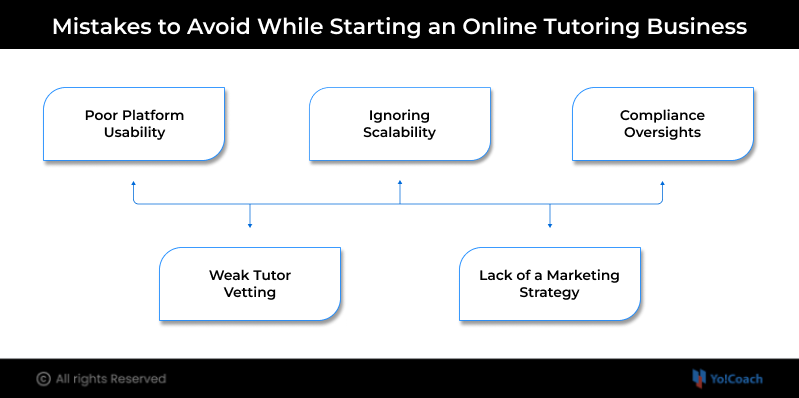
1. Poor Platform Usability
A complicated or unintuitive platform quickly frustrates users. If students struggle to find tutors, book sessions, or make payments, they are unlikely to return. Similarly, tutors may disengage if onboarding and session management feel complicated. A clean interface, intuitive navigation, and mobile-friendly design are critical for delivering a positive user experience and improving retention.
2. Weak Tutor Vetting
Tutors are the backbone of your online tutoring business. Failing to properly screen and verify tutors can result in inconsistent teaching quality, negative reviews, and loss of learner trust. Without clear qualification checks, demo sessions, or performance monitoring, your platform’s credibility can suffer, making it harder to attract and retain students over time.
3. Ignoring Scalability
Many tutoring platforms start small, using basic tools and manual processes. However, as the number of users grows, these systems often fail to handle increased traffic, bookings, and transactions. Ignoring scalability can lead to slow performance, system crashes, and operational bottlenecks, ultimately limiting your platform’s growth potential.
4. Lack of a Marketing Strategy
Even a well-designed tutoring platform needs consistent visibility. Relying solely on organic discovery or word-of-mouth limits growth potential. Moreover, without a clear marketing plan, including SEO, paid ads, content marketing, and partnerships, attracting students and tutors becomes a challenge, delaying traction and revenue generation.
5. Compliance Oversights
Overlooking legal and regulatory requirements can result in fines, disputes, or even forced shutdowns. Issues such as data privacy violations, missing policies, or improper business registration can harm your platform’s reputation and sustainability. Additionally, ensuring compliance from the beginning protects your business and builds long-term trust.
Avoiding these mistakes helps lay a strong foundation for your online tutoring business and prepares your platform for growth, credibility, and long-term success.
How Yo!Coach Can Help Your Online Tutoring Business Thrive
Building a fully functional online tutoring marketplace that addresses usability, scalability, compliance, and automation challenges from scratch can be complex, time-consuming, and costly. This is where Yo!Coach comes in and simplifies the journey.
Yo!Coach is a purpose-built, ready-to-launch online tutoring and consultation software built specifically to power marketplaces like Preply or Verbling. Instead of assembling multiple tools or managing custom development, Yo!Coach provides everything you need to launch and scale your tutoring platform efficiently.
Here is how Yo!Caoch accelerates your journey:
- All-in-One Virtual Classroom: It comes with an integrated whiteboard, screen sharing, and video chat.
- Automated Scheduling: The system auto-detects user time zones, ensuring accurate scheduling for global users. Hence, it keeps the session aligned, even if the student is in New York and the tutor is in London.
- Seamless Payments: It features automated commission management. When a student pays, the system automatically splits the fee between the tutor’s wallet and your admin profit, reducing manual work and providing transparency.
- White-Label & Scalable: Unlike most SaaS tools, Yo!Coach is a self-hosted solution. You retain full ownership of the customizable source code and own the data, with no recurring monthly fees.
By leveraging Yo!Coach, you avoid many of the common pitfalls associated with launching an online tutoring business. You can go live with a secure, professional, and scalable platform that is ready to support growth from day one.
Schedule a Personalized Yo!Coach Demo
Tutor Marketplaces Powered by Yo!Coach
1. WTutors
WTutors is a global online tutoring marketplace connecting students with qualified tutors across academic subjects and professional skills. Built to support real-time learning, the platform offers seamless scheduling, secure payments, and interactive virtual classrooms. Powered by Yo!Coach, WTutors delivers a scalable, user-friendly tutoring experience for learners and educators worldwide.
2. Desk Tutorial
Desk Tutorial is an online learning platform focused on personalized tutoring and academic support for students. The marketplace enables smooth tutor onboarding, session scheduling, and live classes, creating a structured yet flexible learning environment. With Yo!Coach, as its technology backbone, Desk Tutorial efficiently manages operations while delivering consistent learning experiences.
3. StudyUnite
StudyUnite is a modern tutoring marketplace designed to connect students with expert educators across multiple disciplines. The platform emphasizes ease of access, transparent pricing, and interactive learning tools. Using Yo!Coach, StudyUnite supports automated scheduling, secure transactions, and scalable marketplace operations, helping learners find the right tutors quickly and reliably.
4. SabiTeach
SabiTeach is an online tutoring platform built to make quality education accessible through one-on-one and group learning sessions. The marketplace supports global tutor-student connections, flexible scheduling, and virtual classrooms. Powered by Yo!Coach, SabiTeach operates as a robust, scalable tutoring ecosystem tailored for long-term growth.
Conclusion
Starting an online tutoring business in 2026 offers significant potential for long-term growth. As the market continues to expand rapidly, entrepreneurs who leverage future trends, adopt the marketplace model, and use robust online tutoring software like Yo!Coach can thrive in this space.
However, success lies in careful planning, legal compliance, effective marketing, and choosing the right technology partner. As education increasingly moves online, now is the perfect time to build and scale your future-ready online tutoring marketplace.
Start Your Online Tutoring Business Today
Get In Touch