
The global online learning market has undergone significant shifts in recent years. What once focused mainly on simple course uploads has now evolved into interactive learning marketplaces that support live tutoring, coaching, mentoring, and community-driven learning experiences. Hence, businesses launching learning platforms today need more than just a basic Learning Management System (LMS). They need a solution that supports scalability, multiple instructors, flexible monetization, and long-term growth.
Pinlearn is one such platform that helps businesses enter the online education space. While it offers a functional starting point to launch a tutoring or course-based platform, many founders eventually find themselves exploring alternatives as their requirements become more complex.
This blog explains what Pinlearn is, where it fits best, why businesses outgrow it, and what kind of platform is better suited for building modern, scalable eLearning marketplaces.
Table of Contents
What Is Pinlearn?
Pinlearn is a readymade eLearning marketplace software that enables businesses to build online platforms for tutoring and course-based learning. It allows multiple instructors to register, create educational content, and sell courses or tutoring sessions to learners through a centralized system.
Pinlearn is often used by:
- Coaching institutes transitioning from offline to online learning
- Independent tutors looking to build a shared teaching platform
- Small education startups testing a marketplace-based learning concept
The platform typically includes core functionalities such as course creation, learner enrollment, tutor profiles, and payment handling, making it a practical entry point for launching a basic eLearning marketplace.
How Pinlearn Works
Pinlearn operates on a standard marketplace structure designed for quick deployment:
- Admin manages the platform, approves tutors, sets commissions, and oversees content quality.
- Tutors/Instructors create courses or offer tutoring sessions.
- Learners browse courses, enroll, and access learning content.
By providing these core workflows, Pinlearn helps businesses launch relatively quickly without building everything from scratch. For early-stage platforms or concept validation ideas, this approach can reduce initial development time and technical effort.
Challenges Businesses Face While Using Pinlearn
As learning platforms grow, their requirements change and become more complex. This is where many businesses begin to experience friction with Pinlearn and consider whether the platform can support their next stage of growth. Given below are some of the common challenges that businesses face while using Pinlearn:
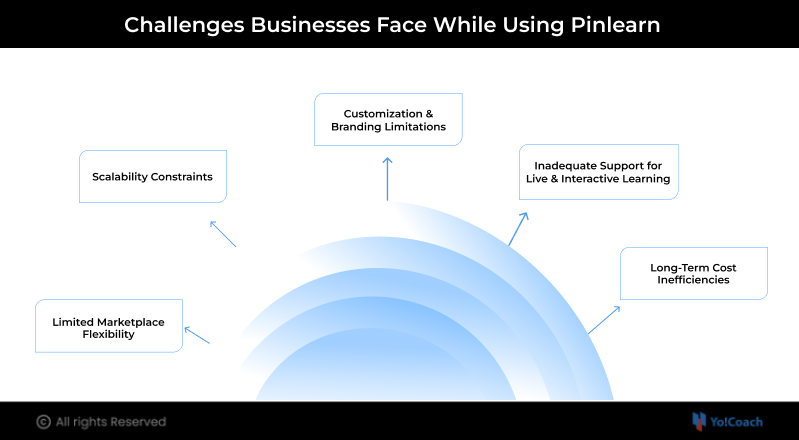
1. Limited Marketplace Flexibility
Modern learning platforms are no longer confined to selling recorded courses. Today, eLearning businesses expect to offer a mix of:
- One-on-one sessions
- Group classes
- Subscription-based learning
- Bundled offerings
- Hybrid models (live + recorded)
Pinlearn’s structure can feel restrictive when trying to support multiple learning formats and monetization models under one roof, limiting how businesses evolve their offerings.
2. Scalability Constraints
As user numbers increase, platforms must be able to handle:
- High traffic volumes
- A growing number of instructors
- Global learners
- Complex scheduling and payments
Many businesses find that scaling Pinlearn beyond a certain point requires heavy customization. This increases development time, cost, and creates technical dependency that slows growth.
Looking for a Scalable Online Tutoring Marketplace Solution?
3. Customization & Branding Limitations
While Pinlearn allows modifications, adapting it to match a unique brand identity or user experience often requires significant development effort. This can slow innovation and make it harder for businesses to differentiate in an increasingly competitive learning market.
4. Inadequate Support for Live & Interactive Learning
Live tutoring and coaching require:
- Real-time interaction
- Scheduling flexibility
- Session management
- Learning engagement tools
When these capabilities are not deeply integrated into the platform architecture, businesses must rely on third-party tools. This leads to fragmented workflows and an inconsistent user experience for both learners and instructors.
5. Long-Term Cost Inefficiencies
What initially appears to be a cost-effective solution can become expensive over time. Businesses often face rising costs due to:
- Add-on feature costs
- Custom development expenses
- Maintenance and upgrade overhead
- Technical dependencies
As these expenses accumulate, many founders begin to reconsider whether their current platform supports sustainable and long-term growth.
What Businesses Actually Look for in a Pinlearn Alternative?
When businesses start evaluating alternatives to Pinlearn, they are rarely just looking for more features. In most cases, they are reassessing their entire platform strategy and asking a critical question: Whether their current technology can truly support where they want the business to go next.
Based on how modern learning marketplaces operate, the expectations from a Pinlearn alternative typically fall into the following areas:
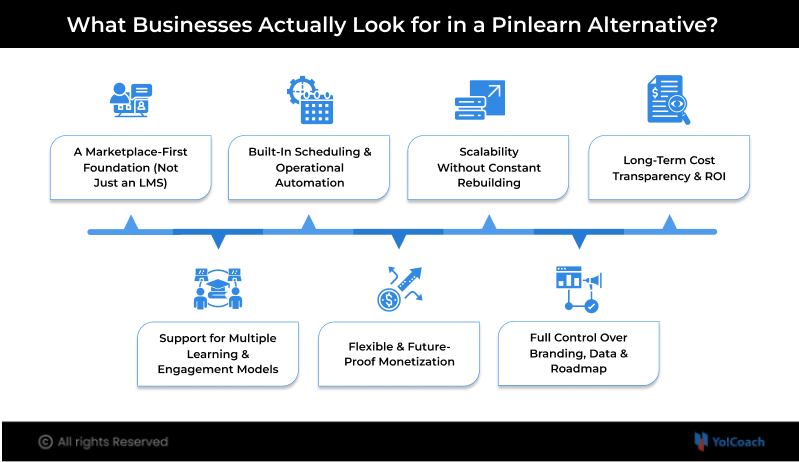
1. A Marketplace-First Foundation (Not Just an LMS)
Businesses today aim to build two-sided marketplaces, not static course libraries. This requires a platform designed to manage:
- Multiple tutors or coaches as independent service providers
- Learners with personalized discovery, booking, and engagement journeys
- Admins who oversee quality control, commissions, and platform policies
An ideal alternative should treat tutors and learners as equal participants in a marketplace ecosystem, rather than add-ons to a traditional LMS structure.
2. Support for Multiple Learning & Engagement Models
Learning is no longer one-dimensional. Businesses now want the flexibility to offer:
- One-on-one tutoring or coaching
- Group or batch-based live classes
- Recorded, self-paced courses
- Hybrid models that combine live and on-demand learning
A strong Pinlearn alternative must allow these formats to coexist seamlessly, without forcing businesses to restructure their offerings or rely heavily on external tools.
3. Built-In Scheduling & Operational Automation
Manual coordination does not scale. As platforms grow, businesses expect:
- Intelligent availability and calendar management
- Automated booking, rescheduling, and cancellations
- Time-zone handling for global users
- Notifications and reminders for sessions
Scheduling is no longer a nice-to-have feature. It’s a core operational requirement. Alternatives are expected to simplify daily operations, not add complexity.
4. Flexible & Future-Proof Monetization
Modern learning platforms experiment continuously with pricing and revenue models. Businesses look for alternatives that support:
- Pay-per-session or hourly pricing
- Subscription-based access
- Bundled packages and memberships
- Commission-based earnings for tutors
- Promotional pricing and discounts
The freedom to evolve monetization strategies without platform limitations is a major driver behind switching from Pinlearn.
Build an Online Tutoring Marketplace With Growth in Mind
5. Scalability Without Constant Rebuilding
Many platforms work fine at launch but struggle as usage grows. Businesses actively look for alternatives that can:
- Handle increasing numbers of tutors and learners
- Support higher traffic and concurrent sessions
- Expand into new learning categories or niches
- Grow globally without performance trade-offs
A Pinlearn alternative should scale alongside the business, rather than forcing costly rebuilds every time the platform evolves.
6. Full Control Over Branding, Data & Roadmap
As competition increases, differentiation becomes critical. Businesses want:
- Complete control over branding freedom
- Ownership of platform and user data
- Control over the feature roadmap and integrations
- Freedom from vendor-imposed limitations
Alternatives are evaluated not just by features, but by how much control they give back to the business owner.
7. Long-Term Cost Transparency & ROI
Finally, businesses prioritize predictability. Instead of fragmented expenses caused by add-ons, plugins, or frequent customizations, they look for:
- Clear upfront investment
- Lower long-term maintenance costs
- Better return on investment as the platform scales
The objective is not merely to launch affordably, but to operate sustainably over the long-term.
Suggested Read: Top Pinlearn Alternatives & Competitors in 2026
Introducing Yo!Coach: A Purpose-Built Learning Marketplace Platform
After evaluating the limitations of platforms like Pinlearn, many businesses turn to Yo!Coach is a robust software solution built specifically for online tutoring, coaching, and consultation marketplaces, not just for basic course selling.
Unlike traditional LMS platforms, Yo!Coach is built around interaction, flexibility, and long-term scalability. This makes it suitable for businesses that want to grow beyond basic eLearning and build a dynamic, service-driven learning marketplace.
Why Yo!Coach Is a Stronger Alternative to Pinlearn
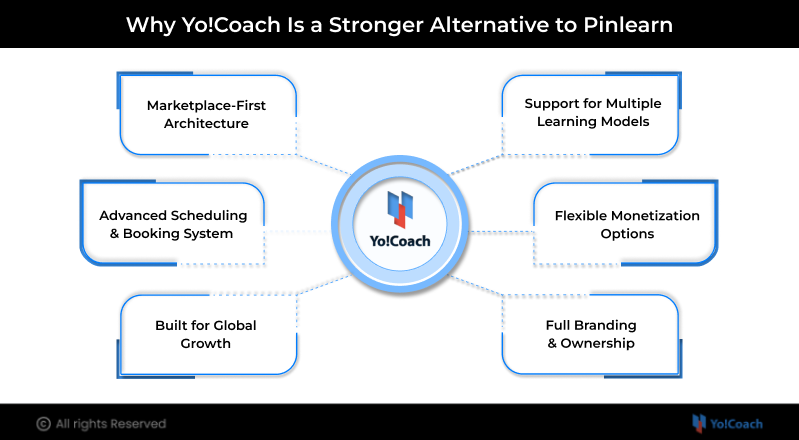
1. Marketplace-First Architecture
Yo!Coach is designed from the ground up as a multi-instructor marketplace, not as a modified course plugin or LMS. This means:
- Tutors and coaches manage their availability and services
- Learners can discover, book sessions, and engage seamlessly
- Admins control commissions, quality standards, and platform policies efficiently
This structure aligns closely with modern learning businesses.
2. Support for Multiple Learning Models
Yo!Coach gives businesses the flexibility to offer a wide range of learning formats, including:
- One-on-one tutoring
- Group classes
- Live coaching
- Recorded courses
- Hybrid learning models
Instead of forcing businesses into one format, Yo!Coach adapts to different educational use cases as the business evolves.
3. Advanced Scheduling & Booking System
Scheduling is central to tutoring and coaching platforms. Yo!Coach includes:
- Tutor availability management
- Automated booking flows
- Rescheduling and cancellation handling management
- Time-zone support for a global user base
These capabilities reduce manual coordination and improve user satisfaction on both sides.
4. Flexible Monetization Options
Yo!Coach supports diverse revenue models such as:
- Hourly or session-based pricing
- Subscription plans
- Package and bundle deals
- Commission-based tutor earnings
- Promotional pricing and discounts
This flexibility allows businesses to test, refine, and optimize revenue without structural limitations.
5. Built for Global Growth
Yo!Coach is designed to support international expansion from the outset, with:
- Multiple languages
- Multiple currencies
- International payment workflows
This makes it suitable for platforms targeting global learners from day one, something many businesses struggle to achieve with entry-level solutions.
6. Full Branding & Ownership
Businesses using Yo!Coach retain:
- Complete branding control
- Source code ownership
- Full access to the platform and user data
This level of ownership ensures long-term independence and eliminates vendor lock-in risks.
7. Scalable & Future-Ready
Yo!Coach is built to scale alongside your business. Whether you’re onboarding hundreds or thousands of tutors, expanding into new learning categories, niches, or introducing new learning formats, the solution is designed to scale without forcing constant rebuilds.
Explore Yo!Coach for Your Online Tutoring Marketplace
Pinlearn vs Yo!Coach: A Practical Perspective
When businesses compare Pinlearn and Yo!Coach, the difference becomes clearer once the focus shifts from surface-level features to long-term business viability. The real question is not what the platform can do on day one, but how well it supports long-term business growth.
Pinlearn is typically positioned as an entry-level solution for launching a basic online learning or tutoring platform. It works reasonably well for straightforward use cases such as selling recorded courses or running small-scale tutoring operations. However, as business requirements expand, Pinlearn often begins to feel more like a rigid framework than a flexible marketplace engine.
Yo!Coach, on the other hand, is designed with a marketplace-first mindset. Instead of centering the platform around courses alone, it focuses on enabling dynamic interactions between tutors, coaches, and learners. This makes a noticeable difference in how the platform performs once real users, real schedules, and real monetization complexities come into play.
From a practical standpoint:
- Pinlearn is better suited for businesses that want to validate a basic learning concept quickly, with limited customization and simpler workflows.
- Yo!Coach is better aligned with businesses that aim to build a scalable tutoring or coaching marketplace, where live sessions, flexible pricing, tutor autonomy, and global expansion are core requirements.
Another key distinction lies in platform adaptability. With Pinlearn, adding new learning models or revenue streams often requires structural changes or additional development. While Yo!Coach is built to accommodate evolving business models from the outset, whether that means introducing subscriptions, expanding into new coaching niches, or supporting hybrid learning formats.
For businesses that want a deeper understanding of how these platforms compare in real-world scenarios, a detailed breakdown of capabilities, limitations, and real-world use cases is available in this comprehensive comparison of Yo!Coach Vs Pinlearn.
Ultimately, the choice is less about which platform has more features today, and more about which one can support where your business is headed tomorrow. For founders who see their platform as a long-term product rather than a short-term experiment, Yo!Coach offers a more future-ready foundation.
Conclusion
Online learning businesses often start small, but as they grow, their technology needs evolve. Modern tutoring and coaching marketplaces require flexibility, scalability, and full control—far beyond just hosting courses. They need platforms that support live interactions, multiple monetization models, global audiences, and continuous innovation without technical limitations.
Purpose-built marketplace solutions are better suited to meet these demands than traditional LMS frameworks. Yo!Coach is designed with long-term growth in mind, offering a marketplace-first architecture, flexible learning models, and complete ownership. It enables businesses to build a scalable, future-ready learning platform that supports sustainable success.
Frequently Asked Questions (FAQs)
Q 1. Is Pinlearn suitable for launching an online learning platform?
Ans. Yes, Pinlearn is suitable for launching a basic online learning or tutoring platform, especially for small teams or early-stage startups. It works well when requirements are limited to straightforward course delivery or simple tutoring workflows. However, it is not well-suited for large-scale businesses that need high scalability, advanced workflows, and flexible monetization models.
Q 2. Why do businesses look for Pinlearn alternatives?
Ans. Businesses typically look for alternatives when they face limitations related to scalability, customization, monetization flexibility, or live learning capabilities. As platforms grow, these constraints can slow expansion and increase operational complexity.
Q 3. What should I look for in a Pinlearn alternative?
Ans. A strong alternative for Pinlearn should offer:
- A marketplace-first architecture
- Support for live, group, and self-paced learning
- Advanced scheduling and booking
- Flexible monetization options
- Full branding and data ownership
- Scalability for long-term growth
These factors help ensure the platform can evolve alongside your business.
Q 4. How is Yo!Coach different from a traditional LMS like Pinlearn?
Ans. Traditional LMS platforms focus primarily on course management. Yo!Coach, by contrast, is built specifically for tutoring and coaching marketplaces, emphasizing live interaction, scheduling, tutor autonomy, and marketplace operations rather than static content delivery.
Q 5. Is Yo!Coach suitable only for tutoring platforms?
Ans. Yo!Coach excels at tutoring and coaching marketplaces; it is also suitable for:
- Language learning platforms
- Professional coaching and mentoring
- Consultation marketplaces
- Hybrid learning models combining live and recorded content
Its flexibility allows it to adapt to various learning-based business models.
Q 6. Can businesses scale globally using Yo!Coach?
Ans. Yes, businesses can scale globally using Yo!Coach. It supports features required for global expansion, such as multi-language support, multi-currency handling, and timezone-aware scheduling, making it suitable for platforms targeting international audiences.
Q 7. Is switching from Pinlearn to another platform worth it?
Ans. Switching platforms is worth considering if your current solution is limiting growth, increasing costs through custom development, or restricting your ability to innovate. Evaluating alternatives early can help avoid costly migrations later.
Q 8. How do I decide if Yo!Coach is the right Pinlearn alternative for my business?
Ans. Yo!Coach is a good fit if your goal is to build a scalable, marketplace-driven learning platform with live interactions, flexible revenue models, and full control over branding and growth strategy. Businesses focused on long-term sustainability typically find it aligns better with their objectives.
Want to Launch Your Own eLearning Platform?
Get In Touch