In today’s digital era, mental health awareness is rising rapidly, along with the demand for accessible counselling services online. Patients are seeking convenient, confidential, and reliable support from qualified mental health professionals. A well-designed mental health counselling website not only connects therapists with clients but also streamlines appointments, scheduling, payments, and consultations seamlessly.
Whether you are a psychologist, psychiatrist, counselor, or an entrepreneur planning to build a consultation marketplace website, understanding how to create a platform tailored to mental health services is essential. This guide walks you through every stage, from beginning to successful launch.
Table of Contents
- What is a Mental Health Counselling Website?
- Benefits of Building a Mental Health Counselling Website
- Must-Have Features in a Mental Health Counselling Website
- Steps to Build a Mental Health Counselling Website
- How Yo!Coach Can Help?
- Health and Wellness Marketplace Powered by Yo!Coach
- Conclusion
- FAQs
What is a Mental Health Counselling Website?
A mental health counselling website connects licensed therapists, psychologists, and counselors with individuals seeking professional mental health support. These websites offer a secure and convenient environment where patients can book appointments, attend video or chat consultations, and access helpful resources such as articles, self-help tools, or wellness programs.
By combining accessibility, confidentiality, and professional care, these platforms make mental health services more reachable to people regardless of their location, creating a seamless and supportive online experience.
A mental health counselling website can serve multiple purposes, including:
- Direct Consultation: Patients can schedule one-on-one appointments with individual therapists.
- Marketplace Model: Multiple counselors can offer their services under one platform, creating a structured consultation marketplace website.
- Education & Resources: Provide blogs, mental health tools, self-assessment tests, or meditation guides to users.
By combining ease of access with privacy and expert support, mental health websites are becoming an indispensable part of the modern mental healthcare space.
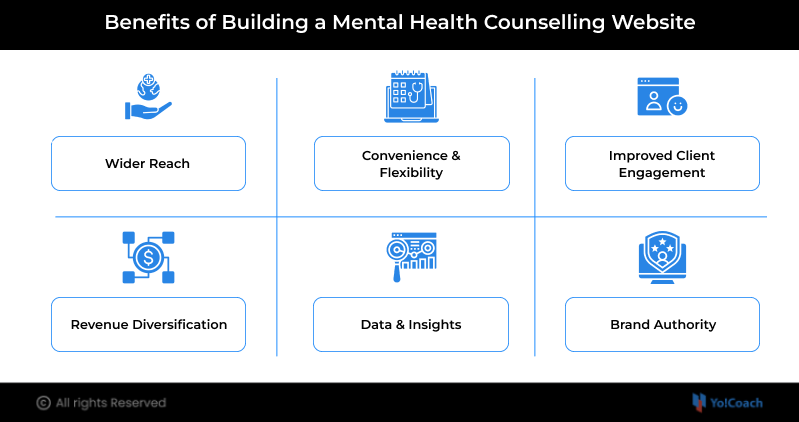
Benefits of Building a Mental Health Counselling Website
Creating a mental health counselling website offers multiple advantages for both therapists and clients, making it an effective way to scale and modernize mental health services online. Other than that, it offers:
1. Wider Reach
Therapists can extend their services beyond local boundaries and connect with patients across cities, states, or even countries. At the same time, clients gain access to specialists they may not find locally, making mental health support more accessible.
2. Convenience & Flexibility
Patients can schedule sessions at times that fit their schedules, while counselors can efficiently manage their appointments more efficiently. The integration of online consultation tools ensures smooth, virtual therapy sessions without the need for physical visits.
3. Improved Client Engagement
Features such as session reminders, follow-ups, and access to mental health resources keep clients engaged in their therapy journey. This helps build trust, encourages consistent therapy, and strengthens long-term therapist-client relationships.
4. Revenue Diversification
A mental health counselling website can generate income in multiple ways, including consultation fees, subscription plans for counselors, featured listings, or advertising. A consultation marketplace website model further expands potential by hosting multiple therapists.
5. Data & Insights
Tracking appointments, session feedback, and client behavior provides valuable insights. Therapists and platform owners can use this data to improve service quality, identify client needs, and make data-driven decisions to optimize outcomes.
6. Brand Authority
A professional online presence positions therapists as credible experts, enhancing reputation and trustworthiness. Over time, the website becomes a reliable source of mental health guidance and information, strengthening long-term brand authority.
Launch Your Own Scalable Counselling Marketplace
Must-Have Features in a Mental Health Counselling Website
A successful mental health counselling website goes beyond basic appointment booking. It must support smooth operations, privacy, and deliver a positive user experience for all types of users: clients, therapists, and administrators.
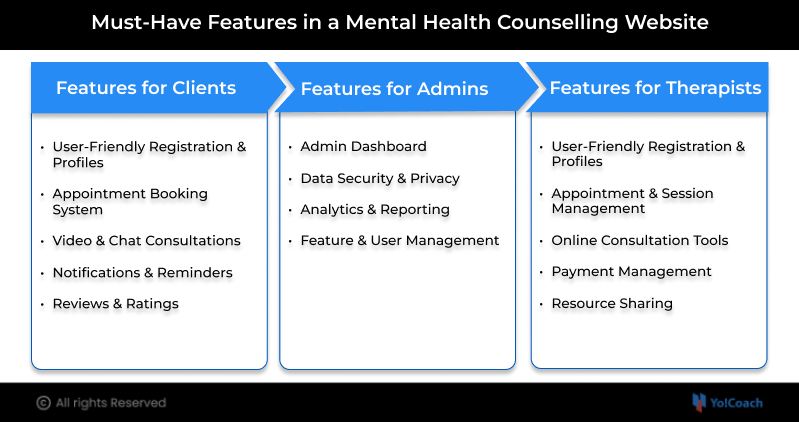
Features for Clients
1. User-Friendly Registration & Profiles
Clients should be able to register quickly and create personalized profiles where they can manage appointments, review session history, and track their progress. A clear and simple interface ensures an easy and smooth onboarding experience.
2. Appointment Booking System
An automated scheduling system allows clients to check therapist availability, book sessions, and receive instant confirmations. This reduces manual coordination and makes accessing therapy more convenient.
3. Video & Chat Consultations
Secure video and chat consultation tools enable clients to connect with therapists from anywhere. End-to-end encryption helps protect sensitive conversations and ensures a seamless online therapy experience.
4. Notifications & Reminders
Automated email or SMS reminders help clients remember upcoming sessions. This reduces missed appointments and supports consistent engagement throughout their mental health journey.
5. Reviews & Ratings
Clients can share feedback on sessions, helping others choose the right therapist and increasing trust in the platform. Ratings also encourage therapists to maintain high-quality service.
Features for Therapists
1. User-Friendly Registration & Profiles
Therapists can create a professional profile highlighting their credentials, experience, areas of expertise, and availability. A well-structured professional profile builds credibility and helps clients find the right professional for their needs.
2. Appointment & Session Management
Therapists can easily manage their schedule, view upcoming appointments, and handle cancellations or rescheduling effortlessly. This reduces administrative workload and allows them to focus more on patient care.
3. Online Consultation Tools
Integrated video and live chat tools enable therapists to conduct secure online sessions. These tools improve accessibility for clients and allow therapists to expand their reach beyond physical locations.
4. Payment Management
The platform enables therapists to receive payments directly through the platform. Features like instant or split payments, refunds, and transparent commission tracking simplify financial operations and improve clarity.
5. Resource Sharing
Therapists can share helpful resource materials such as articles, exercises, or videos with clients, enhancing engagement and reinforcing therapy between sessions.
Features for Admins
1. Admin Dashboard
A centralized dashboard allows administrators to manage therapists, monitor client activity, track revenue, and maintain compliance with healthcare standards and regulations.
2. Data Security & Privacy
Admins ensure that all client and therapist data is stored securely by ensuring compliance with HIPAA, GDPR, or relevant local regulations. Security features like encrypted communication and secure cloud storage help protect sensitive information.
3. Analytics & Reporting
Detailed reports on platform usage, client behaviour, session frequency, and revenue streams help administrators make data-driven decisions and improve platform performance.
4. Feature & User Management
Admins can approve therapist registrations, define commission structures, manage service categories, and control platform content to maintain quality and consistency.
By structuring features according to user type, a mental health counselling website can deliver a seamless and secure experience for clients, empower therapists to focus on care rather than administration, and provide admins the tools to manage the platform effectively.
Build a Feature-Rich Health and Counseling Website
Steps to Build a Mental Health Counselling Website
Building a mental health counselling website requires thoughtful planning, careful execution, and a clear understanding of both user needs and technical requirements. Here’s a step-by-step guide to creating a reliable and successful platform.
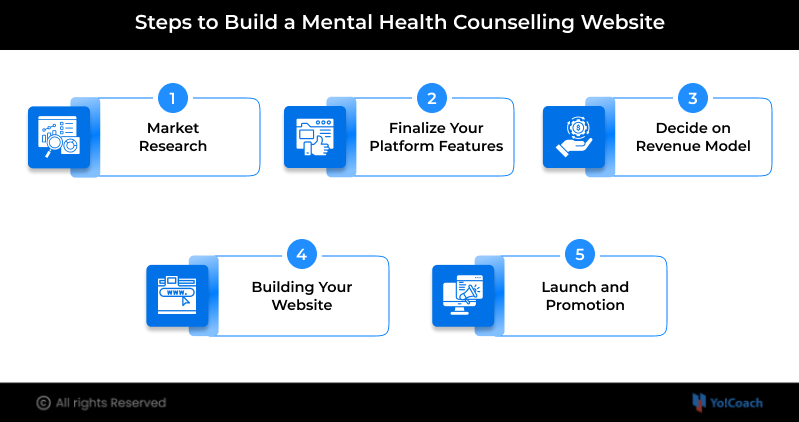
Step 1: Market Research
Before starting development, conduct thorough market research to understand your target audience, competition, and industry trends. Focus on:
- Identify the needs of potential clients: What kind of mental health support are they looking for? What age groups or demographics do they belong to?
- Analyze competitors: Study existing platforms, their features, pricing models, and client feedback to identify gaps you can fill.
- Understand market trends: Remote therapy, telehealth tools, and integrated wellness resources are growing in demand.
This research will help you design a platform that will align with user expectations, stand out from competitors, and offer features that add real value.
Step 2: Finalize Your Platform Features
Before building a health and counselling website, you must decide the feature set and tools that need to be integrated on the platform. Features work as the foundation for your platform. Hence, incorporating essential features is crucial.
Essential features include:
- Online consultation tools (video, audio, chat)
- Secure video conferencing integration
- Appointment scheduling and calendar management
- Automated booking confirmations and reminders
- Commission and payout management
- Admin dashboard for platform control and monitoring
- Therapist onboarding and profile management
- Therapist verification and approval workflows
- Client profiles and session history
- Secure data storage and encryption
- Compliance with healthcare and data protection regulations
- Reviews, ratings, and a feedback system
This ensures a clear roadmap for development.
Step 3: Decide on Revenue Model
Choosing the right revenue model is critical for long-term success. Depending on your platform type, you can consider:
- Per-Session Commission: Earn a percentage from every consultation completed through the platform.
- Subscription Plans: Charge therapists monthly or annually for listings or access to premium features.
- Client Memberships: Offer exclusive content, priority bookings, or special sessions through paid plans.
- Ads & Promotions: Generate additional income by featuring therapists, wellness programs, or related services.
A well-aligned revenue model ensures profitability while balancing the needs of both client and therapist.
Step 4: Building Your Website
This is the most critical phase of the process. There are two main development approaches to consider:
1. Custom Development Approach
This approach involves developing a health and counselling website entirely from the ground up. Platforms built using custom development are tailored, according to your specific workflow, features, design, and business requirements. Further, listed below are some of the advantages and disadvantages of custom development for better understanding:
a. Advantages:
- Full control over design and functionality
- Highly customizable architecture tailored to unique business requirements
b. Disadvantages:
- Higher development and maintenance costs
- Longer time to market (often several months)
- Ongoing reliance on developers for updates and bug fixes
- Risk of scalability and security issues if not developed properly
Best for: Large enterprises with unique business models and significant budgets.
2. Readymade Solutions
These are pre-built platforms designed specifically for online consultation and marketplace websites, like Yo!Coach.
a. Advantages:
- Faster Launch: Core features such as scheduling, payment integration, video consultations, and analytics are already in place.
- Cost-Effective: Significantly lower development costs compared to custom solutions.
- Proven Architecture: Tested for security, scalability, and performance.
- Regular Updates: Platforms receive ongoing updates for new features and compliance standards.
b. Disadvantages:
- Need to meet the minimum server requirement to host the platform..
Recommendation: For most startups and small-to-medium businesses, readymade solutions like Yo!Coach are the smarter choice. They minimize technical complexity, reduce costs, and allow you to focus on growing your client base instead of building the website from scratch.
Step 5: Launch and Promotion
Once your website is ready, focus on promoting your platform to attract clients and therapists, so that your platform reaches the right audience:
- SEO Optimization: Optimize for search engines using relevant keywords related to mental health counselling and online therapy to attract organic traffic.
- Social Media Promotion: Use social media platforms like Instagram, Facebook, and LinkedIn to reach potential clients and share mental health content.
- Collaborations: Partner with therapists, wellness coaches, and industry influencers to boost credibility and visibility.
- Promotional Offers: Free trials, discounted first sessions, or membership perks encourage early adoption.
- Email Marketing: Use email marketing to share newsletters, updates, and wellness tips to improve retention.
A well-planned launch strategy ensures your platform gains traction quickly and starts building a loyal client base.
How Yo!Coach Can Help?
Building a mental health counselling website from the ground up can be time-consuming, expensive, and technically complex. Yo!Coach offers a ready-made solution that simplifies this process, enabling entrepreneurs, clinics, or therapists to launch a full consultation marketplace website quickly and efficiently. With minimal technical effort, you can launch a secure, scalable, and feature-rich platform designed specifically for online therapy and mental health services.
Yo!Coach is built to cater to all user types, including clients, therapists, and administrators, delivering a seamless experience while maintaining data privacy, regulatory compliance, and operational efficiency. It allows businesses to focus on delivering quality mental health services rather than worrying about the technical complexities of website development.
Key Features of Yo!Coach:
- Video & Chat Consultations: Enables secure, real-time therapy sessions through video and chat, allowing therapists and clients to connect seamlessly.
- Appointment & Scheduling System: An initiative scheduling system simplifies booking for therapists and clients.
- Payment Integration: Yo!Coach supports multiple payment method options with automated payouts, which help manage payouts efficiently.
- Ratings & Reviews: Allows clients to share feedback and rate therapists based on their services. Additionally, it helps build credibility and trust among users.
- Analytics Dashboard: A dedicated dashboard enables users to track and get detailed insights into sessions, revenue, and the platform’s performance.
- Scalable & Secure: Yo!Coach is built to support multiple therapists and clients while maintaining data privacy and regulatory compliance.
Benefits:
- Quick deployment with minimal coding requirements.
- Cost-effective compared to custom development.
- Ongoing updates and maintenance included.
Yo!Coach provides robust features and technological infrastructure, allowing entrepreneurs and therapists to focus on delivering quality mental health support rather than worrying about technical challenges.
Explore Yo!Coach Demo
Health and Wellness Marketplace Powered by Yo!Coach
Yo!Coach empowers health and wellness entrepreneurs to focus on service delivery while the platform manages technology, scalability, and security. Whether launching a therapy marketplace, wellness consultation platform, or multi-specialty health service, Yo!Coach provides the flexibility and infrastructure required to grow confidently in a regulated and trust-driven industry.
1. ProviderNext
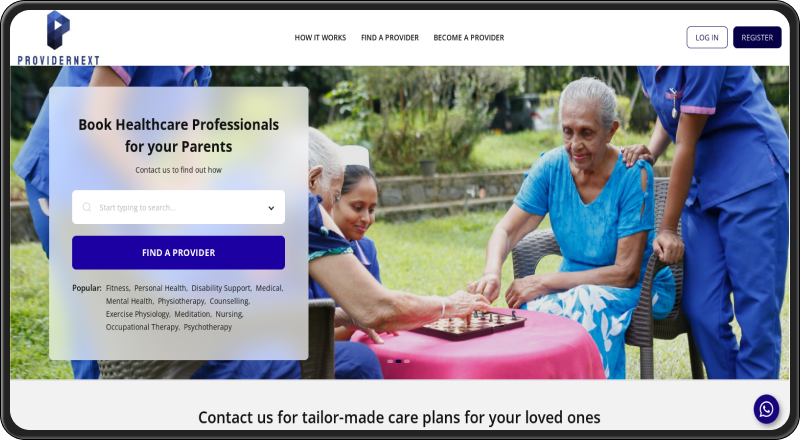
ProviderNext is a health-focused digital platform designed to connect users with professional wellness and care providers through structured online consultations.
Requirements
- A centralized marketplace to onboard and manage multiple health and wellness providers
- Secure online consultation capabilities for remote client engagement
- Appointment scheduling with real-time availability management
- Seamless payment processing for consultations and service packages
- Compliance-ready infrastructure to protect sensitive health data
Solution Delivered by Yo!Coach
Using Yo!Coach, ProviderNext launched a fully functional consultation marketplace that supports end-to-end service delivery. The platform enabled secure video consultations, automated scheduling, and integrated payment workflows. Further, role-based access and centralized administration allowed ProviderNext to scale operations efficiently while maintaining service quality and data security.
2. Therapy Panda
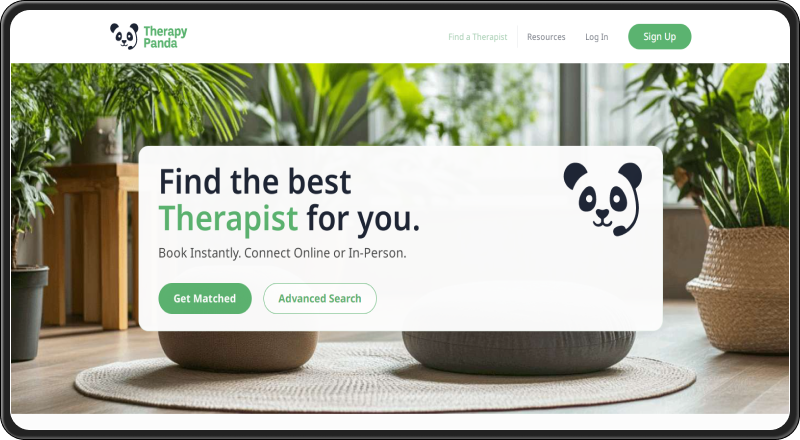
Therapy Panda is an online mental health platform focused on making professional therapy accessible through a digital consultation model.
Requirements
- A user-friendly platform for clients to discover and book therapists
- Secure video and chat-based therapy sessions
- Therapist profile management with verification workflows
- Flexible scheduling and session management
- Secure payment handling with transparent billing
- Tools to build trust, including reviews and ratings
Solution Delivered by Yo!Coach
Leveraging Yo!Coach, Therapy Panda launched a robust online therapy marketplace with built-in video consultation tools, scheduling automation, and secure payment integration. Additionally, therapist profiles, ratings, and session management features helped build credibility and improve client engagement. Other than that, the admin dashboard enabled efficient monitoring of platform activity, ensuring smooth operations and long-term scalability.
Schedule One-on-One Personalized Demo to see Yo!Coach in Action
Conclusion
The demand for online mental health support continues to rise, making it an ideal time to build a professional, secure, and user-friendly mental health counselling website. Whether you are planning to launch a consultation marketplace website, success depends on choosing the right combination of features, development approach, and go-to-market strategy.
With solutions like Yo!Coach, launching and managing an online counselling website becomes faster and more efficient, even when working with multiple counselors. A thoughtfully designed mental health counselling website not only supports a sustainable business model but also makes a meaningful impact by providing accessible mental health care to those who need it most.
Frequently Asked Questions (FAQs)
Q 1. Is it legal to offer online mental health counselling through a website?
Ans. Yes, in many countries it is legal to offer online mental health counselling if the platform and therapists comply with local healthcare regulations. Moreover, therapists must hold valid licenses for the regions they serve, and the website must follow data protection and telehealth laws such as HIPAA (USA), GDPR (EU), or other country-specific medical compliance standards.
Q 2. How do I verify therapists on a mental health counselling website?
Ans. Therapist verification involves collecting and validating professional credentials, licenses, certifications, and identity documents during onboarding. Many platforms include an admin approval workflow to manually review therapist profiles before they go live to ensure quality, credibility, and patient safety.
Q 3. Can a mental health counselling website support multiple languages?
Ans. Yes, modern counselling websites can support multi-language functionality. This includes translated interfaces, multilingual therapist profiles, and localized content. It allows you to serve clients from different regions and cultural backgrounds more efficiently.
Q 4. What security measures are required for mental health websites?
Ans. Mental health platforms must implement strong security measures, such as:
- Data encryption
- Secure login authentication
- Role-based access control
- Encrypted video sessions
- Secure cloud storage.
Additionally, regular security audits and compliance with healthcare data regulations are essential to protect sensitive patient information.
Q 5. Can clients choose between video, audio, and chat-based counselling?
Ans. Yes, most online counselling websites allow clients to choose their preferred consultation mode, including video calls, audio sessions, or live chat. Providing flexible consultation modes accommodates different comfort levels, accessibility needs, and privacy preferences among clients.
Q 6. How can I ensure client confidentiality on my platform?
Ans. Client confidentiality can be ensured through encrypted communication channels, secure data storage, anonymized profiles (if needed), and strict access controls. Clear privacy policies, consent mechanisms, and compliance help build trust and transparency with users.
Q 7. Can I integrate insurance or third-party healthcare providers?
Ans. Yes, mental health counselling websites can integrate insurance providers or third-party healthcare services. However, this requires additional compliance checks, billing workflows, and API integrations depending on the region and insurer-specific requirements.
Q 8. What ongoing maintenance does a mental health counselling website require?
Ans. Ongoing maintenance includes regular security updates, server monitoring, feature enhancements, compliance updates, bug fixes, and performance optimization. Readymade platforms often include these services, while custom-built websites may require a dedicated technical team.
Q 9. How long does it take to launch a mental health counselling website?
Ans. The time to launch a mental health counselling website depends on the development approach. A custom-built platform may take several months, while a readymade solution can be launched within a few weeks after configuration, branding, and content setup.
Q 10. Can mental health websites offer anonymous counselling?
Ans. Yes, many platforms allow anonymous or semi-anonymous counselling where clients can hide personal details while still receiving professional support. This feature is especially valuable for users seeking help with sensitive issues or those concerned about privacy.
Q 11. How can I attract therapists to join my counselling platform?
Ans. You can attract therapists by offering fair commission structures, flexible schedules, reliable payouts, strong data security, and tools that reduce administrative work. Marketing through professional networks, mental health associations, and social media can also help onboard quality professionals.
Q 12. Can I scale the platform as my user base grows?
Ans. Yes, a scalable mental health counselling website can support growing numbers of therapists and clients by using cloud infrastructure, modular architecture, and performance optimization tools. However, choosing the right technology from the beginning is the key to long-term scalability.
Want to Start Your Online Counselling Platform?
Get In Touch