The global online tutoring market has expanded significantly over the last decade, driven by remote learning adoption, flexible schedules, and the increasing demand for personalized education. Platforms like Preply demonstrate how the right use of technology seamlessly connects tutors and learners across borders.
If you are planning to build an online tutoring website similar to Preply, selecting the right technology stack is one of the most critical decisions. As the selected tech stack directly impacts the performance and scalability, user experience, security, and the ability for future expansion.
In this blog, you will explore the essential tech stack required to build a Preply-like tutoring platform, learn why each component matters, and finally discuss how a ready-made solution like Yo!Coach can significantly reduce development time and risk.
Table of Contents
- Understanding the Preply Business Model
- Core Components of Preply Like Tutoring Platform Tech Stack
- Challenges of Building a Preply-like Platform from Scratch
- Yo!Coach: A Ready-Made Solution to Build a Platform like Preply
- Tutoring and Language Learning Marketplaces Launched with Yo!Coach
- Build vs Buy: Final Comparison
- Final Thoughts
- Frequently Asked Questions (FAQs)
Understanding the Preply Business Model
Before diving into the technology stack, it is important to understand how Preply operates from a business, user-experience, and revenue perspective. This helps understand how technical architecture directly supports real-world marketplace workflows and supports long-term platform growth.
Preply follows a two-sided online tutoring marketplace model, designed to efficiently connect learner demand with tutor expertise. The platform enables:
- Tutors to onboard easily, create detailed profiles, define pricing, and manage real-time availability.
- Students to discover tutors through intelligent search, filters, and recommendations.
- Seamless booking and rescheduling of one-on-one learning sessions.
- Live tutoring delivered through integrated video communication.
- Centralized handling of payments, platform commissions, reviews, ratings, and in-platform messaging.
From a business standpoint, the model is optimized for:
- Global reach with multi-currency and cross-border transactions.
- Trust-building through verified profiles, reviews, and secure payments.
- Recurring usage driven by personalized learning experiences.
To effectively support this marketplace-driven approach, the underlying system must be highly scalable, reliable, and secure, ensuring smooth coordination between tutors, students, and administrators as the platform grows.
Suggested Read: How Does Preply Work – Business Model & Key Features
Want to Turn This Proven Tutoring Marketplace Model into Your Own Platform?
Core Components of Preply Like Tutoring Platform Tech Stack
A Preply-like platform is built on a layered architecture, where each layer plays a distinct role in delivering a seamless, scalable, and reliable tutoring experience. These layers works together to ensure smooth interaction between users, stable operations, and long-term business growth.
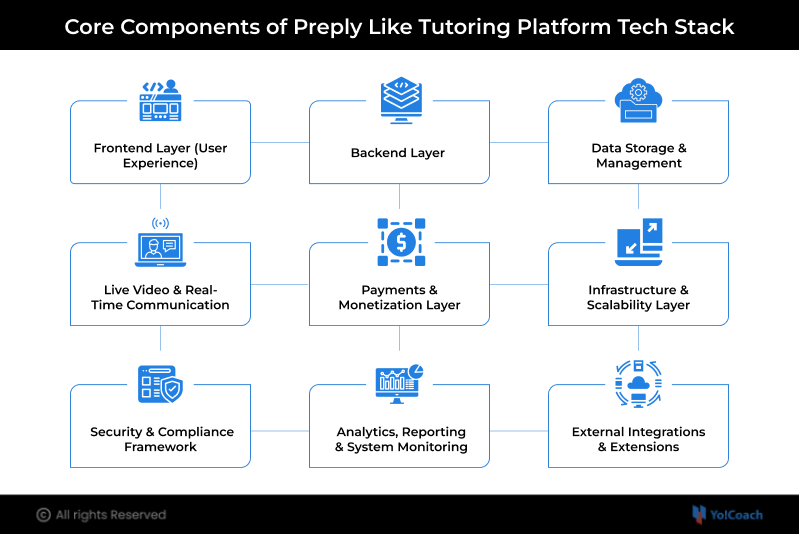
1. Frontend Layer (User Experience)
The frontend is the first impression of your tutoring platform, which represents the visual and interactive layer. It shapes how easily tutors and learners interact with the system, explore profiles, book sessions, and attend classes. A well-crafted frontend reduces friction, improves usability, and directly influences conversion rates, session bookings, and overall user satisfaction.
From a strategic perspective, the frontend should be:
- Fast and responsive across devices
- Easy to navigate for non-technical users
- Optimized for search engines
- Accessible on web and mobile
Core Frontend Responsibilities:
- Tutor discovery through search and filters
- Profile presentation with ratings and reviews
- Scheduling and booking interfaces
- Dashboards for tutors and students
- Secure authentication and onboarding flows
- Responsive design for mobile, tablet, and desktop users
2. Backend Layer
The backend acts as the operational backbone of a Preply-like tutoring platform. It manages data processing, business rules, and communication between different system components. A strong backend enables seamless coordination between users, supports future feature additions, and maintains system stability, making it essential for scalability, reliability, and long-term platform sustainability.
A well-designed backend should be:
- Scalable to handle growing users and sessions
- Modular for easy feature expansion
- Secure to protect sensitive data
Core Backend Responsibilities
- User and role management (admin, tutor, student)
- Availability and scheduling logic
- Booking and session lifecycle management
- Pricing, commissions, and payouts
- Notifications and alerts
- API communication with third-party services
The backend architecture should prioritize performance, reliability, and long-term maintainability
3. Data Storage & Management
An online tutoring marketplace relies heavily on structured and unstructured data to function smoothly. From user interactions to transaction history, every action depends on reliable data handling. An efficient data layer ensures that information remains accurate, secure, and accessible, while also supporting performance optimization and future growth as the platform scales in terms of users, sessions, and content volume.
Types of Data Managed
- User profiles and credentials
- Tutor availability and schedules
- Booking and session history
- Payment and transaction records
- Reviews, ratings, and feedback
- Chat messages and learning resources
A robust data layer should support fast read/write operations, secure storage of sensitive information, and flexibility to scale as the platform grows.
4. Live Video & Real-Time Communication
Live tutoring sessions are an important component of a Preply-like platform. Reliable real-time communication capabilities directly impact learning quality and user satisfaction. Additionally, when sessions run smoothly, students remain engaged, tutors can teach effectively, and the platform builds long-term trust across different devices, locations, and network conditions.
Essential Real-Time Capabilities:
- High-quality video and audio sessions
- Low latency for smooth interaction
- Screen sharing for explanations and demonstrations
- In-session chat and file sharing
- Session recording for review and quality control
The focus should be on delivering a stable and secure live learning experience, even under varying internet conditions and across global regions.
5. Payments & Monetization Layer
Monetization is a critical component of any tutoring marketplace. The payment system must support global transactions while remaining secure and transparent. A well-structured payment system not only simplifies financial operations but also strengthens trust, encourages tutor participation, and supports sustainable revenue generation as the marketplace grows.
Core Payment Capabilities:
- Secure online payments
- Support for multiple currencies
- Automated tutor payouts
- Platform commission management
- Refunds and cancellation handling
- Support for packages, subscriptions, or hourly pricing
A reliable payment layer builds confidence among tutors and students and ensures smooth financial operations for the platform owner.
6. Infrastructure & Scalability Layer
Infrastructure defines how well a tutoring platform performs under growth and peak demand. As user activity increases, the system must remain stable and responsive without service disruptions. A scalable infrastructure enables platforms to expand globally, manage resource usage efficiently, and maintain consistent performance, ensuring long-term operational resilience and a reliable learning experience.
Infrastructure Objectives:
- High availability and uptime
- Ability to scale resources on demand
- Fast content delivery across regions
- Secure storage of media and session data
- Backup and disaster recovery mechanisms
A robust infrastructure enables flexibility, cost efficiency, and global reach for a Preply-like platform.
Turn Your Tutoring Business Idea into a Globally Scalable Business
7. Security & Compliance Framework
Security and compliance are the foundational requirements for online tutoring platforms, as they handle personal information, communications, and financial data. A well-implemented security framework reduces risk, supports regulatory adherence, and builds long-term confidence among students, tutors, and enterprise partners.
Key Security Requirements:
- Encrypted data transmission
- Secure authentication and authorization
- Role-based access control
- Protection against common cyber threats
- Regular system audits
Compliance Considerations
- Data privacy regulations
- Payment security standards
- Child safety and age-related compliance (where applicable)
A strong security framework protects users and enhances platform credibility.
8. Analytics, Reporting & System Monitoring
Analytics and monitoring provide visibility into how the platform is performing from both a technical and business perspective. By analyzing usage patterns and system health, platform owners can identify growth opportunities, improve user experiences, and resolve issues proactively. This data-driven approach enables smarter decisions, operational efficiency, and continuous improvement as the platform scales.
What Should Be Measured:
- User acquisition and engagement
- Tutor performance and retention
- Session success rates
- Revenue and commission trends
- System uptime and error rates
Monitoring tools ensure technical stability, while analytics enable informed business decisions.
9. External Integrations & Extensions
Third-party integrations help extend platform functionality without reinventing the wheel. By connecting with complementary tools and services, the platform can adapt to new requirements, streamline operations, and enhance user experience.
Common Integration Areas:
- Email and notification services
- Calendar synchronization
- Customer support tools
- Marketing and CRM systems
A flexible integration layer allows the platform to evolve with changing business needs.
Challenges of Building a Preply-like Platform from Scratch
Building an online tutoring marketplace entirely from the ground up may appear attractive for full control, but in practice, it introduces multiple strategic, technical, and operational challenges that can slow growth and increase risk.
While the above tech stack sounds achievable, building everything from scratch presents several challenges, such as:
- High development costs
- Long time-to-market
- Complex testing & bug fixing
- Scalability risks
- Ongoing maintenance overhead
This is where ready-made tutoring marketplace solutions become highly valuable, offering a faster, more reliable path to launch and scale.
Yo!Coach: A Ready-Made Solution to Build a Platform like Preply
For entrepreneurs and businesses seeking to enter the online tutoring market quickly, Yo!Coach offers a powerful and efficient alternative to custom development.
It is a ready-made online tutoring marketplace software solution designed specifically to support platforms like Preply.
Why Consider Yo!Coach?
Building a Preply-like platform requires managing multiple technical components, including user management, live video, payments, and scalability. Rather than assembling and maintaining an entire tech stack independently, Yo!Coach offers a pre-built, scalable foundation where essential marketplace features are already integrated. This significantly reduces development time, cost, and technical risk, allowing businesses to launch faster with greater confidence.
Key Capabilities of Yo!Coach
- Tutor & student management
- Advanced search & filtering
- One-on-one and group classes
- Built-in video conferencing integrations
- Secure payment & commission management
- Multi-language and multi-currency support
- Admin dashboard with analytics
- Mobile-responsive design
Simplified Tech Stack with Yo!Coach
Yo!Coach significantly reduces the technical complexity involved in building an online tutoring marketplace by providing a well-structured technology foundation. Instead of managing multiple systems independently, businesses gain access to a proven backend framework and optimized data architecture designed for performance and reliability. It offers:
- Proven backend architecture
- Optimized database design
- Pre-integrated payment gateways
- Ready APIs for video conferencing
- Cloud deployment flexibility
This allows businesses to focus more on marketing, tutor onboarding, and growth strategies, rather than core engineering challenges.
Customization & Scalability with Yo!Coach
A common misconception about ready-made solutions is limited flexibility. Yo!Coach overcomes this by providing complete control over the platform, enabling businesses to tailor features, workflows, and user experiences according to their unique requirements. Yo!Coach addresses this by offering:
- 100% source code ownership
- Custom feature development
- UI/UX customization
- Third-party API integrations
As your tutoring platform grows, Yo!Coach can scale alongside your business needs.
Tutoring and Language Learning Marketplaces Launched with Yo!Coach
Several successful tutoring and language learning platforms have been launched using Yo!Coach, each addressing different educational needs and audience segments. Some of them are mentioned below. Let’s have a look:
- WTutors
WTutors used Yo!Coach to launch a complete tutoring marketplace with tutor onboarding, session scheduling, live video classes, and secure payments. Admin dashboard and analytics helped streamline operations, manage commissions, and scale the marketplace efficiently.
- IntellaTutor
IntellaTutor leveraged Yo!Coach to deliver personalized private tutoring through live virtual classrooms and automated scheduling. Integrated payments and structured session management allowed tutors to focus on teaching while ensuring a smooth and organized learning experience for students.
- Bloom Learning
Bloom Learning built its academic tutoring platform with Yo!Coach to support one-on-one learning with calendar-based scheduling and integrated video sessions. The scalable architecture ensured consistent performance while helping tutors and students manage sessions efficiently.
- FluencyABC
FluencyABC leveraged Yo!Coach to create a flexible language learning platform with live sessions, personalized scheduling, and global accessibility. Multi-language support and secure payment features helped deliver engaging lessons while supporting learner retention and platform growth.
Get a One-on-One Live Demo of Yo!Coach
Build vs Buy: Which Approach Is Right for Your Business?
Choosing between building from scratch and using a ready-made solution impacts cost, timelines, scalability, and risk. This comparison highlights the key differences to support informed decision-making.
| Aspect | Custom Development | Yo!Coach |
| Time to Launch | 6-12 months | 4-8 weeks |
| Initial Cost | High | Cost-effective |
| Scalability | Depends on the architecture | Proven & scalable |
| Maintenance | In-house team needed | Supported |
| Risk Factor | High | Lower |
Final Thoughts
Building an online tutoring website like Preply requires a strategically planned tech stack that brings together frontend design, backend systems, live video streaming, payments, security, and cloud infrastructure. While custom development offers full control, it also demands significant time, budget, and technical expertise.
Hence, for startups and enterprises aiming for faster market entry with reduced risk, Yo!Coach serves as a balanced and reliable solution. It combines the robustness of a proven architecture with the flexibility to customize and scale, making it an ideal choice for launching a Preply-like online tutoring platform.
Frequently Asked Questions (FAQs)
Q 1. What are the core components required to build an online tutoring website like Preply?
Ans. The core components required to build an online tutoring website like Preply include:
- User-facing interface
- Backend business logic
- Secure data storage
- Real-time video communication
- A payment and monetization system
- Scalable infrastructure
- Security and compliance mechanisms
- Analytics, and third-party integrations.
Q 2. Is it necessary to finalize specific technologies at the early planning stage?
Ans. No, it is not necessary to finalize specific technologies at the early planning stage. However, defining functional requirements and system architecture is more important than selecting specific technologies. A strong conceptual foundation allows flexibility to adopt or change technologies as the platform evolves.
Q 3. Why is the business model important before choosing the tech stack?
Ans. The business model determines how tutors and students interact, how revenue is generated, and how trust is built. Thus, you should select the business model before the tech stack, so that it supports these workflows efficiently to ensure scalability, reliability, and user satisfaction.
Q 4. How important is live video functionality for an online tutoring platform?
Ans. Live video is a core feature for an online tutoring platform. High-quality, low-latency communication directly impacts learning outcomes, session continuity, tutor performance, and overall platform credibility.
Q 5. What monetization models are commonly used by platforms like Preply?
Ans. Popular monetization models commonly used by platforms like Preply include:
- Commission-based earnings
- Hourly tutoring fees
- Prepaid lesson packages
- Subscriptions and premium tutor listings.
A flexible monetization layer allows platforms to test and expand revenue streams.
Q 6. How does a tutoring platform handle scheduling and availability?
Ans. Tutoring platforms allow tutors to define their availability, while students can
book sessions in real time. Automated scheduling systems manage time zones, prevent conflicts, and send reminders to reduce cancellations and no-shows.
Q 7. How can scalability be ensured as the platform grows?
Ans. Scalability is achieved through modular system design, cloud-based infrastructure, efficient data handling, and continuous performance monitoring, allowing the platform to handle increased users and sessions smoothly and efficiently.
Q 8. What security measures are critical for online tutoring platforms?
Ans. Essential security measures for online tutoring platforms include:
- Encrypted communication
- Secure authentication
- Role-based access control
- Protected payment processing
- Compliance with data privacy regulations to safeguard user information.
Q 9. How important are reviews and ratings in a tutoring marketplace?
Ans. Reviews and ratings are essential components for building trust and transparency. They help students make informed decisions and encourage tutors to maintain high-quality teaching standards.
Q 10. Is mobile accessibility essential for tutoring platforms?
Ans. Yes, mobile accessibility is essential for tutoring platforms. It ensures that users can attend sessions, manage schedules, and communicate easily from any device, improving engagement and retention.
Q 11. Can a Preply-like platform support both one-on-one and group tutoring?
Ans. Yes, a Preply-like platform can support both one-on-one and group tutoring. A well-designed platform supports multiple learning formats and cohort-based learning to diversify engagement and revenue.
Q 12. Can a readymade software be customized for niche tutoring markets?
Ans. Yes, a readymade software can be customized for niche tutoring markets. The core architecture can be adapted for language learning, exam preparation, coding, music, professional skills, or other niche education segments.
Q 13. What role does the admin dashboard play in managing the platform?
Ans. The admin dashboard acts as a centralized control system, enabling platform owners to manage users, sessions, commissions, disputes, content moderation, and performance reports.
Q 14. Is it possible to add new revenue streams in the future?
Ans. Yes, it is possible to add new revenue streams in the future. A scalable platform allows future monetization options such as subscriptions, certifications, corporate training programs, and premium tutor promotions.
Q 15. Can ready-made solutions handle complex tutoring workflows?
Ans. Yes, ready-made solutions can handle complex tutoring workflows. These solutions are designed to manage scheduling, payments, commissions, live sessions, and user roles efficiently while allowing customization as the platform grows.
Q 16. How does Yo!Coach help reduce development time and risk?
Ans. Yo!Coach offers a pre-built tutoring marketplace architecture with essential features already in place, reducing development time, speeding up launch timelines, and minimizing technical risks.
Q 17. Is Yo!Coach suitable for both startups and enterprises?
Ans. Yes, Yo!Coach is suitable for both startups and enterprises. It is flexible enough for startups launching quickly and robust enough for enterprises looking to scale or modernize their tutoring operations.
Q 18. How long does it take to launch an online tutoring platform using Yo!Coach?
Ans. With Yo!Coach, you can launch your tutoring platforms within a few weeks, depending on customization requirements, which is significantly faster than building a solution entirely from scratch.
Q 19. How can platform owners ensure consistent session quality?
Ans. To ensure consistent session quality, the platform owner should do through tutor verification, performance monitoring, student feedback, analytics, and clearly defined platform guidelines.
Q 20. How does Yo!Coach support long-term scalability and maintenance?
Ans. Yo!Coach is built on a scalable architecture and offers technical support, upgrade options, and customization services. It enables long-term growth without heavy in-house technical management.
Ready to Start Your Preply-Like Tutoring Website?
Get In Touch