

The UK online tutoring market has seen steady growth in the last few years, driven by increased adoption of online learning, strong demand for GCSE and A-Level preparation, professional skill development, and flexible remote education models. From independent tutors and small tuition centres to large multi-subject tutoring agencies, tutoring businesses across the UK are actively investing in tutor management software to streamline operations, improve learner experience, scale efficiently, and support sustainable growth.
Despite this growth, one of the biggest challenges for tutoring businesses is choosing the right tutor management software at the right price. Many tutor management systems initially appear affordable but become expensive as the business expands. Rising subscription fees, per-tutor or per-student charges, commissions, and paid add-ons can significantly increase long-term expenses. This makes it essential to look beyond pricing plans and understand the long-term cost implications before committing to a software.
In this blog, we compare the pricing plans of popular tutor management software used in the UK, explain how different pricing models work, and highlight the key factors tutoring businesses should consider beyond just monthly fees alone. Other than that, you will also explore how Yo!Coach, with its one-time licensing approach, positions itself in the UK market as a scalable and cost-efficient alternative.
Table of Contents
- How Tutor Management Software Pricing Works
- Common Hidden Costs Comparison
- Key Factors to Consider Beyond Price
- Features Included in Base Plans
- Overview of Popular Tutor Management Software in the UK
- Pricing Comparison Table
- Understanding Yo!Coach’s One-Time Licensing Approach
- Cost Comparison: Short-Term vs Long-Term Value
- Why UK Tutoring Businesses Are Moving Away from Subscriptions?
- Final Thoughts
- Frequently Asked Questions (FAQs)
How Tutor Management Software Pricing Works
Before comparing individual platforms, it is important to understand how tutor management software pricing typically works in the UK. Most platforms follow one of several pricing models, each with different cost implications as your tutoring business grows.
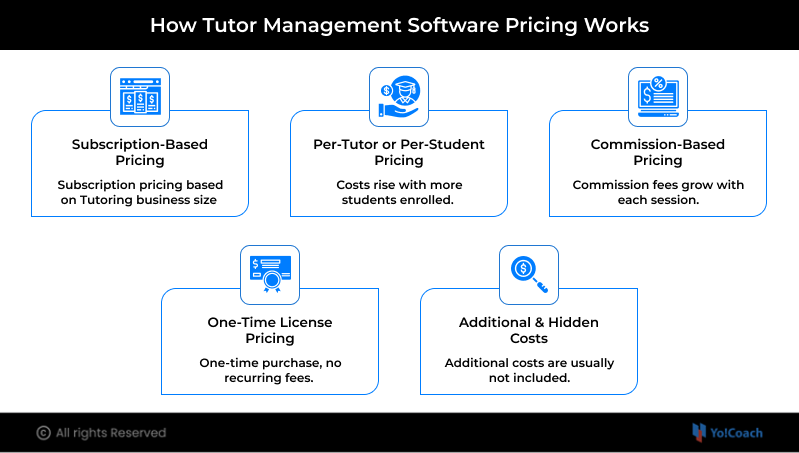
Understanding these models helps avoid unexpected expenses and ensures the software you choose remains cost-effective in the long run.
1. Subscription-Based Pricing
Subscription-based pricing is the most common and widely used model in the UK. Tutoring businesses pay a monthly or annual fee, which is often determined by factors such as:
- Number of tutors
- Number of active students
- Access to advanced features or higher-tier plans
While this model reduces upfront costs, fees tend to increase as your business expands. Over time, what starts as an affordable subscription can become a significant recurring expense.
2. Per-Tutor or Per-Student Pricing
Some platforms charge based on the number of active tutors or enrolled students. While this may seem fair initially, costs can rise sharply as enrolments increase, making it less suitable for fast-growing tutoring platforms. For tutoring businesses planning to scale, this pricing structure can limit growth and make budgeting unpredictable.
3. Commission-Based Pricing
Commission-based platforms take a percentage of each tutoring session or transaction. Although popular with marketplace-style platforms, this model directly reduces margins. As revenue increases, commission fees grow alongside it, impacting long-term profitability.
4. One-Time License Pricing
A one-time license pricing involves a single upfront investment to purchase the software. There are no recurring licensing fees, making this model ideal for businesses that want predictable long-term costs and full ownership.
5. Additional & Hidden Costs
Regardless of the pricing model, tutoring businesses should be aware of the additional costs that are often not included in base plans, such as:
- Payment gateway charges
- Video conferencing integrations
- Branding or white-label fees
- Support, upgrades, and maintenance costs
Want to Avoid Hidden Fees in Tutor Management Software?
Common Hidden Costs Comparison
| Cost Type | Subscription Platforms | Commission-Based Platforms | One-Time License (Yo!Coach) |
| Payment gateway fees | Extra | Extra | Extra |
| Video tools | Paid add-ons | Limited or included | Pre-Integrated |
| Branding/white-label | Paid add-on | Usually unavailable | Included |
| Scaling costs | Increase monthly | Increase per transaction | No increase in cost |
| Data ownership | Platform-controlled | Platform-controlled | Business-owned |
Key Factors to Consider Beyond Price
While pricing plays an important role when choosing tutor management software, it should not be the only deciding factor. For UK tutoring businesses, the true value of a software lies in how well it supports daily operations, future growth, and long-term independence.
Looking beyond monthly fees helps ensure that the platform you choose does not introduce hidden limitations or rising costs as your business scales. Given below are key factors that you should consider beyond pricing:
| Factor | Why It Matters for UK Tutoring Businesses |
| Core features | Avoid paying extra for essential tools |
| Scalability | Enables growth without rising software costs |
| Branding | Builds long-term trust and credibility with learners and parents |
| Data ownership | Ensures full control over business and user data |
| Compliance | Essential for GDPR and UK payment regulations |
Features Included in Base Plans
Some tutor management softwares limit access to key features, such as automated scheduling, invoicing, reporting, or communication tools. These features are often locked behind higher-tier plans, increasing operational costs over time. Thus, edupreneurs should always review what is included in the base plan before selecting or comparing software.
1. Scalability
A solution that works for 20 students may become costly or inefficient when managing 500 students. Pricing should align with future growth plans. Moreover, choosing a scalable solution ensures your platform can grow efficiently.
2. Customisation & Branding
Strong branding helps UK tutoring businesses build trust and credibility with learners, parents, and institutions. Solutions that offer white-label capabilities allow businesses to create a consistent and professional brand experience without restrictions.
3. Data Ownership & Control
Many SaaS platforms retain ownership of user data, limiting flexibility and control. Whereas, self-hosted solutions provide complete control and ownership of user data.
4. UK Compliance
Tutor management software must support GDPR compliance, secure payment processing, and VAT-friendly billing. Ensuring compliance protects your business and builds trust with users.
Overview of Popular Tutor Management Software in the UK
Below is an overview of widely used and popular tutor management software in the UK, with a specific focus on their pricing approach and how it impacts long-term costs, scalability, and business control.
1. Yo!Coach: Pricing Overview
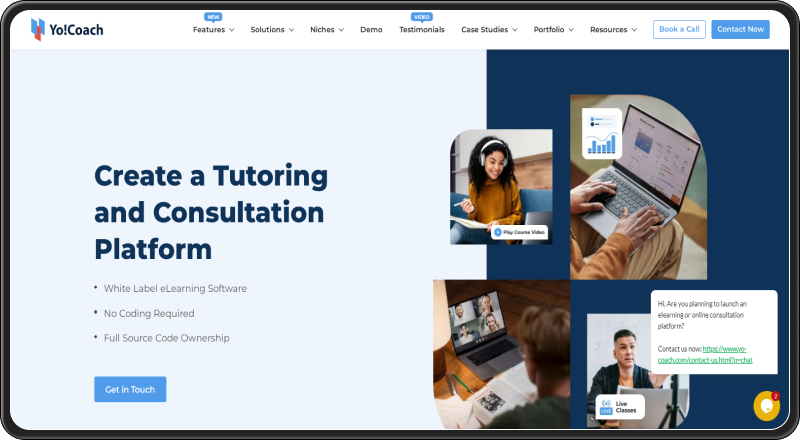
Yo!Coach is a self-hosted tutor management and marketplace software built for businesses that prioritise ownership and long-term cost control.
- Pricing Model: One-time license
- Pricing Structure: Single upfront cost with optional add-ons
- Starting From: £799 one-time fees for life access without any recurring charges (approx. market-standard launch cost)
- Best For: Tutoring startups, academies, and agencies planning to scale
Yo!Coach does not charge monthly, per-tutor, or per-student fees. UK tutoring businesses can scale freely without increasing software cost while maintaining full branding, data ownership, and operational control.
See Yo!Coach in Action
2. TutorCruncher: Pricing Overview
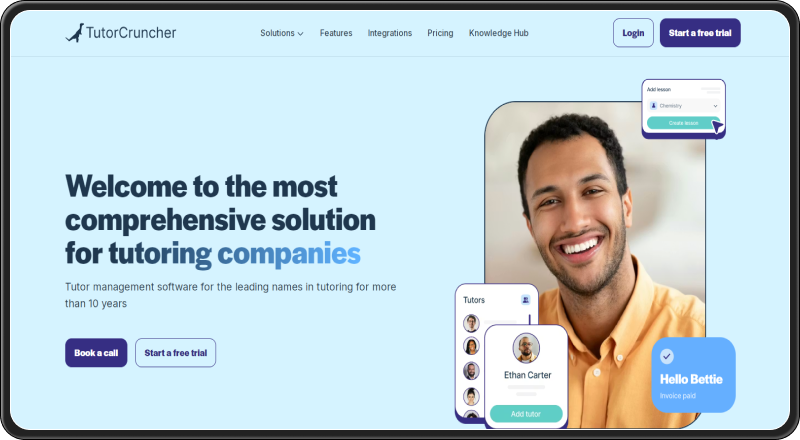
TutorCruncher is a popular UK-based tutor management system commonly used by tutoring agencies with complex administrative workflows.
- Pricing Model: Subscription-based
- Pricing Structure: Monthly fees based on tutor and student volume
- Starting from: £200/month+ for enterprise tiers
- Best For: Admin-heavy tutoring agencies
While the platform offers strong admin/s tools, costs increase as the business grows, and branding flexibility is limited compared to self-hosted solutions.
3. Teachworks: Pricing Overview
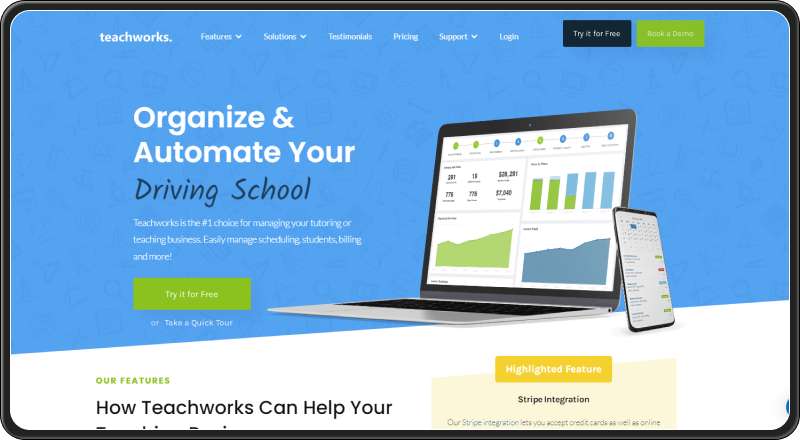
Teachworks follows a per-student pricing structure, making it suitable for smaller tutoring businesses.
- Pricing Model: Per-student subscription
- Starting from: Monthly £148 (£0.05 per student lesson) for enterprise level
- Best For: Small tutoring businesses and small independent tutors
Although affordable initially, pricing can rise quickly as student numbers increase, which may limit scalability for growing platforms.
4. LearnCube: Pricing Overview

LearnCube focuses primarily on delivering online tutoring through virtual classroom delivery.
- Pricing Model: Feature-based subscription
- Starting from: Monthly £99 for Online School Premium, for enterprise level – request for quote
- Best For: Video-focused and live online tutoring services
Advanced functionality often requires higher-tier plans or third-party integrations, which can increase overall costs.
Pricing Comparison Table
| Attribute | Yo!Coach | TutorCruncher | Teachworks | LearnCube |
| Pricing Model | One-time license | Subscription | Per-student | Feature-based |
| Cost Structure | One-time cost | Monthly fees | Monthly fees | Monthly or annual |
| Branding Control | Full | Limited | Limited | Partial |
| Scalability | High | Medium | Low-Medium | Medium |
| Ownership | Full ownership | Platform-based | Platform-based | Platform-based |
Suggested Read: Yo!Coach VS Tutorcruncher: Which is Cost-Effective?
Understanding Yo!Coach’s One-Time Licensing Approach
Yo!Coach follows a one-time licensing model, which sets it apart from most tutor management software in the UK. Instead of paying ongoing subscription or usage-based fees, businesses make a single upfront investment and own the platform entirely.
For tutoring startups, academies, and agencies planning to grow steadily, this model offers greater financial control and operational independence. Since there are no recurring software fees, it makes Yo!Coach is particularly attractive for tutoring startups and agencies with long-term growth plans.
What’s Included in Yo!Coach Pricing
The one-time license includes all core features required to run and scale a professional tutoring marketplace, such as:
- Fully branded tutoring marketplace
- Tutor and student management tools
- Scheduling and booking system
- Secure payments handling and commission management
- Admin dashboard and analytics
Optional costs such as hosting, customisation, or extended support are transparent and optional. There are no hidden charges or mandatory upgrades.
Invest Once and Build a Scalable Tutor Marketplace
Cost Comparison: Short-Term vs Long-Term Value
Instead of looking only at monthly pricing, UK tutoring businesses should evaluate the total cost of ownership over multiple years. Given below is a fresh, software-wise estimated 5-year cost comparison, based on commonly used plans and typical growth scenarios.
Estimated 5-Year Cost Comparison
| Attribute | Yo!Coach | TutorCruncher | Teachworks | LearnCube |
| Pricing Basis | One-time license | Subscription | Per-student subscription | Feature-based subscription |
| Estimated Monthly Cost | One-time investment for lifetime access, starts at £799 | Startup: £60 Enterprise: £200(+ payment processing fees) | Growth: £38 (+£0.15 per student lesson) Premium: £148 (£0.05 per student lesson) | Online School Premium: £99 Enterprise: Request for quote |
| Estimated 5-Year Cost(approx) | Remains the same, no further charges | £3,600-£12,000+(depending upon the pricing tier) | £2,400-£9,000+ | £6,000-£12,000+ |
| Cost Behaviour | Stable and predictable | Increases with tutors and usage | Rises as students grow | Add-ons increase cost |
Note: Costs are indicative and may vary based on usage, features, and business size. Subscription and commission-based platforms often introduce additional costs as scale increases.
What This Comparison Shows
- Subscription platforms appear affordable initially, but compound significantly over time.
- Per-student pricing models become expensive once enrolments grow beyond early stages.
- Commission-based platforms directly impact profitability as revenue increases.
- Yo!Coach’s one-time license keeps software costs fixed, making long-term financial planning easier for growing UK tutoring businesses.
Furthermore, for tutoring startups and agencies planning to operate beyond the short term, evaluating multi-year costs provides a more accurate picture than comparing monthly fees alone.
Why UK Tutoring Businesses Are Moving Away from Subscriptions?
In recent years, UK tutoring businesses have become more cautious about relying on subscription-based tutor management software. While subscriptions offer a low barrier to entry, they often fall short when it comes to long-term scalability, profitability, and operational independence. These factors are key priorities for growing tutoring platforms planning sustained growth.
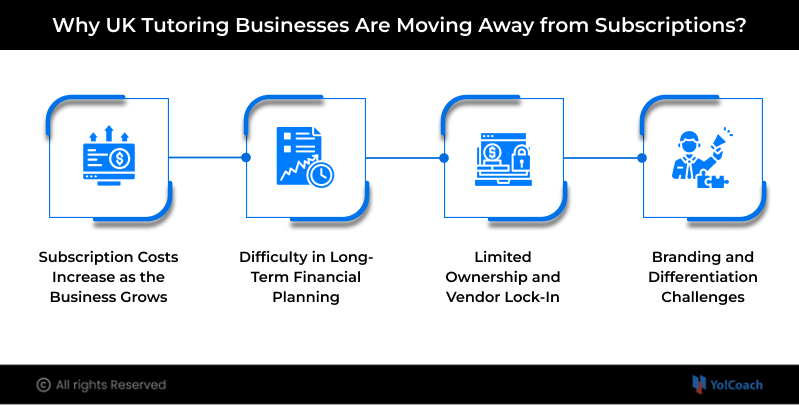
1. Subscription Costs Increase as the Business Grows
Most subscription-based platforms calculate pricing based on the number of tutors, students, classes, or features used. As enrolments grow, monthly fees increase automatically. For UK tutoring businesses experiencing seasonal demands or long-term expansion, this creates a direct cost penalty for growth.
What begins as a £30 to £50 monthly subscription can easily grow into hundreds of pounds per month once additional tutors, students, or premium features are added.
2. Difficulty in Long-Term Financial Planning
Subscriptions make it difficult to forecast costs over multiple years. Many platforms introduce:
- Feature-based upgrades
- Higher-tier plans
- Paid integrations
- Premium support fees
These incremental additions often go unnoticed until annual budgets are reviewed. As a result, UK SMEs and tutoring startups increasingly prefer fixed or predictable cost structures that make financial planning easier.
3. Limited Ownership and Vendor Lock-In
With subscription-based software, businesses are essentially renting access to a platform they do not own. This often results in:
- Limited control over data storage and usage
- Restrictions on custom workflows and integrations
- Dependence on the vendor’s roadmap and pricing changes
Over time, switching software later can involve data migration costs, downtime, and retraining, making it difficult to exit once deeply embedded.
4. Branding and Differentiation Challenges
As the UK tutoring market becomes more competitive, branding plays a critical role in building trust with parents, students, and institutions. Many subscription platforms limit branding flexibility by:
- Restricting white-label options
- Charging extra for brand customisation
- Offering generic user experiences
This makes it difficult for tutoring businesses to establish a strong, independent market presence.
As a result, UK tutoring businesses are re-evaluating their software investments and moving toward solutions that provide cost stability, full branding control, data ownership, and scalability without recurring penalties.
One-time licensed softwares meet these expectations by allowing businesses to invest once and scale freely, aligning software costs with long-term business goals rather than monthly usage.
Suggested Read: 56 Reasons To Choose Yo!Coach Over any other Tutoring Software
Build Your Tutoring Marketplace in a Cost-Effective Manner
Final Thoughts
Choosing tutor management software in the UK is not about finding the lowest monthly price. It is about understanding how pricing models affect your business over time. What appears affordable at the start can become costly as your tutoring platform grows, making it essential to look beyond upfront fees and consider long-term impact.
Subscription and commission-based platforms may work well for short-term needs or individual tutors. However, as tutoring businesses grow, these models often introduce rising costs, limited flexibility, and reduced profitability. A more sustainable approach is to evaluate the total cost of ownership, including multi-year software fees, branding restrictions, scalability expenses, and data control and compliance requirements.
For UK tutoring businesses planning long-term operations, owning the platform rather than renting it offers clear advantages. Moreover, one-time licensed solutions such as Yo!Coach provides predictable costs, full ownership, and the flexibility required to scale without financial pressure. Ultimately, the right choice depends on your growth strategy. But for tutoring startups, academies, and agencies focused on building a scalable and independent brand, prioritising long-term value over short-term affordability leads to more sustainable success.
Frequently Asked Questions (FAQs)
Q 1. What is the average cost of tutor management software in the UK?
Ans. The costs vary depending on the pricing model. Subscription-based platforms usually start with low monthly fees, while one-time licensed solutions require upfront investment. Over time, subscriptions often become more expensive due to user limits, feature upgrades, and add-ons as the business grows.
Q 2. Is Yo!Coach suitable for UK businesses?
Ans. Yes, Yo!Coach is suitable for UK tutoring businesses as it supports GDPR compliance, UK payments, and provides full branding control. Its self-hosted structure also gives businesses complete ownership of data and long-term cost predictability.
Q 3. Which pricing model is best for long-term growth?
Ans. For long-term growth, pricing models with fixed or predictable costs are often more sustainable. One-time licensing avoids rising monthly fees and allows tutoring businesses to scale tutors, students, and sessions without increasing software expenses over time.
Q 4. What is the cheapest tutor management software in the UK?
Ans. The cheapest option in the short term is usually a basic subscription platform designed for solo tutors or very small teams. However, as student numbers grow, per-user fees, feature upgrades, and add-ons can significantly increase costs, making them less economical long term.
Q 5. Is one-time licensed tutor management software better than subscriptions?
Ans. One-time licensed software is often considered better for long-term use because it offers cost predictability, full data ownership, and no recurring license fees. Subscription models, on the other hand, may suit short-term needs but often become costly as the business scales.
Q 6. Do tutor management platforms charge per tutor or per student?
Ans. Yes, many UK tutor management systems charge per tutor or per student, which directly increases costs as your platform grows. However, this pricing model works for small operations but may limit scalability for growing tutoring businesses.
Q 7. Are commission-based tutoring platforms profitable?
Ans. Commission-based tutoring platforms are convenient for launching quickly, but they reduce profit margins as revenue increases. Moreover, paying a percentage of every transaction can significantly impact profitability compared to owning your own platform with fixed software costs.
Q 8. Can I switch tutor management software later?
Ans. Yes, you can switch tutor management software later, but switching platforms can involve data migration challenges, downtime, and retraining costs. Thus, choosing a scalable and flexible solution early can reduce future operational disruptions.
Q 9. Does tutor management software support UK payment methods?
Ans. Most UK-focused platforms support Stripe, PayPal, and card payments. Self-hosted solutions like Yo!Coach allows businesses to integrate preferred gateways and manage VAT and invoicing more efficiently.
Q 10. Is tutor management software suitable for both online and offline tutoring?
Ans. Yes, modern tutor management softwares support online sessions, in-person tutoring, hybrid models, automated scheduling, invoicing, and payment tracking for all formats.
Q 11. What features should UK tutoring businesses prioritise?
Ans. Key features that a UK tutoring business should prioritise include:
- Tutor & student management
- Automated scheduling
- Secure payments
- Reporting & analytics
- GDPR compliance
- Branding & customisation
- Scalability without rising costs
Q 12. Why are UK tutoring businesses choosing self-hosted platforms?
Ans. UK tutoring businesses prefer white-label self-hosted platforms for greater data control, branding freedom, long-term savings, and independence from recurring SaaS fees. This approach supports scalability and helps businesses build strong, independent tutoring brands.
Ready to Launch a Tutoring Platform Suitable for the UK Market?
Get In Touch