
Managing tutors, scheduling lessons, processing payments, and tracking learner progress all require software built specifically for tutoring businesses. This comparison reviews solutions, including Yo!Coach, TutorCruncher, Teachworks, SimplyBook.me, and Class Manager, highlighting how each solution supports operational efficiency and business growth. The comparison helps tutoring organizations choose technology that aligns with their management needs.
As we move through 2026, the global education sector is undergoing a noticeable shift. What was once a scattered mix of private tutors, neighborhood learning centers, and disconnected digital tools is now consolidated into centralized, high-performance marketplaces. These platforms have become modern hubs of learning, where a student in a small town can connect with a highly specialized tutor anywhere in the world within seconds. Access to expertise is no longer limited by geography, and technology is reshaping how knowledge is discovered, delivered, and consumed.
At the same time, tutoring has evolved far beyond a side income or supplementary service. It is now a core pillar of the global service economy. The continued rise of remote work, cross-border careers, and skills-based hiring has fueled unprecedented demand for personalized, one-on-one instruction. Parents, professionals, and lifelong learners are increasingly moving away from rigid, standardized education models in favor of flexible learning experiences tailored to individual goals, schedules, and outcomes.
This shift has given rise to a new generation of education-focused entrepreneurs. These edupreneurs understand that success in today’s tutoring market depends not only on the quality of teaching but also on the efficiency and scalability of the platform delivering it. By building technology-driven tutoring marketplaces, they are transforming education into structured, commission-based businesses that can grow globally while maintaining consistent quality and learner trust.
Table of Contents
- What is Tutor Management Software?
- Key Features to Look for in 2026
- Types of Tutor Management Software: Self-Hosted Vs SaaS
- Best Tutor Management Software Detailed Comparison
- Comparison Table : Top Tutor Management Software
- How To Choose Your Tutor Management Software – A 2026 Guide
- Why Yo!Coach Is the Best Tutor Management Software in 2026
- Final Verdict: The Path Forward
- FAQs
What is Tutor Management Software?
In the professional marketplace landscape of 2026, Tutor Management Software (TMS) has evolved far more than a simple scheduling or record-keeping tool. It is the core operational engine of a multi-vendor tutoring business, enabling seamless coordination between users, payments, sessions, and platform governance. At its core, TMS provides the technical foundation required to manage scale, maintain quality, and support trust across a dynamic learning ecosystem.
Defining the Marketplace Context
While an individual tutor may rely on a basic app to organise lessons or track their students, a TMS (Tutor Marketplace Software) is built to manage the relationship between three stakeholders, each with distinct roles and responsibilities:
1. The Admin (The Platform Owner): Responsible for defining marketplace rules, onboarding and approving tutors, configuring commissions, and overseeing platform performance, compliance, and user safety.
2. The Tutor (The Vendor): Operates an independent profile or micro-storefront, sets availability and pricing, manages bookings, and delivers live tutoring sessions through the platform.
3. The Student (The Consumer): Discovers tutors through search and filters, evaluates profiles and reviews, books sessions, completes secure payments, and participates in live classes.
Key Features to Look for in 2026
To build a competitive tutoring platform in 2026, your software must cover a set of non-negotiable capabilities. Even a single gap can lead to platform leakage, where tutors and students take their interactions off-platform to avoid friction or fees. The strongest platforms are those that remove obstacles, build trust, and keep every interaction seamless from discovery to payment. Let’s have a look at the key features:
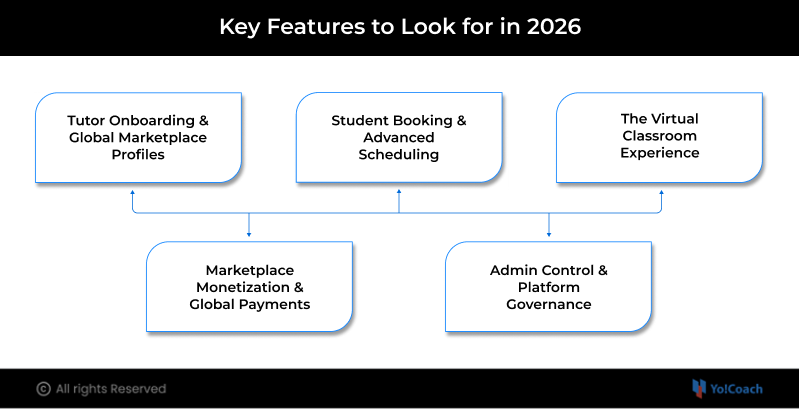
1. Tutor Onboarding & Global Marketplace Profiles
A tutoring platform is only as strong as the talent it attracts and retains. Effective onboarding and rich profiles help establish credibility from the first interaction.
- Structured Verification: It ensures tutors move through a multi-step application process, uploading identity documents and certifications for manual admin approval, which protects platform quality and trust.
- Rich Profiles: This enables tutors to present themselves professionally through video introductions, dynamic skill tags such as exam preparation or child-friendly teaching, and verified credentials displayed as digital badges.
- SEO-Ready Pages: Every tutor profile should be an indexable, fast-loading web page that can rank on search engines, bringing organic traffic to your platform.
- Smart Filtering: Advanced search filters allow students to sort by price range, language fluency, availability windows, and specific niche expertise.
2. Student Booking & Advanced Scheduling
The scheduling system acts as the nervous system of the entire platform. Any inefficiency here directly impacts user satisfaction.
- Real-Time Synchronization: It allows calendars to integrate seamlessly with Google, Outlook, and Apple, preventing double bookings and scheduling conflicts.
- Time-Zone Integrity: This feature ensures session times are translated accurately across regions, accounting for daylight savings and eliminating confusion for global users.
- Package vs. Hourly Booking: This gives tutors the flexibility to sell single sessions or discounted lesson bundles, increasing long-term engagement and lifetime value per student.
- Automated Reminders: SMS and email notifications sent at 24-hour and 1-hour intervals help reduce no-shows by prompting students ahead of their scheduled sessions.
3. The Virtual Classroom Experience
Modern virtual classrooms have moved far beyond basic video calls. They are now interactive and collaborative, designed to support real learning outcomes.
- In-Browser HD Video: Utilizing WebRTC technology for zero-download, high-fidelity video that works on any browser or device.
- Integrated Whiteboard: Professional tools for math symbols, chemical formulas, and collaborative drawing with the option to export session materials as PDFs.
- Code Editors & File Sharing: Essential for the massive coding-tutor market, allowing real-time collaborative programming with syntax highlighting.
- Session Recording: Automatic recording with cloud storage, allowing students to review lessons and admins to audit for quality assurance and dispute resolution.
4. Marketplace Monetization & Global Payments
This is where a tutoring marketplace transforms into a scalable business.
- Split-Payment Logic: Using gateways like Stripe automatically divides payments between tutors and the platform in real time, removing manual accounting and delays.
- Escrow Systems: Money is held securely in a virtual wallet and only released to the tutor once the session is marked as completed by the student or the time elapses.
- Multi-Currency & Localized Payments: Support for credit cards, digital wallets, such as Apple Pay, Google Pay, and even region-specific methods like Pix (Brazil) or UPI (India).
- Subscription Models: The option enables recurring revenue by allowing students to pay monthly for a defined number of sessions, creating predictable income streams.
5. Admin Control & Platform Governance
For platform owners, visibility and control are essential to maintain quality and prevent abuse.
- Tutor Approvals & Moderation: A centralized system for reviewing applications and enforcing platform policies.
- Dispute Handling: A structured portal where admins can review session recordings, chat logs, and payment history to settle refund requests fairly.
- Commission Configuration: Flexible settings to change commission rates globally or for specific high-performing tutors.
- CMS & Content Control: A built-in Content Management System empowers admins to manage landing pages, blogs, and FAQs without technical assistance, supporting ongoing growth and SEO.
Built a Feature-Packed Tutoring Marketplace
Types of Tutor Management Software: Self-Hosted Vs SaaS
This is one of the most critical decisions an edupreneur will make. The choice between SaaS and self-hosted software directly impacts long-term profitability, operational control, and even how attractive the business becomes to investors or tutors.
1. Self-Hosted/White-Label Software
Self-hosted solutions such as Yo!Coach follows a license-based ownership model. Instead of paying ongoing subscription fees, you purchase the software once and deploy it on your own server or hosting environment.
- The Benefit for Edupreneurs: There are no recurring fees tied to tutor count, student volume, or transaction value. You retain full ownership of your data, branding, and codebase, allowing you to customize the platform to match your exact business vision.
From an investment standpoint, owning your technology stack turns the platform into a true digital asset rather than a rented tool, making the business far more attractive.
2. SaaS (Software as a Service)
SaaS platforms such as TutorCruncher or Teachworks operate on a subscription-based, rental model. You pay a recurring monthly or annual fee to access their infrastructure, features, and updates. For early-stage tutoring businesses, this can feel convenient because setup is fast and upfront costs are low.
- Limitations: Most SaaS platforms charge based on the number of tutors, sessions, or a percentage of your total revenue. Hence, as your marketplace expands from a handful of tutors to hundreds or thousands, software costs increase in parallel, often consuming budgets that could otherwise be invested in marketing or user acquisition.
In addition, SaaS platforms lock you into their ecosystem. Pricing changes, feature removals, or policy updates are outside your control, leaving little room to adapt as your business evolves.
Best Tutor Management Software Detailed Comparison
Choosing the right tutor management software in 2026 is a strategic decision that directly impacts scalability and profitability. With tools ranging from simple tutor apps to full marketplace platforms, understanding what each solution is built for is essential before making a long-term choice. Let’s explore some of the top Tutor Management Software:
1. Yo!Coach
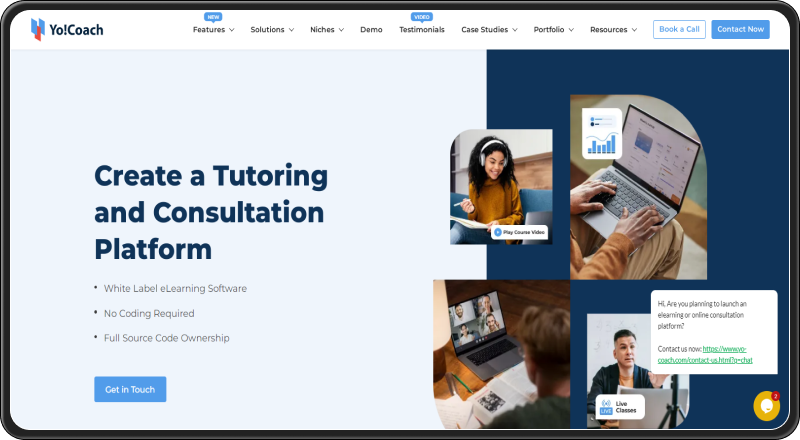
Yo!Coach is a purpose-built tutor marketplace software designed specifically for launching and scaling one-to-one tutoring marketplaces. Unlike tools adapted from LMS or agency management systems, its architecture is marketplace-first, by design. It supports multi-vendor operations, independent tutor profiles, commission-based monetization, and centralized admin control from the outset. As a self-hosted solution, Yo!Coach gives platform owners full ownership of their data, codebase, and branding, making it well-suited for edupreneurs aiming to build a scalable, global tutoring marketplace without recurring SaaS constraints.
- #1 Choice: Yo!Coach is engineered to handle the high-traffic demands of global platforms, managing the complete lifecycle from tutor onboarding and session bookings to automated payouts.
- Monetization Flexibility: It supports one-to-one sessions, group classes, and even digital products such as downloadable study materials, enabling hybrid revenue models.
- Customization & Scalability: With access to the customizable source code, platform owners can develop niche-specific features, whether for test prep, medical tutoring, or professional coaching.
- Why it’s for Edupreneurs: By removing usage-based or revenue-linked fees, it eliminates the success tax. Whether you serve 100 or 10,000 students, software costs remain stable, improving margins as you scale.
Schedule One-on-One Personalized Demo to See Yo!Coach in Action
2. TutorCruncher
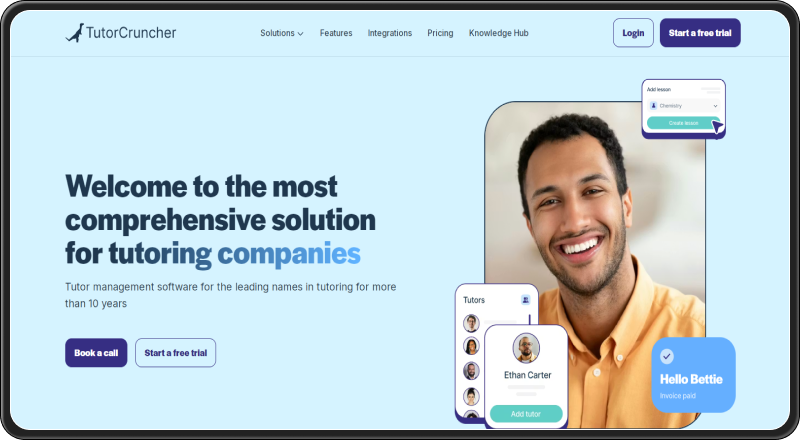
TutorCruncher began as a back-office management system for tutoring agencies and education businesses. The software is built around administrative efficiency, offering tools for scheduling, CRM, invoicing, payroll, and reporting. Its architecture assumes a managed business model where the platform owner controls pricing, tutors, and customer relationships.
- Admin-Focused Features: Strong support for payroll processing and complex reporting needs typical of traditional agencies.
- Scalability Challenges: For open, public-facing marketplaces, the interface can feel restrictive, and pricing models tied to sessions or revenue may become costly as volume grows.
3. LearnWorlds
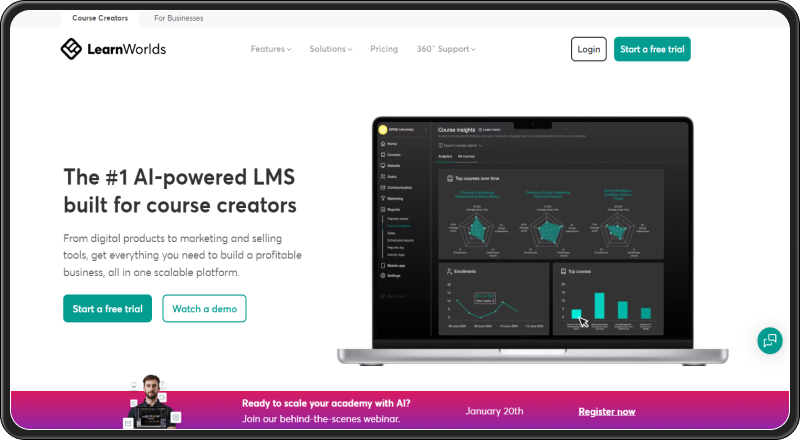
LearnWorlds is a course-centric learning management system (LMS) that has expanded to support live sessions and instructor-led learning. Its software architecture is optimized for creating and delivering structured educational content such as video courses, learning paths, and communities. While LearnWorlds can support multiple instructors, it is not natively designed as a tutor marketplace.
- Strengths: Advanced tools for creating interactive courses and managing learning communities.
- Marketplace Gaps: It lacks native multi-vendor onboarding, public tutor discovery, and independent storefront management, making it less suitable for large tutoring marketplaces.
4. Teachworks
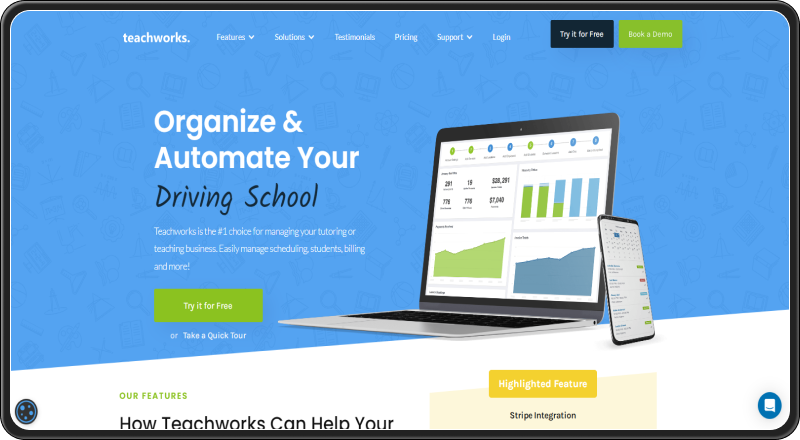
Teachworks is best described as a traditional tutoring operations platform designed to help tutoring centers organize lessons, manage tutor schedules, and handle billing processes. The software emphasizes stability and structured workflows, making it effective for managing a fixed team of tutors under centralized control.
- Operational Strengths: It is excellent for managing schedules and payments for local or centralized tutoring teams.
- Limited Flexibility: It does not offer the discovery, filtering, or public profiles required for peer-to-peer or global marketplaces.
5. TutorBird
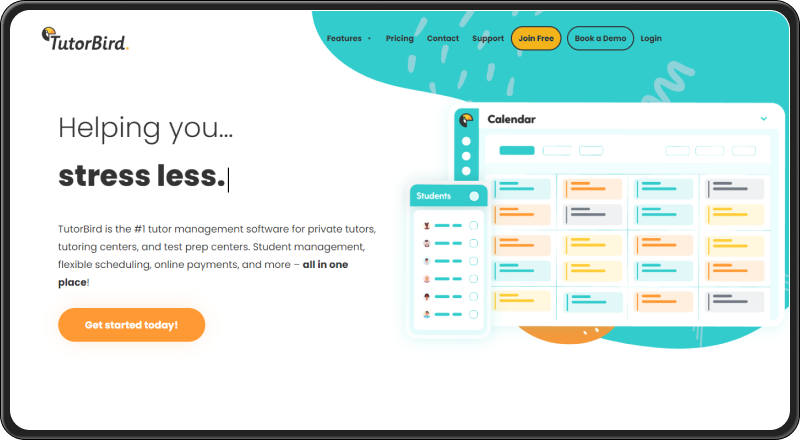
TutorBird is a lightweight tutor management tool built to simplify daily operations for individual tutors and small tutoring teams. It focuses on essential features such as lesson scheduling, student management, and basic billing, prioritizing ease of use over advanced functionality.
- Best Use Case: Ideal for solo tutors managing a limited number of students.
- Marketplace Verdict: It is not built for large marketplaces as it has no mechanism for third-party tutors to register and pay you a commission.
6. Pinlearn
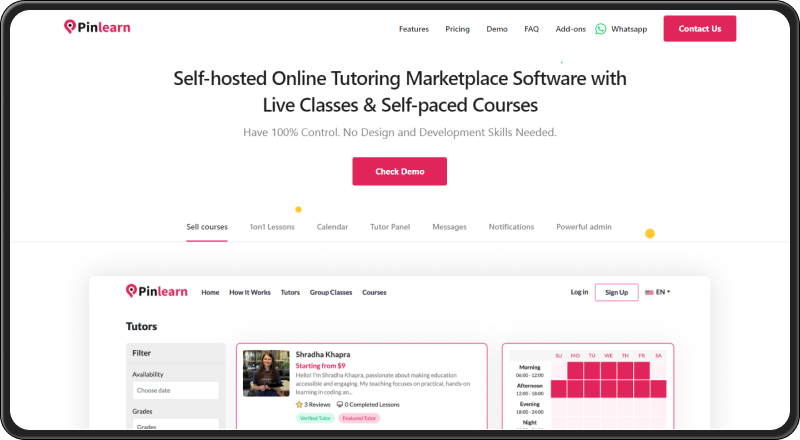
Pinlearn is a self-hosted tutoring marketplace software that offers entrepreneurs a one-time purchase alternative to SaaS platforms. The software includes core marketplace components such as tutor listings, scheduling, live classes, and payment integration.
- Strengths: Supports both one-to-one and group tutoring models.
- Weaknesses: While functionally capable, the user interface (UI) and user experience (UX) have historically trailed behind market leaders. In 2026, when students expect a high-end experience, a weak UI can result in high churn rates.
Suggested Read: Yo!Coach VS Pinlearn
7. Wise

Wise is a modern education solution that combines live class delivery with learning management capabilities, positioning itself as a hybrid LMS and tutoring solution. The software is designed to enhance real-time engagement through interactive classrooms, attendance tracking, and performance analytics.
- Live Class Tools: Features such as auto-attendance and engagement tracking are well executed.
- LMS + Tutoring Hybrid: It functions better as a virtual school or cohort-based learning platform than as an open tutoring marketplace, with less emphasis on tutor discovery and independent vendor payouts.
Comparison Table : Top Tutor Management Software
| Attribute | Yo!Coach | TutorCruncher | LearnWorlds | Pinlearn | Wise (Wise.live) | Teachworks |
| Deployment Type | Self-Hosted | SaaS | SaaS | Self-Hosted | SaaS | SaaS |
| Marketplace Support | Excellent | Good | Limited | Moderate | Moderate | None |
| Commission Management | Fully Automated | Semi-Manual | Restricted | Built-in | Basic | Not Applicable |
| Customization Level | High | Medium | Medium | Low to Medium | Low | Low |
| Pricing Model | One-time License | Monthly + Usage Fees | Subscription | One-time License | Subscription | Subscription |
| Best Fit For | Scale-focused Edupreneurs | Tutoring Agencies | Course Creators | Budget-Friendly Startups | Hybrid Learning Schools | Small Tutoring Teams |
How To Choose Your Tutor Management Software – A 2026 Guide
Choosing tutor management software is a long-term commitment that shapes how your platform grows, scales, and operates. Migrating systems after you have hundreds or thousands of students is complex, expensive, and disruptive. To avoid costly rework later, evaluate your options based on:
1. Your Business Model
Start by defining how your tutoring marketplace will operate and generate revenue. Decide whether you are building a commission-based marketplace, a subscription-driven platform, or a hybrid model. Your choice will determine how tutors are onboarded, how pricing is handled, and what level of control the admin requires, making it critical to select software aligned with this structure.
2. Mobile Strategy
By 2026, over 75% of tutoring interactions occur on mobile. Make sure the software delivers a mobile-first experience, whether through a Progressive Web App or a native-feeling interface. If booking or attending sessions feels clunky on mobile, user adoption and retention will suffer.
3. API and Customization
As your platform grows, you will need to connect external tools such as CRMs, email marketing platforms, analytics systems, or payment services. Confirm that the software offers a robust API or built-in integrations to support this flexibility. Customization is not just about design; it is about ensuring your platform can evolve with your business instead of limiting it.
Why Yo!Coach Is the Best Tutor Management Software in 2026
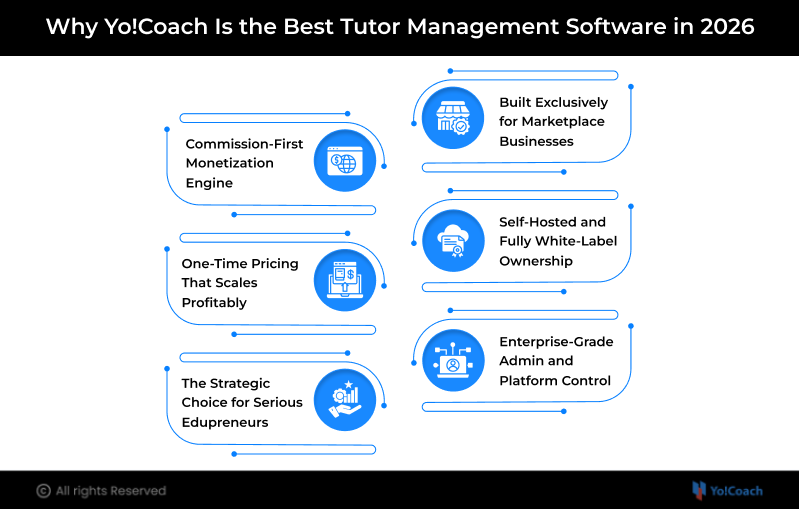
In 2026, the success of a tutoring marketplace depends on far more than basic scheduling or video calls. The real competitive edge lies in how quickly a platform can launch, how efficiently it can scale, and how well costs remain controlled as usage grows. This is where Yo!Coach plays a defining role. Designed specifically for marketplace-driven tutoring businesses, Yo!Coach enables edupreneurs to compete with well-funded global platforms by providing the infrastructure needed for sustainable, large-scale growth from day one.
1. Built Exclusively for Marketplace Businesses
Yo!Coach is not a traditional LMS or agency management system with marketplace features added later. Its entire architecture is built around multi-vendor marketplace logic, where independent tutors operate as sellers and students act as buyers. From tutor onboarding and profile creation to public discovery, bookings, and payouts, every workflow is natively marketplace-driven. This results in smoother operations, fewer technical constraints, and a platform that scales naturally as tutor and student numbers increase.
2. Commission-First Monetization Engine
Monetization sits at the core of Yo!Coach’s design. The solution generates revenue from the very first transaction through automated commission splitting, flexible pricing controls, and support for multiple selling formats. Tutors can offer single sessions, prepaid lesson bundles, or group classes, while commissions are calculated and distributed automatically. This reduces manual effort, minimizes disputes, and delivers predictable revenue growth.
3. Self-Hosted and Fully White-Label Ownership
In a market where SaaS platforms frequently change pricing, restrict features, or limit data access, Yo!Coach offers a clear strategic advantage through full ownership. As a self-hosted, white-label solution, it allows edupreneurs to build an online tutoring platform on their own domain with complete control over branding, data, and functionality. There are no vendor lock-ins or forced upgrades, making the platform a long-term digital asset rather than a rented tool.
4. One-Time Pricing That Scales Profitably
Unlike subscription-based software that becomes more expensive as your platform grows, Yo!Coach follows a one-time licensing model. There are no recurring fees tied to tutor count, session volume, or revenue percentages. As your marketplace scales to hundreds or thousands of tutors, software costs remain fixed, allowing margins to improve over time.
5. Enterprise-Grade Admin and Platform Control
Running a global tutoring marketplace requires more than basic dashboards. Yo!Coach equips platform owners with enterprise-grade admin tools to manage large tutor networks, oversee global transactions, resolve disputes, and analyze performance in real time. From commission tracking and payouts to tutor verification and revenue analytics, every control is built to support scale without compromising oversight.
6. The Strategic Choice for Serious Edupreneurs
When evaluated across scalability, monetization, ownership, and long-term cost efficiency, Yo!Coach stands out as one of the most future-ready tutor management solutions in 2026. It is built for edupreneurs who want to launch, grow, and lead a full-scale tutoring marketplace.
Launch Your Own Scalable Tutoring Marketplace
Final Verdict: The Path Forward
The tutoring industry of 2026 is no longer defined solely by who teaches best, but by who delivers learning in the most effective way. For small, tightly managed operations, tools like TutorBird or Teachworks can meet basic needs. Course creators focused on structured, pre-recorded content will continue to find strong value in LearnWorlds. However, for marketplace edupreneurs aiming to build a scalable, independent, and high-value tutoring brand, Yo!Coach stands out as the most future-ready option.
FAQs
Q 1. Is Yo!Coach suitable for building a Preply-like or Tutor.com-style platform?
Ans. Yes, Yo!Coach suitable for building a Preply-like or Tutor.com-style platform. It supports multi-vendor tutor listings, advanced search and filtering, global payments, automated commissions, and scalable admin controls required for high-volume, public-facing tutoring marketplaces.
Q 2. What business models does Yo!Coach support?
Ans. Yo!Coach supports commission-based marketplaces, hybrid models combining one-to-one and group sessions, prepaid lesson packages, subscription-based tutoring, and digital product sales. This flexibility allows platform owners to diversify revenue streams, experiment with pricing strategies, and adapt the business model as learner behavior and market demand evolve.
Q 3. Is Yo!Coach a SaaS or self-hosted solution?
Ans. Yo!Coach is a self-hosted, white-label solution. Platform owners retain full ownership of the software, data, and branding, without dependency on recurring SaaS subscriptions. This model provides greater control, long-term cost predictability, and freedom to customize or scale the platform.
Q 4. What are the benefits of Yo!Coach’s one-time pricing model?
Ans. With one-time pricing, Yo!Coach eliminates recurring subscription costs that increase as your platform scales. As the platform scales, software costs remain fixed, allowing profitability to improve over time and ensuring predictable financial planning for long-term marketplace growth.
Q 5. Does Yo!Coach include a built-in virtual classroom?
Ans. Yes, Yo!Coach includes built-in virtual classrooms for both one-to-one and group sessions. Features such as in-session chat, file sharing, lesson history, and session recordings help improve learning quality, support accountability, and provide transparency for students, tutors, and platform administrators.
Q 6. Can Yo!Coach be customized for niche tutoring marketplaces?
Ans. Yes, Yo!Coach allows extensive customization to support niche tutoring verticals such as language learning, exam preparation, coding education, medical tutoring, or professional coaching. Platform owners can tailor workflows, features, and user experiences to match specific industry requirements.
Q 7. Does Yo!Coach integrate with third-party tools?
Ans. Yes, Yo!Coach supports APIs and third-party integrations, enabling platform owners to connect CRMs, email marketing platforms, analytics tools, and payment gateways. This ensures the platform can evolve alongside the business and integrate seamlessly into a broader technology ecosystem as operations scale.
Ready to Build a Global Tutoring Platform?
Get In Touch