
The global education industry has transformed significantly over the last decade. Traditional classroom-based tutoring is steadily being replaced by flexible, technology-driven online learning models. Today, students expect instant access to tutors, seamless booking experiences, automated reminders, and smooth virtual sessions, all delivered through a professional, branded interface.
For entrepreneurs and education businesses looking to start an online tutoring business, one of the biggest operational challenges is managing tutor availability, student bookings, payments, and schedules efficiently. Relying on spreadsheets, emails, or messaging apps quickly becomes inefficient and difficult to scale. This is where Tutor Scheduling Software becomes essential.
Among the available options in the market, white-label tutor scheduling software has emerged as a powerful, cost-effective, and fast-to-market solution. Instead of spending months or years on building a platform from scratch, businesses can launch a fully branded tutoring platform equipped with advanced scheduling and management capabilities.
This blog provides a complete, in-depth look at white-label tutor scheduling software, what it is, why it’s booming in 2026, how it compares to custom-built systems, the features you should look for, pricing models, and more.
Table of Contents
- What Is a White-Label Tutor Scheduling Software?
- Rise of White-Label EdTech Solutions in 2026
- White-Label vs Custom-Built Scheduling Software for Tutoring Businesses
- Must-Have Features in a White-Label Tutor Scheduling Software
- Key Scheduling Challenges in Tutoring Businesses
- White-Label Tutor Scheduling Software Pricing Models Explained
- Best White-Label Tutor Scheduling Software: Yo!Coach
- Conclusion
What is a White-Label Tutor Scheduling Software?
White-label tutor scheduling software is a ready-made, fully functional online tutor scheduling solution that allows education businesses to rebrand and customize it to match their business requirements. The software is developed and maintained by a technology provider, while you rebrand, customize, and operate it under your own brand name.
Unlike generic scheduling tools, white-label tutor scheduling software is built specifically for the online tutoring ecosystem. It enables seamless tutor availability management, student booking, class scheduling, automated notifications, payment processing, and often virtual classroom integrations, all within a single system.
Key Characteristics of White-Label Tutor Scheduling Software
- Complete branding control with custom logo, domain, colors, and interface
- Pre-built tutor scheduling workflows designed for tutors and students
- Centralized admin dashboard to manage users, sessions, and revenues
- Scalable architecture designed for growth and global expansion
- Complete ownership of customers’ data and platform operations
For businesses looking to start or scale an online tutoring platform quickly, white-label tutoring solutions remove the technical complexity while providing enterprise-grade functionality, scalability, and flexibility.
Rise of White-Label EdTech Solutions in 2026
The demand for white-label EdTech solutions, particularly tutor scheduling software, has accelerated significantly in 2026. Shifts in learning behaviour, rising technology costs, and the need for faster launches are pushing education businesses toward ready-made, scalable platforms.
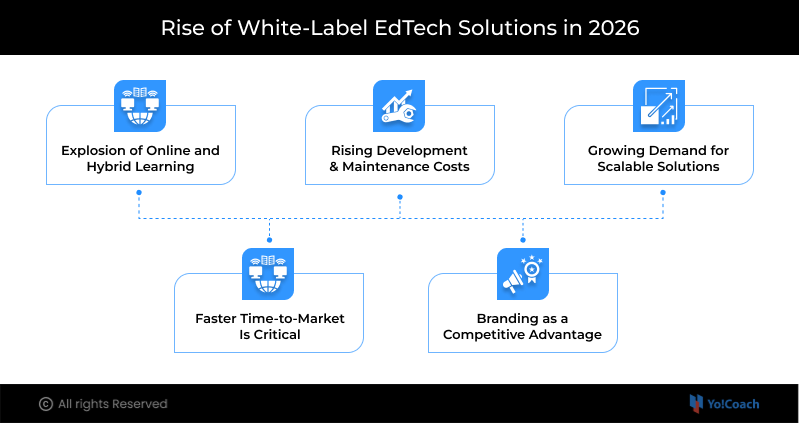
1. Explosion of Online and Hybrid Learning
Digitalization has changed the learning habits permanently. Students, parents, and working professionals now prefer flexible learning schedules that fit around work, school, and personal commitments. Moreover, online tutoring has become mainstream across K-12 education, test prep, language learning, and corporate training.
To keep up with this increasing demand, tutoring businesses need robust digital platforms, something white-label solutions offer instantly without long development cycles.
2. Faster Time-to-Market Is Critical
Competition in the EdTech space is intense. Building custom software can take 12-18 months and requires substantial investment. White-label tutor scheduling software enables businesses to launch an online tutoring platform within weeks, helping them enter the market faster and stay ahead of competitors.
3. Rising Development and Maintenance Costs
Custom development is no longer just about building software. Ongoing maintenance, security updates, feature enhancements, and compatibility require continuous investment. White-label solutions offload this burden to experienced software providers, reducing both cost and operational risk.
4. Branding as a Competitive Advantage
Modern learners associate trust and quality with polished digital experiences. A polished, consistent, and professional platform builds trust and credibility. White-label EdTech solutions allow tutoring businesses to deliver a fully branded experience that looks custom-built, without the associated development cost.
5. Growing Demand for Scalable Solutions
As tutoring businesses expand globally, scheduling across time zones, managing multiple tutors, and handling peak demand becomes complex. White-label EdTech solutions are built with scalability in mind, making it easier to grow without operational bottlenecks.
Turn Your EdTech Idea Into a Live Platform
White-Label vs Custom-Built Scheduling Software for Tutoring Businesses
One of the most important decisions tutoring entrepreneurs face is whether to build custom scheduling software or adopt a white-label solution. While both approaches have their advantages, white-label tutor scheduling software often proves to be the more practical and scalable choice. Below is a clear comparison highlighting why white-label software is often the smarter choice.
Comparison Table: White-Label vs Custom-Built Tutor Scheduling Software
| Aspect | White-Label Tutor Scheduling Software | Custom-Built Software |
| Development Time | 2–6 weeks | 6–18 months |
| Initial Cost | Low to moderate | Very high |
| Maintenance | Handled by the provider | Owner’s responsibility |
| Feature Readiness | Pre-tested, industry-ready | Built gradually |
| Scalability | Built-in | Requires re-engineering |
| Security & Updates | Regular updates included | Additional cost |
| Risk Level | Low | High |
| Branding | Fully customizable | Fully customizable |
Why White-Label Makes More Sense
White-label tutor scheduling software offers a proven framework shaped by real-world usage. Instead of experimenting with untested features, businesses gain access to stable, optimized workflows that are already refined for tutoring operations.
Custom-built software may seem appealing due to full control, but it often leads to delays, cost overruns, and ongoing technical challenges. Hence, for most tutoring businesses, especially startups and mid-sized organizations, white-label solutions offer the perfect balance between customization, cost efficiency, speed, and long-term reliability.
Must-Have Features in a White-Label Tutor Scheduling Software
A successful online tutoring platform must deliver a smooth experience for all th stakeholders. Students want simplified workflow, tutors need flexibility, and admin/s require complete control. A robust solution should cater to all stakeholders. Given below are some features that a white-label tutor scheduling software must have:
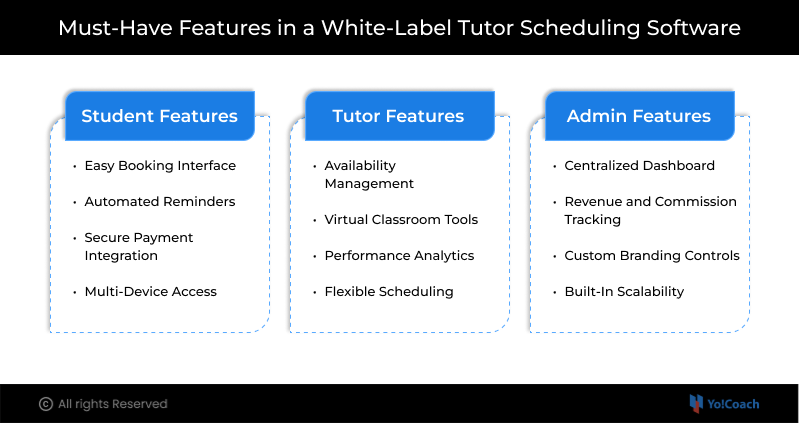
For Students
Students expect a frictionless booking experience that saves time and reduces confusion. The right features help improve satisfaction and retention.
- Easy Booking Interface: A simple, intuitive calendar that allows students to browse tutor availability and book sessions in just a few clicks.
- Automated Reminders: Notifications via email/SMS to remind students of upcoming sessions and reduce missed classes.
- Secure Payment Integration: Secure and flexible payment options for per-session bookings, packages, or subscriptions.
- Multi-Device Access: A responsive, mobile-friendly design that allows students to book and attend sessions from any device.
For Tutors
Tutors need tools that help them manage time effectively while delivering high-quality learning experiences.
- Availability Management: Tutors can set working hours, set blackout dates, and manage schedules independently.
- Virtual Classroom Tools: Integration with video conferencing tools such as Zoom or MS Teams for live sessions.
- Performance Analytics: Insights into attendance, student progress, session history, and feedback.
- Flexible Scheduling: Ability to easily reschedule or cancel sessions based on predefined rules, reducing manual coordination.
For Administrators
Administrators require visibility, control, and automation to manage operations at scale.
- Centralized Dashboard: Manage tutors, students, sessions, and schedules from a single interface.
- Revenue and Commission Tracking: Monitor payments, tutor payouts, commissions, and detailed financial reports.
- Custom Branding Controls: Apply your logos, color scheme, themes, and domain names to maintain brand consistency.
- Built-In Scalability: Easily onboard new tutors, add services, or expand into new markets without performance issues.
Discuss The Right Set Of Features For Your Tutoring Platfor
Key Scheduling Challenges in Tutoring Businesses and Their Solution
As tutoring businesses grow, scheduling quickly becomes more complex. Managing tutors, students, sessions, and payments manually often leads to errors, delays, and frustrated users. Tutor scheduling software addresses these challenges by automating critical processes and creating a smoother experience for everyone involved.
1. Scheduling Conflicts and Double Bookings
When tutoring sessions are managed manually through spreadsheets, emails, or chat tools, overlapping bookings are common. Tutors may be scheduled for multiple sessions at the same time, resulting in last-minute cancellations, frustrated students, and loss of credibility.
Solution: Automated Availability Management
Tutor scheduling software displays real-time tutor availability and automatically blocks booked time slots. Once a session is confirmed, the system calendars are updated instantly, ensuring that double bookings and conflicts are completely avoided.
2. High No-Show and Cancellation Rates
Students forgetting sessions or missing classes at the last minute leads to lost revenue and wasted tutor hours. Without reminders or structured rescheduling options, no-show rates remain difficult to control.
Solution: Smart Reminders and Rescheduling Tools
White-label tutor scheduling software sends automated email and SMS reminders ahead of each session. Built-in rescheduling and cancellation rules make it easy for students to manage changes easily, significantly reducing missed appointments.
3. Managing Tutors Across Multiple Time Zones
As tutoring businesses expand globally, coordinating sessions across different time zones becomes complex and challenging. Additionally, manual time conversions often lead to confusion and missed sessions.
Solution: Automatic Time Zone Detection
Tutor scheduling software automatically detects user time zones and displays session times accurately for both tutors and students. This ensures users always see accurate schedules, regardless of their geographic location.
4. Excessive Administrative Work
Admin/s often spend countless hours managing tutor availability, confirming sessions, tracking payments, and updating schedules manually. This operational overload limits their ability to focus on growth and strategic planning.
Solution: End-to-End Scheduling Automation
A tutor scheduling platform centralizes scheduling, payments, and session management within a single dashboard. Automated workflows reduce manual effort and allow admin/s to manage operations efficiently and scale with ease.
5. Inconsistent and Poor User Experience
Complicated booking processes, delayed confirmations, and a lack of transparency frustrate both students and tutors. A poor scheduling experience directly impacts trust, retention, and repeat bookings.
Solution: Seamless Booking Experience
White-label tutor scheduling software delivers a smooth, self-service booking journey with instant confirmations, clear availability, and secure payments. This professional experience improves satisfaction and encourages long-term engagement.
White-Label Tutor Scheduling Software Pricing Models Explained
Selecting the right pricing model is a critical decision when investing in tutor scheduling software. The model you choose affects not only your upfront costs, but also your ability to scale, manage operations efficiently, and remain profitable in the long-run. Therefore, understanding how each pricing model works is essential as it will help you select a solution that aligns with your business goals.
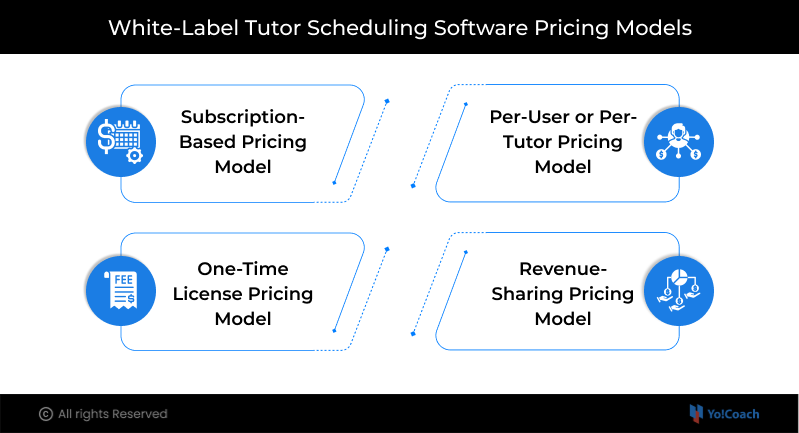
1. Subscription-Based Pricing Model
In the subscription-based pricing model, businesses pay a recurring monthly or annual fee to access the tutor scheduling software. The software provider hosts, maintains, and updates the platform, while the business continues paying for ongoing usage.
Pros:
- Low upfront investment, making it accessible for new businesses
- Faster onboarding and deployment
- Software updates and maintenance are usually included
Cons:
- Costs accumulate over time, often exceeding the initial value of the software
- Payments continue regardless of how actively the platform is used
- Limited financial predictability for long-term planning
While subscriptions are appealing for short-term or pilot projects, they can become expensive as your tutoring business matures. Additionally, continuous payments reduce long-term profitability and can restrict growth if pricing tiers increase with usage.
2. Per-User or Per-Tutor Pricing Model
In this model, businesses are charged based on the number of active users, tutors, or students on the platform. Costs increase as more users are added.
Pros:
- Affordable at a small scale
- Allows early-stage businesses to manage initial expenses
- Easy to understand and implement
Cons:
- Expenses rise directly with business growth
- Difficult to forecast costs during rapid expansion
- May discourage onboarding additional tutors or students
While per-user pricing seems manageable at the start, it can quickly become a growth barrier. As your platform gains popularity, each new tutor or student adds to your expenses, which can limit scaling efforts and negatively impact profitability.
3. Revenue-Sharing Pricing Model
Under the revenue-sharing model, the software provider takes a pre-defined percentage of the revenue generated through tutoring sessions conducted on the platform.
Pros:
- Minimal upfront investment
- Suitable for startups with limited capital
- Costs scale alongside revenue
Cons:
- Continuous reduction in profit margins
- Long-term dependency on the software provider
- Less control over pricing strategies and earnings
Although revenue sharing may appear fair in the early stages, it becomes increasingly expensive as your business grows. Over time, the cumulative revenue shared with the provider may far exceed the cost of owning the software outright.
4. One-Time License Pricing Model
The one-time license pricing model involves a single upfront payment that grants lifetime ownership of the tutor scheduling software. Optional fees may apply for technical support, updates, or additional customization.
Pros:
- No recurring subscription or revenue-sharing fees
- Higher return on investment over the long term
- Full ownership and control of the platform
- Fixed and predictable one-time investment
- Freedom to scale without increasing software costs
Cons:
- Higher initial cost compared to subscription-based models
This model is ideal for businesses focused on long-term growth and sustainability. By eliminating recurring costs, it maximizes profitability and provides complete control over branding, data, and monetization. Several white-label tutor scheduling software, such as Yo!Coach, follow this one-time licensing approach, making it well-suited for scalable tutoring businesses.
Choosing the Most Strategic Pricing Model
As tutoring businesses grow, recurring software costs and revenue-sharing models often turn into long-term financial burdens. Subscription fees increase year after year, per-user pricing limits scalability, and revenue-sharing models reduce profit margins as earnings rise. Hence, for businesses aiming to build a sustainable and scalable tutoring platform, a one-time pricing model offers the most strategic advantage.
Furthermore, by paying once, you own software outright, which provides businesses with complete control over their platform, eliminates recurring expenses, and maximizes long-term return on investment. This pricing approach is especially beneficial for entrepreneurs and institutions planning long-term growth rather than short-term experimentation.
Best White-Label Tutor Scheduling Software: Yo!Coach
Yo!Coach is a self-hosted, white-label online tutoring software built to help entrepreneurs and education businesses start an online tutoring business quickly and efficiently. It offers a ready-to-launch platform with built-in tutor scheduling, session management, payments, and virtual classroom capabilities, all under your own brand.
Designed specifically for the tutoring ecosystem, Yo!Coach eliminates the need for lengthy custom development. Hence, businesses can focus on growth, marketing, and learner engagement while operating on a stable, scalable platform.
Yo!Coach One-Time Pricing Model
Yo!Coach follows a one-time licensing model, making it an ideal choice for businesses that prioritize long-term scalability and platform ownership.
With this model, you get:
- A single upfront payment with no recurring monthly fees
- Full ownership and control of the platform
- Higher long-term ROI compared to subscription-based solutions
- The freedom to scale tutors and students without increasing software costs
Key Benefits of Yo!Coach
- Fully customizable white-label solution
- Advanced tutor scheduling and availability management
- Secure and flexible payment gateway integration
- Multi-language and multi-currency support for global reach
- Scalable architecture built for long-term growth
- Optional support, maintenance, and upgrade services
Yo!Coach is well-suited for startups, growing tutoring companies, and educational institutions that want full control over branding, data, and monetization without recurring software expenses.
Experience Yo!Coach Through a Guided Demo
Conclusion
As the online education market continues to expand, efficient scheduling is no longer optional; it has become a foundation for success. Tutor scheduling software simplifies operations, improves user experience, and enables tutoring businesses to scale with confidence.
For edupreneurs looking to start an online tutoring business or modernize existing operations, white-label tutor scheduling software provides the fastest and most cost-effective path to market. It combines professional-grade features, branding flexibility, and scalability without the time, cost, and risk associated with custom development.
Furthermore, solutions like Yo!Coach strengthens this value proposition by offering a one-time pricing model, complete platform ownership, and a proven framework designed specifically for the tutoring industry. In a highly competitive EdTech landscape, choosing the right scheduling solution can determine whether a business struggles with operational inefficiency or achieves sustainable growth. White-label tutor scheduling software is not just a tool; it is a strategic investment in the future of your tutoring business.
Take the First Step Toward Building Your EdTech Marketplace
Get In Touch