How to Manage Multiple Tutors Efficiently: A Complete Guide for Tutoring Entrepreneurs


The tutoring industry has undergone a major transformation. What once started as a single tutor teaching a handful of students has now transformed into structured academies, multi-tutor institutes, and global online tutoring marketplaces.
But with growth comes complexity. As your tutoring business expands, a critical question arises: how do you manage multiple tutors efficiently without compromising teaching quality, operational control, or profitability?
Managing 2-3 tutors informally may work in the early stages. But once you scale to 10, 20, or even 100 tutors, coordination becomes significantly more demanding. Scheduling conflicts, inconsistent teaching quality, communication gaps, payment tracking issues, and performance monitoring challenges can slow down growth.
The difference between a growing tutoring business and a scalable tutoring platform lies in systems, structure, and strategy. In this blog, you will discover practical strategies to manage multiple tutors efficiently while building a sustainable and scalable tutoring business model.
Table of Contents
What is a Multi-Tutor Marketplace?
A multi-tutor marketplace is a centralized online platform that brings multiple independent tutors and students together under one structured system. Instead of a single educator managing all sessions, the platform enables several tutors to offer lessons across different subjects, grades, skill levels, or exam categories.
The platform oversees onboarding, sets service standards, manages pricing frameworks, and earns revenue through commissions, subscriptions, or service fees. This allows tutors to focus on delivering quality lessons.
How Does it Work?
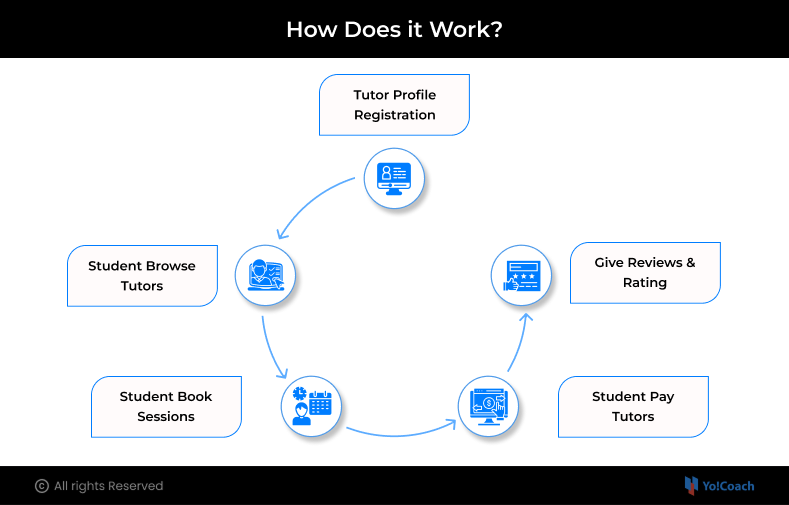
- Tutors sign up, submit their credentials, and create detailed profiles. The admin reviews and approves them before they start accepting bookings.
- Students browse tutor profiles using filters such as subject, price, experience, ratings, and availability to find the best match.
- Students choose an available time slot and book sessions directly through the platform’s scheduling system.
- After the lesson is conducted, students make payments through the platform, which deducts commission and transfers earnings to tutors.
- After each session, students leave ratings and feedback to help maintain quality and transparency.
A well-structured multi-tutor marketplace simplifies coordination, automates administrative tasks, and creates a seamless experience for both tutors and students.
Furthermore, let’s learn why you should build a multi-tutor marketplace.
Why You Should Build a Multi-Tutor Marketplace?
Building a multi-tutor marketplace is a strategic move for entrepreneurs who want scalable growth, operational control, and recurring revenue. Instead of remaining limited by individual capacity, this model transforms your business into a structured, technology-driven education platform. Key reasons include:
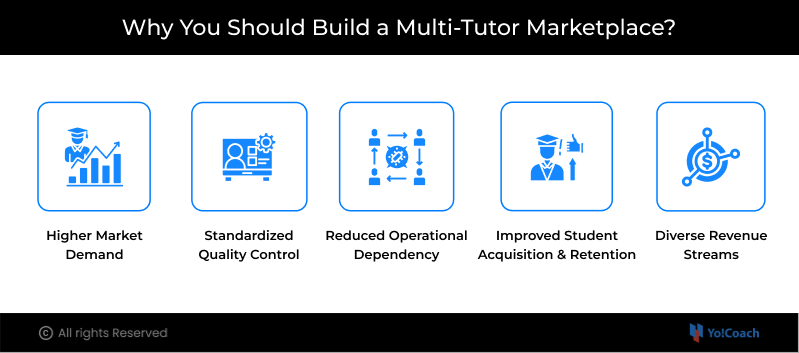
1. Higher Market Demand
Students increasingly prefer platforms that offer variety, flexibility, and verified expertise in one place. A multi-tutor marketplace meets this demand by providing multiple subjects, skill levels, and scheduling options, making it more attractive than single-tutor models.
2. Standardized Quality Control
With centralized onboarding, defined teaching guidelines, and structured review systems, you can maintain consistent service standards. Additionally, performance tracking and student feedback ensure accountability across all tutors while protecting your brand reputation.
3. Reduced Operational Dependency
Depending on one or two tutors creates operational risk. In contrast, a multi-tutor ecosystem distributes workload and revenue generation, ensuring business continuity even if individual tutors become unavailable.
4. Improved Student Acquisition and Retention
Greater tutor choice improves matching accuracy, leading to higher satisfaction. When students find the right teaching style and expertise quickly, retention rates increase, and long-term engagement improves.
5. Diverse Revenue Streams
Beyond session commissions, you can generate income through subscriptions, premium listings, bundled programs, trial session fees, and service charges. Multiple revenue channels create financial stability and scalable growth potential.
While a multi-tutor marketplace unlocks scalability and revenue growth, managing multiple instructors requires structured oversight and consistent systems. Without clear processes, complexity can quickly increase. To ensure operational efficiency and sustained quality, let us now examine some practical Strategies to manage multiple tutors efficiently.
Transform Your Tutoring Business into a Scalable Platform
Strategies to Manage Multiple Tutors Efficiently
As your tutor network grows, managing operations such as increased bookings, communication volume, quality control, and payment coordination becomes inefficient and risky. Without defined processes, inconsistencies can impact student satisfaction and tutor performance. The following strategies provide a comprehensive operational framework to help you manage multiple tutors with clarity, accountability, and long-term scalability. Let’s begin:
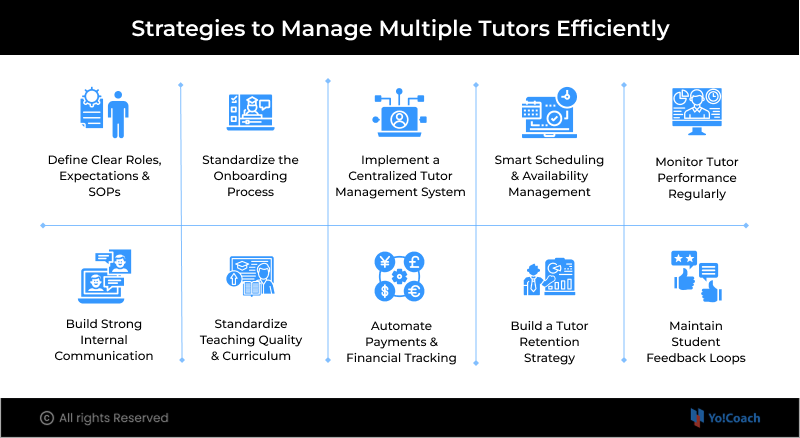
1. Define Clear Roles, Expectations & SOPs
Managing multiple tutors begins with clarity because unclear expectations lead to inconsistent teaching, communication gaps, and operational confusion. Thus, you must define teaching standards, communication protocols, session preparation rules, reporting requirements, and codes of conduct across the tutor network.
Create clear Standard Operating Procedures (SOPs) that explain how sessions should be conducted, how assignments should be reviewed, and how feedback should be submitted. Well-documented SOPs align your tutor network, reduce disputes, and ensure a consistent student experience across your platform.
2. Standardize the Onboarding Process
A structured onboarding process ensures that every tutor who joins your platform represents your brand consistently from day one. Without proper onboarding, teaching quality may vary widely, resulting in student dissatisfaction and brand dilution.
Your tutor onboarding should include:
- Background verification
- Skill assessment
- Demo session evaluation
- Platform training
- Teaching guidelines orientation
Standardization at the entry level protects brand credibility and ensures consistent service quality.
3. Implement a Centralized Tutor Management System
As your tutoring business grows, manual coordination through spreadsheets and messaging apps quickly becomes inefficient and error-prone. A centralized tutor management system acts as the operational backbone that organizes scheduling, tracks attendance, tutor-student assignments, learning materials, and payment management in one place.
A centralized tutor management system helps you:
- Assign tutors efficiently
- Track bookings and attendance
- Monitor tutor performance
- Automate reminders and reports
- Manage payments seamlessly
Structured software reduces administrative workload and prevents operational chaos.
4. Use Smart Scheduling & Availability Management
Scheduling is one of the most complex aspects of managing multiple tutors, especially when dealing with different time zones, subject availability, and student preferences. Without structured scheduling tools, double bookings, missed sessions, and student frustration become common challenges.
Therefore, you should implement:
- Real-time availability calendars
- Automated booking systems
- Time zone management tools
- Auto reminders
This ensures smoother coordination between tutors and students, enhances student satisfaction, and supports steady revenue flow.
Power Your Tutoring Business With Smart Scheduling
5. Monitor Tutor Performance Regularly
Sustainable growth requires measurable performance standards. By tracking key metrics such as student ratings, session completion rates, retention rates, punctuality, and revenue contribution per tutor, you gain visibility into what is working and what needs improvement. Additionally, regular performance evaluations help you identify top performers, provide training support to underperformers, and maintain consistent teaching quality.
Monitor key performance indicators, such as:
- Student ratings
- Session completion rate
- Student retention rate
- Punctuality
- Feedback scores
- Revenue generated per tutor
Regular performance reviews help identify top performers, support underperformers, and maintain consistent teaching standards:
6. Build Strong Internal Communication
Effective communication is essential for smooth multi-tutor operations. Relying solely on informal chat tools can lead to missed updates and misaligned expectations.
Thus, use structured communication channels such as:
- Dedicated tutor dashboards
- Internal messaging systems
- Weekly update meetings
- Monthly review calls
In addition to that, define escalation processes and complaint resolution steps to maintain clarity and trust.
7. Standardize Teaching Quality & Curriculum
Consistency in teaching quality is critical when multiple tutors represent your brand. By standardizing lesson plans, learning objectives, teaching frameworks, assessment methods, and feedback formats, you ensure that every student receives a uniform learning experience.
Moreover, provide shared resource libraries with:
- Lesson plans
- Teaching frameworks
- Learning objectives
- Assessment methods
- Feedback formats
A structured curriculum ensures every student receives a reliable learning experience.
8. Automate Payments & Financial Tracking
As your tutor network expands, managing payments manually becomes time-consuming and prone to errors. Automating commission calculations, billing, invoicing, and payout scheduling improves financial transparency and operational efficiency.
Provide dashboards where tutors can view:
- Earnings
- Session history
- Pending payments
Further, automation reduces disputes, saves time, and builds financial trust within your platform.
9. Build a Tutor Retention Strategy
Recruiting qualified tutors requires time and resources, so retaining them should be a strategic priority. Offering competitive compensation, performance-based bonuses, professional development opportunities, recognition programs, and flexible scheduling helps build long-term loyalty.
Additionally, focus on retention by offering:
- Competitive compensation
- Performance bonuses
- Professional development opportunities
- Recognition programs
- Flexible schedules
Satisfied tutors deliver better sessions, resulting in stronger student outcomes.
10. Maintain Student Feedback Loops
Students serve as the most reliable indicator of teaching quality. Establishing structured feedback systems, whether after each session or through periodic evaluations, helps you measure session effectiveness, tutor professionalism, and communication clarity.
Use feedback to:
- Improve tutor training
- Reward high performers
- Replace consistently poor performers
A feedback-driven system strengthens credibility and supports continuous improvement across your tutoring marketplace.
How Can a Readymade Solution Help Manage Multiple Tutors?
Managing multiple tutors requires structured systems, automation, and centralized oversight. Instead of building software from scratch, a purpose-built solution, with its pre-built workflows simplify scheduling, onboarding, payments, communication, and performance monitoring, allowing you to scale with operational clarity and control. Yo!Coach is one such purpose-built solution designed specifically to help tutoring entrepreneurs manage and grow multi-tutor marketplaces efficiently.
Simplifying Multi-Tutor Management with Yo!Coach
Yo!Coach is a purpose-built tutoring marketplace solution designed to manage multiple tutors efficiently within a single platform. It integrates essential operational tools that help tutoring entrepreneurs maintain quality while reducing administrative workload.
Key benefits of Yo!Coach
- Built for Marketplace Entrepreneurs: Unlike generic LMS platforms, Yo!Coach is tailored for multi-tutor ecosystems. It allows you to onboard tutors, manage global educators across time zones, automate bookings, and configure commission-based earnings structures, all from a centralized admin panel.
- White-Label & Custom Branding: Yo!Coach is a white-label solution, meaning your platform operates entirely under your brand identity. From logo placement to color schemes and domain customization, you maintain full branding control.
- Built-In Scalability: The architecture is designed to handle increasing tutor and student numbers without performance bottlenecks. As your user base grows, the system scales with you, minimizing the need for constant technical redevelopment.
- Secure Payment & Automation: Integrated secure payment gateways streamline transactions between students and tutors. Automated booking confirmations, reminders, commission calculations, and payout management reduce administrative workload significantly.
- Dedicated Support & Faster Launch: Instead of managing developers or coordinating updates, you receive technical support from the Yo!Coach. This allows you to focus on marketing, partnerships, tutor acquisition, and revenue growth.
Book a Personalized Demo to See Yo!Coach in Action
Final Thought
Technology should move your business forward, not hold it back. When your vision is to build a scalable, multi-tutor online marketplace, the last thing you need is months of development delays or operational uncertainty. The right platform should simplify execution and give you a clear path to launch and scale.
If your goal is to create structured operations, diversified revenue streams, and automated tutor management, investing in a ready-made solution like Yo!Coach can dramatically reduce both risk and time to market. Instead of building from scratch, you can focus on onboarding quality tutors, attracting students, and strengthening your brand.
The faster you implement a reliable system, the faster you position your tutoring business as a structured, revenue-generating digital education platform. Strong infrastructure enables confident growth.
FAQs
Q 1. How can I efficiently manage multiple tutors in my tutoring business?
Ans. Managing multiple tutors efficiently requires structured systems, clear SOPs, centralized scheduling, automated payment tracking, performance monitoring, and consistent communication. Moreover, to efficiently manage tutors, you can leverage a dedicated tutor management solution like Yo!Coach. It simplifies operations by automating bookings, payments, reporting, and tutor coordination, helping you scale without operational chaos.
Q 2. What are the biggest challenges in managing multiple tutors?
Ans. The most common challengesin managing multiple tutors include:
- Scheduling conflicts
- Inconsistent teaching quality
- Communication gaps
- Payment disputes
- Performance tracking issues
- Student retention problems
Without a centralized system, these challenges multiply as your tutor network grows.
Q 3. Why is a centralized tutor management system important?
Ans. A centralized system allows you to manage tutor onboarding, scheduling, attendance, payments, performance metrics, and student feedback from one dashboard. Additionally, it reduces manual workload, prevents errors, and ensures smooth coordination between tutors and students. Solutions like Yo!Coach provides all these features in one scalable ecosystem.
Q 4. Should I choose custom development or ready-made tutoring software?
Ans. No doubt that custom development offers flexibility, but it also requires significant time, investment, and ongoing technical maintenance. Ready-made tutoring software, on the other hand, allows you to launch faster with pre-built features such as tutor dashboards, student dashboards, commission management, and integrated virtual classrooms, reducing both risk and cost.
Q 5. What features are essential in a scalable online tutoring solution?
Ans. A scalable tutoring solution should include:
- Tutor dashboard for session and earnings management
- Student dashboard for bookings and payments
- Admin panel for approvals and analytics
- Integrated virtual classroom
- Automated payment processing
- Multi-revenue model support
Yo!Coach includes all these features, making it suitable for launching and scaling multi-tutor marketplaces.
Q 6. How does Yo!Coach help in managing global tutors?
Ans. Yo!Coach supports multiple languages and currencies, which helps in managing different time zones, automated scheduling, secure global payment integrations, and structured tutor onboarding processes. This makes it easy to handle tutors and students across different regions without operational complexity.
Start Managing Your Tutor Network the Smart Way
Reach Out