The way the world learns, grows, and achieves its goals is fundamentally changing. Traditional methods are giving way to digital, on-demand, and personalized expertise, making the online coaching industry a key part of the modern digital economy.
The rapid growth of the online coaching economy is driven by a shift toward personal development and skill acquisition. Individuals and organizations are actively seeking specialized, results-driven mentorship tailored to their unique circumstances. This surge has created a booming market where expertise is the most valuable currency.
Furthermore, in a world defined by constant technological change and new professional requirements, people need to upskill quickly. Thus, online coaching, with its ability to connect experts with learners across geographical boundaries, perfectly meets this need for flexibility and relevance.
Consequently, online coaching websites are becoming a scalable business model that extends far beyond the individual coach. By creating a marketplace, entrepreneurs can build a platform that hosts hundreds or thousands of coaches, transforming a one-person service into a two-sided network business model with exponential growth potential.
Table of Contents
Three Key User Types on an Online Coaching Website
An online coaching marketplace operates as a digital hub connecting multiple independent coaches with a global audience of students. The platform provides the infrastructure, the tools, and the trust layer for sessions to be discovered, booked, conducted, and paid for securely.
However, the success of the marketplace depends on facilitating seamless interactions between three distinct user roles, each with unique needs and value proposition:
1) Students (The Learners)
- Role: Learners who search, compare, book, and attend coaching sessions.
- Access: They access coaches across different categories and price ranges, benefiting from a wide selection of expertise in one place.
- Value Proposition: The ability to find a specialized coach quickly, read verified reviews, and receive personalized, flexible instruction to achieve a specific goal, such as land a new job, master a new programming language, or achieve a fitness goal.
2) Coaches (The Experts)
- Role: Individual experts who list their services and conduct sessions.
- Income: They earn income through 1-on-1 or group classes, leveraging the platform’s marketing reach and payment/scheduling tools.
- Value Proposition: Access to a readymade student base, a professional digital storefront, and administrative support (scheduling, billing, and communication) that lets them focus entirely on coaching.
3) Admin (The Platform Owner)
- Role: The platform owner who manages users, controls operations, and earns revenue.
- Function: This user controls the website’s policies, moderates content, manages payment gateways, and drives the overall marketing and growth strategy.
- Value Proposition: Earning a commission or fee from every successful transaction on the platform, allowing for scalable, passive revenue from a diverse pool of services.
How the Online Coaching Website Works?
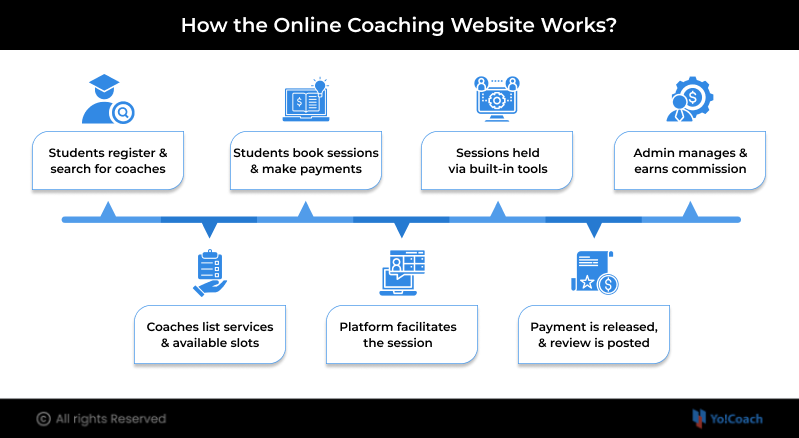
The user journey is structured to be simple, secure, and efficient for all parties:
- Students register and search for coaches: New users sign up and utilize a smart search filter system by niche, price, rating, availability, etc., to discover suitable coaches.
- Coaches list services and available slots: Coaches create detailed profiles, clearly outlining their expertise, pricing structure, and connecting their digital calendar to show real-time availability.
- Students book sessions and make payments: The student selects a coach and an open time slot, then pays the full session fee securely through the platform’s integrated payment gateway.
- Platform facilitates the session: The system notifies both parties and automatically creates a secure, private virtual meeting room (or sends a link to an integrated tool like Zoom) for the session.
- Sessions are conducted via built-in collaboration tools: The coach and student meet online, utilizing the platform’s features like video conferencing, whiteboards, and file sharing for an interactive experience.
- Payment is released, and review is posted: The platform holds the payment until the session is complete, then releases the coach’s fee (minus the admin commission) and prompts the student to leave a rating and review.
- Platform admin monitors operations and earns commission: The admin tracks all bookings, revenue splits, user activity, and performance analytics from a central dashboard.
Turn Your Coaching Idea Into a Scalable Online Marketplace
Step-by-Step Guide to Building a Website for an Online Coaching Business
Building a global coaching marketplace website requires strategic planning across four key dimensions: specialization, features, monetization, and technology. To make it easier for you, a step-by-step guide is given below:
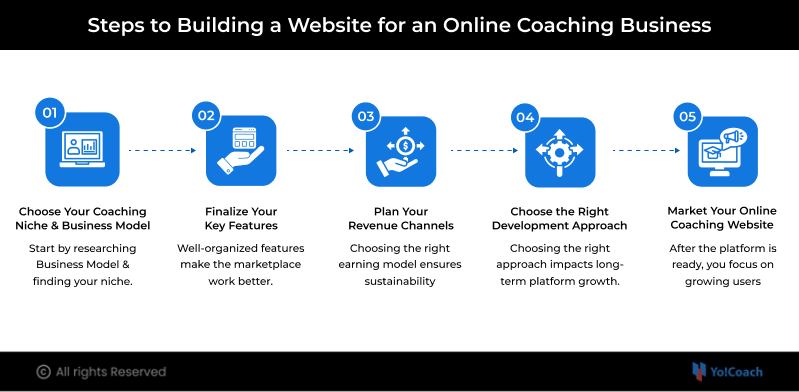
Step 1: Choose Your Coaching Niche & Business Model
Before you start building the website for your online coaching business, it is essential to conduct thorough market research and find your niche and targeted audience. Specialization is the foundation of success in a crowded digital space. Furthermore, some popular coaching niches are listed below.
Popular Coaching Niches
Choosing a niche provides a clearer target audience, simplifies marketing, and allows you to tailor your features precisely. It includes:
- Life Coaching: Focuses on personal goals, relationships, mindfulness, and happiness.
- Business Coaching: Concentrates on entrepreneurship, leadership, sales, marketing strategy, and organizational development.
- Fitness & Wellness Coaching: Includes personalized training, nutrition planning, mental wellness, and overall health optimization.
- Academic & Test-Prep Coaching: Covers subjects like SAT/ACT prep, specific college-level courses, language learning, and coding skills.
- Career & Interview Coaching: Helps with resume building, interview practice, salary negotiation, and career transition planning.
Coaching Delivery Models
Other than the niche, one more important factor to decide on is the coaching model your platform will follow. Thus, some common and most opted models are mentioned below. The structure of your sessions will dictate which technical features you prioritize.
- 1-on-1 Coaching: Highly personalized sessions. Requires robust individual scheduling, private chat, and video conferencing tools. This model commands the highest price points.
- Group Coaching: Sessions delivered to a group of students simultaneously. Requires features for group scheduling, waiting rooms, breakout rooms, and group communication tools. This model is excellent for scaling a coach’s time.
- Hybrid Coaching (1-on-1 + Group): The coach offers a premium 1-on-1 package that includes access to a private group community or a weekly group Q&A session. This combines high value with scalability.
Step 2: Finalize Your Key Features
The right feature set separates a basic website from a powerful, scalable marketplace. However, these features must be organized and tailored for each user type.
Student Features (Focused on Discovery, Booking, and Trust)
- Browse & Search Coaches: Advanced filtering by niche, price range, availability, language, and coach certification.
- Rate & Review Coaches: A transparent system for students to rate their experience, essential for building trust and guiding new users.
- Wallet Management: A secure virtual wallet where students can deposit funds or see their balance for quick, one-click session bookings.
- Mark Favorite Coaches: A simple way for students to save profiles they are interested in for future reference or booking.
- Book a Free Trial/Consultation: A small, low-risk way for students to test the chemistry with a coach before committing to a paid session.
- Schedule Lessons: An intuitive, calendar-based booking system showing the coach’s availability in the student’s local time zone.
Coach Features (Focused on Efficiency, Management, and Delivery)
- Login via Email or Social Profile: Simplified and secure access to their private dashboard.
- Calendar & Booking Management: A clear calendar interface to set availability, block out time, confirm/cancel sessions, and manage recurring bookings.
- Set Up Lesson Pricing: Flexible pricing options for 30/60/90-minute sessions, package deals, and group rates.
- Tools for Interactive Coaching: Integrated tools (given below) for high-quality, engaging session delivery.
- Deliver One-on-One or Group Classes: The ability to seamlessly switch between the two delivery modes with appropriate tools for each.
- Create & Share Lesson Plans/Resources: A content management system for coaches to upload guides, PDFs, homework, and share them directly with specific students or groups.
Admin Features (Focused on Control, Revenue, and Growth)
- Manage Coaches & Students: Centralized dashboards for onboarding, verification, suspension, and account management for all users.
- Seamless Payments & Commission Management: Integration with payment gateways, like Stripe or PayPal, to automatically split the payment between the coach and the platform, managing commissions and payouts.
- Generate Promo Codes & Offers: Marketing tools to create discounts for new students or special offers to retain existing users.
- Tracking & Analytics: Detailed reports on site traffic, popular coaches, booking rates, average session value, and overall revenue.
- View Reports (Financial & Performance): Automated generation of financial reports for tax purposes and business performance analysis.
- Robust Content Management System (CMS): A system to manage the static pages, such as About Us, Pricing, FAQ, landing pages, and the platform’s marketing blog.
Collaboration Tools
The quality of the virtual classroom experience is paramount. Hence, the following tools should be integrated seamlessly:
- Text, Audio & Video Communication: High-definition, low-latency communication for 1-on-1 or group video calls.
- One-on-One or Group Classes: Secure virtual rooms that adapt features based on the session type (e.g., enabling Breakout Rooms for group classes).
- Whiteboard: An interactive, digital whiteboard for visual explanations, drawing diagrams, and collaborative brainstorming.
- Screen Sharing: The ability for both the coach and the student to share their screen for reviewing documents, presentations, or troubleshooting.
- Easy-to-Use Interface: A clean, non-distracting user interface that works reliably across desktop and mobile devices.
- Host Live Sessions, Training & Webinars: The capacity to host larger, non-private events for marketing, community building, or mass training.
Build a Feature-Rich Online Tutoring Website
Step 3: Plan Your Revenue Channels
The next important step is to decide the monetization strategy of your platform, as it is the key to long-term sustainability. A coaching marketplace can employ several models, often concurrently. Given below are some of the most common revenue models:
- Commission-Based Coaching Marketplace: This is the primary and most scalable model. The platform takes a percentage cut (e.g., 10-30%) of the fee for every successful session booked and paid for through the site. This aligns the platform’s success with the coach’s success.
- Subscription-Based Coaching Website: Users pay a fixed monthly or annual fee for platform access. This can apply to students (e.g., “Premium Access” to top-tier coaches or resources) or to coaches (e.g., a “Pro Tier” membership to unlock unlimited bookings and advanced analytics).
- Pay-Per-Session Model: Students pay the full price for each session. You can also offer discounted packages, e.g., pay for 10 sessions upfront and get 1 free.
- Corporate & Enterprise Coaching Programs: A high-ticket revenue stream where you offer tailored coaching packages and platform access to large businesses looking to provide professional development to their employees. This requires a dedicated sales effort and more sophisticated reporting features for the enterprise client.
Step 4: Choose the Right Development Approach
This step determines your upfront cost, time-to-market, and long-term scalability. The choice is between building from scratch or leveraging existing technology.
Option 1: Custom Development
Building your coaching website completely from scratch using a team of developers, coding every feature, database, and user interface element.
Pros:
- Full Customization: You have complete control over every single feature, design element, and integration, allowing for a truly unique user experience.
- Complete Code Ownership: You own the intellectual property, offering maximum control and freedom for future pivots or sales.
Cons:
- Very High Development Cost: The cost of hiring a full development team (front-end, back-end, design, QA) is substantial.
- Long Development Timeline: A full-featured marketplace can take 9-18 months or more for the launch.
- Complex Maintenance & Bug Fixes: You are responsible for all ongoing maintenance, security patches, and resolving bugs.
- Separate Cost for Every New Feature: Every subsequent feature or update requires significant development time and cost.
- High Dependency on Technical Team: You are entirely dependent on your developers for even minor changes and system upkeep.
Option 2: Readymade Software (White-Label Solution)
Using a pre-built online coaching software that already has all the core marketplace features built, tested, and ready to deploy reduces time to market and is cost-efficient.
Pros:
- Faster Launch: You can launch the core, fully functional platform in a matter of weeks, getting to market while the business idea is still hot.
- Lower Upfront Cost: The cost is dramatically lower than custom development since the core coding is already complete.
- Built-in Student, Coach & Admin Panels: All three key user interfaces and dashboards are pre-configured, saving hundreds of hours of design and development.
- Integrated Payments & Collaboration Tools: Essential features like payment processing and video conferencing are already integrated, requiring only configuration.
- Easy Scaling: The underlying technology is designed to handle high user volume, allowing you to scale without immediate, expensive system overhauls.
- Minimal Technical Dependency: You rely on the software provider for maintenance, updates, and major feature additions, minimizing your internal technical team needs.
Cons:
- Platform Upgrades Depend on the Provider: You rely on the software provider’s roadmap for core platform feature updates and new releases.
Decision Point: For most startups and small to medium-sized businesses, the speed, affordability, and stability of a readymade software solution offer a decisive advantage for market entry and initial scaling. Whereas, custom development is generally reserved for large enterprises with unique, non-standard business processes or multi-million dollar budgets.
Yo!Coach: Your All-In-One Solution to Launch and Scale a Coaching Marketplace
For entrepreneurs choosing the readymade software solution, Yo!Coach offers a dedicated, white-label software designed specifically for entrepreneurs looking to build an online coaching website. Utilizing a solution like this allows you to bypass the massive time and expense of custom development while retaining brand ownership and control.
Moreover, with Yo!Coach, you get all the essential features, from booking systems and payment gateways to video conferencing tools, giving you a streamlined, scalable solution that’s easy to set up and grow. Hence, you can focus on building your business instead of worrying about complex technical details.
Key Benefits and Features of Yo!Coach for Marketplace Owners:
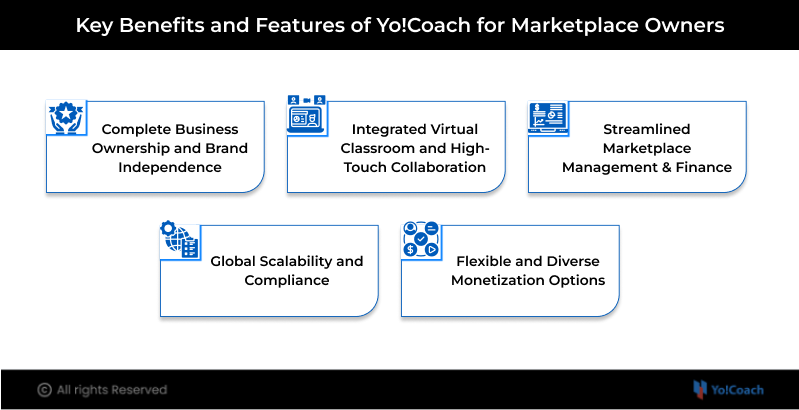
1. Complete Business Ownership and Brand Independence
- 100% White-Label: Launch the platform under your own brand name, logo, and colors. The final product is completely proprietary to your business.
- Source Code Ownership & Lifetime License: You own the lifetime license and the core source code, giving you total control and eliminating recurring software subscription fees.
- Full Customization Potential: The solution infrastructure allows for extensive feature and design customization on top of the base product to meet specific niche requirements (e.g., unique reporting for fitness coaching).
2. Integrated Virtual Classroom and High-Touch Collaboration
- Secure Live Sessions Functionality: Pre-integrated with video conferencing APIs, such as Zoom, Lessonspace, or others,,s to enable seamless, private 1-on-1 and group coaching sessions.
- Interactive Virtual Tools: Includes a collaborative whiteboard, screen sharing, text pad, and real-time document sharing, essential for hands-on coaching.
- Real-Time Chat & Translation: A built-in messaging system with an auto-translation feature to support a global client-coach network.
3. Streamlined Marketplace Management and Finance
- Dedicated Multi-Role Dashboards: Ready-to-use, feature-rich dashboards for the Admin, Coach, and Student, ensuring an optimized workflow for every user type.
- Advanced Scheduling & Goal Management: Features like time-zone-specific scheduling, Google Calendar two-way sync, and dedicated modules for setting and tracking coaching goals.
- Automated Payment and Payout: Integrated with multiple secure payment gateways, including Stripe, PayPal, etc., to securely collect payments and automatically execute commission splitting and coach payouts.
4. Global Scalability and Compliance
- Multi-Lingual and Multi-Currency Support: Essential features for international expansion, allowing users to transact and view content in their preferred language and currency.
- Mobile Readiness: Comes equipped with support for dedicated mobile applications for Android and iOS, and is often built as a Progressive Web App (PWA) for wider accessibility.
- Security and Compliance: Built with necessary security protocols, data protection, and GDPR compliance features to ensure trust and professionalism.
5. Flexible and Diverse Monetization Options
- Multiple Business Models: Supports commission-based live sessions, package deals for group and 1-on-1 coaching, selling pre-recorded courses, and subscription-based revenue models.
- Marketing Tools: Includes features for generating promo codes, gift cards, running a dedicated blog, and basic built-in SEO tools to drive organic traffic from coaches and students.
See How Yo!Coach Can Transform Your Coaching Idea
Step 5: Market Your Online Coaching Website
Once the platform is built, acquisition of both students and quality coaches is the final frontier. Thus, your marketplace should include marketing features, such as:
- SEO for Organic Student Traffic: Optimize coach profiles, categories, and your blog content for relevant search terms (e.g., “online business coach,” “math tutor near me”). Creating high-quality, long-form content is key to ranking.
- Content Marketing & Blogging: Produce valuable content (articles, guides, eBooks) that solves your target students’ problems, positioning your platform as a thought leader in your niche.
- YouTube & Personal Branding: Encourage your coaches to create video content that directs traffic back to their profile on your platform. You can also create branded educational content to attract students.
- Paid Ads for Student & Coach Acquisition: Run targeted campaigns on Google (for intent-based search), Facebook/Instagram (for demographic targeting), and LinkedIn (for professional niches) to efficiently acquire your first users.
- Influencer & Affiliate Partnerships: Partner with popular bloggers, podcasters, or social media personalities in your niche who can promote your platform to their established audience in exchange for a commission.
- Corporate Tie-ups: Approach companies, universities, or non-profits that need to train their staff or members, offering them bulk access to your expert coaches.
Conclusion
The online coaching industry is flourishing, offering incredible opportunities for growth. Thus, building a well-executed marketplace website is an ideal way to capture the value of this booming industry. By positioning yourself as a trusted intermediary between expert coaches and motivated students, you create a scalable, sustainable business model. As coaching demand continues to rise across various niches, the potential to build a thriving, profitable platform is immense. Hence, with the right tools and strategy, you can build a marketplace that not only connects learners with experts but also evolves into a go-to resource in your chosen niche.
FAQs
Q 1. Can I launch a coaching website without technical knowledge?
Ans. Yes, using readymade solutions, you can launch a coaching website without technical knowledge. These solutions provide pre-built dashboards, booking systems, payment gateways, and live session tools. Thus, it allows you to focus on branding, onboarding coaches, and marketing, while the vendor handles all technical aspects, enabling a fast, scalable, and professional online coaching business.
Q 2. What types of coaching websites can I build with Yo!Coach?
Ans. With Yo!Coach, you can build:
- Life coaching websites
- Business coaching platforms
- Fitness & wellness coaching websites
- Academic & test-prep coaching platforms
- Career & interview coaching websites
- Corporate training coaching platforms
Moreover, Yo!Coach supports both 1-on-1 and group coaching models.
Q 3. Does Yo!Coach support live video coaching and collaboration tools?
Ans. Yes, Yo!Coach supports live video coaching and collaboration tools. It comes integrated with powerful collaboration tools, including text chat, audio calls, video conferencing, screen sharing, whiteboard, and live webinars. These tools make it ideal for real-time coaching and training sessions.
Q 4. How do coaches earn money on a Yo!Coach – powered website?
Ans. Coaches can earn money on a Yo!Coach-powered website through:
- Pay-per-session bookings
- Monthly subscription plans
- Group coaching programs
- Corporate training assignments
Additionally, the admin can set commission rates and manage payouts directly from the platform.
Q 5. How can I monetize my online coaching website?
Ans. There are multiple channels through which your online coaching website can generate revenue. It includes:
- Commission on each coaching session
- Subscription plans for students
- Featured coach listings
- Corporate coaching partnerships
- Promotional campaigns and offers
Q 6. Is Yo!Coach scalable for future growth?
Ans. Yes, Yo!Coach is built for scalability and can support:
- Thousands of students and coaches
- Multi-language websites
- Multi-currency payments
- Global user base
- Enterprise-level coaching requirements
Q 7. How long does it take to launch a coaching website using Yo!Coach?
Ans. A Yo!Coach – powered coaching website can typically be launched within a few days, depending on branding, content upload, and payment gateway configuration. It is a much faster choice than custom development.
Q 8. Is Yo!Coach suitable for startups as well as established coaching brands?
Ans. Yes, Yo!Coach is an ideal choice for startups as well as established coaching brands, including:
- Individual coaches scaling into a marketplace
- EdTech companies
- Digital agencies
- Corporate training providers
- Entrepreneurs building global coaching businesses
Ready to Build a Website For Your Online Coaching Business?
Get In Touch