
The global demand for personalized, high-quality education has never been higher, and the online tutoring sector is growing to meet it. Students no longer need to be limited by geography, school schedules, or the availability of local tutors. With the right technology, a student in Tokyo can work with an Oxbridge-trained tutor in London in real time and platforms like Spires are making this a daily reality.
Founded in 2014 by Oxbridge graduates, Spires Online Tutors has established itself as one of the world’s most technologically advanced tutoring marketplaces. What sets Spires apart is not just its network of elite tutors across 400+ subjects, but its sophisticated use of machine learning, a reverse auction bidding system, an integrated virtual classroom, and automated payment infrastructure — all working in concert to deliver exceptional educational outcomes at scale.
This guide is a comprehensive roadmap for entrepreneurs, EdTech startups, and educational businesses that want to build a tutoring platform like Spires — one that is not merely functional, but genuinely competitive, scalable, and differentiated in a crowded global market.
Table of Contents
Understanding the Spires Model
Before designing your own platform, it is essential to understand the architecture, mechanics, and strategic decisions that have made Spires so successful. Spires provides a rich blueprint for any entrepreneur looking to build a tutoring platform that combines technological sophistication with real educational impact.
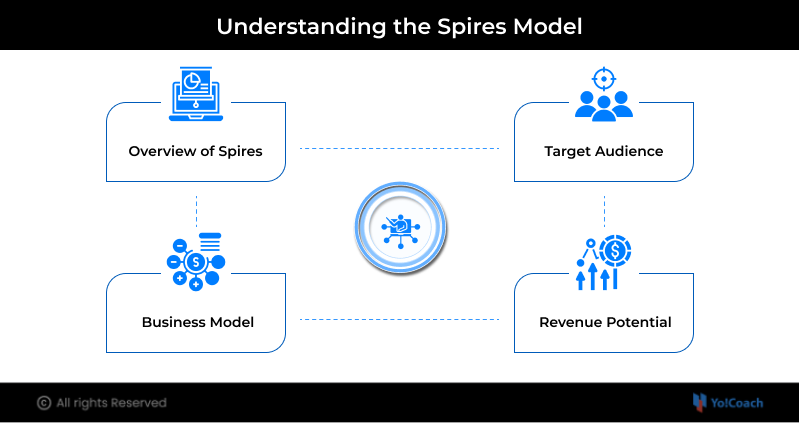
1. Overview of Spires: What It Is and How It Works
Spires operates as a demand-driven, technology-powered two-sided marketplace. Unlike traditional tutoring platforms where students simply browse tutor profiles, Spires uses a unique reverse auction model that fundamentally changes the discovery dynamic:
- Post a Request: A student describes their tutoring need — subject, level, exam board, and specific goals. The platform instantly notifies relevant, vetted tutors.
- Receive Competing Bids: Qualified tutors review the job and submit personalized offers with their hourly rate and an introductory message. This creates healthy price competition and brings in the most motivated tutors for each specific job.
- Compare and Choose: The student browses incoming bids, views tutor profiles (qualifications, university background, reviews), and communicates with candidates before making a selection.
- Book and Pre-Pay: Once a tutor is selected, payment is made securely upfront via Stripe. Spires automatically deducts its commission and holds the remainder for the tutor.
- Attend Online Sessions: Lessons take place inside Spires’ fully integrated browser-based virtual classroom, complete with HD video, an interactive whiteboard, file sharing, and automatic session recording. Students can revisit the recording at any time after the lesson.
2. Target Audience
A successful platform like Spires serves three distinct and equally important user groups:
- Students: From secondary school (GCSE, A-Level, IB) through undergraduate and postgraduate levels, as well as professionals studying for chartered qualifications. They need fast access to highly qualified, subject-specific tutors who understand their syllabus.
- Parents: Typically the purchasing decision-maker for school-age students. They prioritize verified qualifications, tutor background checks, transparent pricing, and evidence of grade improvement.
- Tutors: Professionals, academics, and postgraduate students who want a flexible, high-quality platform to reach students globally. They value a platform that handles all administration — payments, scheduling, recording — so they can focus entirely on teaching.
3. Business Model: Commission-Based with Tiered Reductions
Spires operates on a commission model that is both transparent and incentive-aligned. The platform charges a percentage fee on top of each tutor’s set hourly rate, paid by the student at the point of booking:
- Starting Commission (35%): New tutor-student relationships begin at a 35% platform commission. For example, if a tutor charges £50/hour, the student pays £67.50 and the tutor receives £50.
- Tiered Reduction: The commission decreases by 1% for every 5 hours logged with the same student, down to a floor of 20%. This powerful mechanism incentivizes long-term tutor-student relationships, increases lifetime value for both parties, and rewards loyalty.
- No Hidden Fees: All quoted prices are fully inclusive of the platform fee and applicable taxes — there are no signup fees for students.
4. Revenue Potential: Market Size and Monetization Opportunities
The global online tutoring market is one of the fastest-growing segments in EdTech, projected to reach tens of billions of dollars globally over the next decade, driven by rising academic pressure, international student mobility, and the proven effectiveness of one-to-one learning.
Monetization opportunities beyond commission include:
- Premium Tutor Listings: Featured placement in search results for tutors willing to pay a subscription or one-time fee.
- White-Label API Access (Spires Connect Model): Offer other tutoring agencies and independent tutors access to your platform infrastructure under their own brand — a B2B revenue stream with recurring contract value.
- Institutional Partnerships: Contract with schools, universities, or corporate HR departments for subsidized access to your tutor network.
- Premium Student Subscriptions: Monthly plans offering access to session recordings, study materials, or priority tutor matching.
Have A Unique Tutoring Business Model Idea In Mind?
Steps to Build a Tutoring Platform Like Spires
Building a world-class tutoring marketplace requires a methodical approach. The following steps are essential for any entrepreneur determined to build a tutoring platform like Spires that can compete, scale, and deliver genuine educational value.
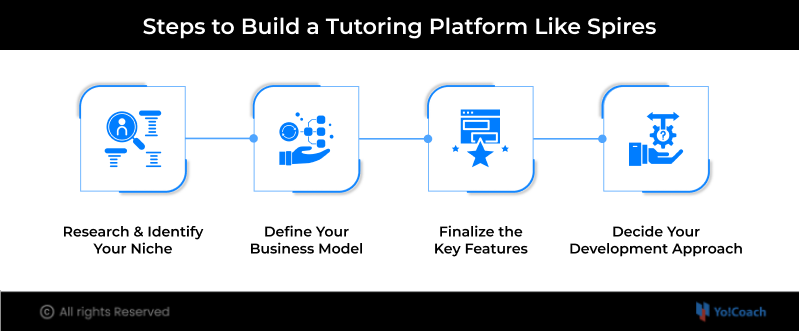
Step 1: Research & Identify Your Niche
The most significant strategic decision you will make is where to focus. Spires itself began with a focus on Oxbridge-level academic tutoring and professional qualifications — a clear, premium niche — before expanding. Attempting to compete on every subject simultaneously is resource-intensive and rarely effective at launch.
Strong niche options to consider:
- University & Postgraduate Support: Dissertation tutoring, PhD supervision support, and exam prep for final-year university students — an underserved, high-value segment.
- Professional Certifications: Chartered accountancy (ACA, ACCA, CIMA), legal qualifications, and financial certifications (CFA, FRM). These learners are typically professionals willing to pay premium rates.
- Specific Curriculum Mastery: Focus on one examination system deeply — the IB, the A-Level system, the SAT/ACT — and become the most trusted platform for that audience globally.
- STEM for Higher Education: Mathematics, physics, engineering, and computer science at undergraduate level are chronically undersupplied in the tutoring market.
- Geographic Focus: Target a country or region where online tutoring adoption is growing rapidly but strong platforms are not yet established — Southeast Asia, the Middle East, or Latin America.
Step 2: Define Your Business Model
The choice of business model shapes your pricing strategy, tutor retention, and cash flow dynamics. Three models are worth considering:
- Commission Per Session (Spires Model): The platform deducts a percentage fee from each completed lesson. With a tiered reduction system (as Spires uses), this strongly incentivizes long-term relationships and keeps your best tutors engaged on the platform.
- Subscription-Based Model: Students or parents pay a fixed monthly fee for a set number of hours per month. Predictable revenue, but harder to recruit elite tutors who prefer market-rate pricing.
- Hybrid Model: A base commission combined with optional premium tiers — e.g., reduced commission for high-volume tutors, or priority matching features for premium student subscribers. This is the most scalable long-term model.
Step 3: Finalize the Key Features
The success of your platform is determined by the quality of experience delivered to all three user groups. The following features are non-negotiable for a platform that aspires to match the standard set by Spires.
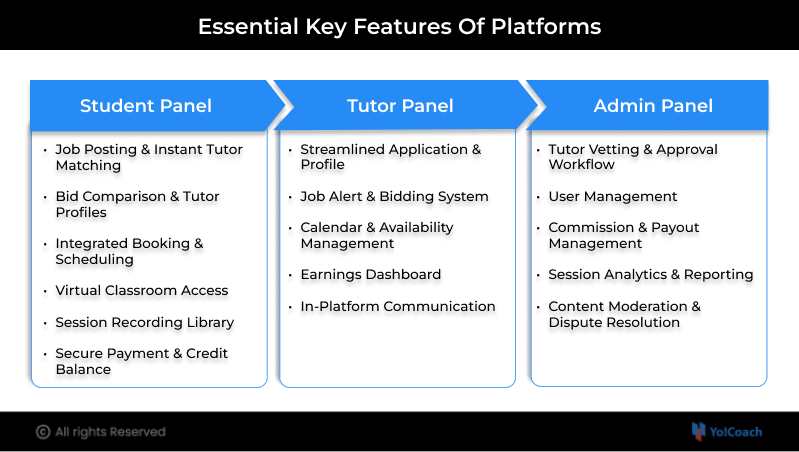
a. Student Panel
- Job Posting & Instant Tutor Matching: The reverse auction mechanism is Spires’ most distinctive feature. Students post a request; the platform’s algorithm instantly alerts the most relevant, available tutors. This reduces the average time-to-first-bid dramatically.
- Bid Comparison & Tutor Profiles: A clean dashboard showing all incoming bids with tutor qualifications, university background, reviews, and hourly rate. Students should be able to contact tutors via in-platform messaging before committing.
- Integrated Booking & Scheduling: An intuitive calendar showing real-time tutor availability with one-click booking. Automated reminders and a clear cancellation policy reduce no-shows.
- Virtual Classroom Access: Browser-based sessions with no app download required. Must include HD video/audio, an interactive collaborative whiteboard, screen sharing, and automatic session recording.
- Session Recording Library: All past lessons should be accessible for replay at any time. This is a major differentiator for students who want to review complex topics.
- Secure Payment & Credit Balance: Pre-payment via Stripe with a transparent credit/session balance dashboard. Full payment history and downloadable receipts.
b. Tutor Panel
- Streamlined Application & Profile: A structured onboarding flow that captures academic qualifications, university background, teaching experience, subject specializations, and hourly rate. The platform should support document upload for verification (degrees, professional memberships, background checks).
- Job Alert & Bidding System: Tutors receive real-time notifications for new student requests matching their subjects. A clean interface for submitting a bid with a personalized introductory message and proposed rate.
- Calendar & Availability Management: Tutors set their availability and the system handles scheduling logic, automatic timezone conversion, and calendar syncing (Google, Outlook).
- Earnings Dashboard: A transparent, real-time view of gross earnings, platform commission, net payout, and next automated payout date. Commission rate should visibly update as the tutor accumulates hours with each student.
- In-Platform Communication: Secure messaging with students for pre-session discussion, without exposing personal contact information.
c. Admin Panel
The Admin panel is the operational command center of your platform. A robust, well-designed Admin Panel is essential to build a tutoring platform like Spires that can scale without proportional increases in operational overhead.
- Tutor Vetting & Approval Workflow: A multi-stage application review system. Spires accepts only 4% of tutor applicants — a selectivity that is core to the platform’s brand. The admin panel must support document review, interview scheduling, and approval/rejection workflows.
- User Management: Complete ability to view, verify, suspend, or remove students and tutors, with audit logs for all actions.
- Commission & Payout Management: Automated payout processing (Stripe Connect), tools to configure and adjust the tiered commission structure, and a refund and dispute management workflow.
- Session Analytics & Reporting: Comprehensive dashboards tracking total hours delivered, revenue by subject/tutor/region, student retention rates, and tutor utilization.
- Content Moderation & Dispute Resolution: A ticket-based system for handling disputes, with the ability to review session recordings as evidence — a significant trust and safety advantage of the recorded-classroom model.
Step 4: Decide Your Development Approach
The build-vs-buy decision is the most consequential technical choice you will make. Each approach has distinct implications for cost, speed, flexibility, and risk:
- Custom Development: Full control over every feature and user experience detail. However, this requires a high budget ($30,000–$70,000+), a significant development timeline (6–12+ months), and an ongoing engineering team for maintenance and iteration. The reverse auction system, virtual classroom, tiered commission engine, and automated payout infrastructure are each individually complex modules.
- Readymade / White-Label Solution: Purpose-built tutoring platform software (such as Yo!Coach) that includes the core marketplace infrastructure — bidding, payments, virtual classroom, dashboards — out of the box. Dramatically lower cost ($2,000–$15,000) and faster time-to-market (2–6 weeks). The ideal approach for testing a niche quickly and scaling once product-market fit is proven.
Looking For A Feature-Rich Readymade Tutoring Software?
Cost to Build a Tutoring Platform Like Spires
When assessing investment, the goal is not just to launch but to build a tutoring platform like Spires that can grow and sustain itself. Costs vary significantly based on approach and feature complexity.
1. Approximate Cost Range Breakdown
| Development Approach | Time to Launch (MVP) | Estimated Cost (USD) | Primary Cost Drivers |
| Custom Development (From Scratch) | 6–12+ Months | $30,000 – $70,000+ | Reverse auction engine, virtual classroom, tiered commission logic, payment automation |
| Readymade Solution (White-Label) | 2–6 Weeks | $2,000 – $15,000 | Software license, branding customization, hosting/cloud setup |
Building from scratch can cost $30,000–$70,000+, whereas a readymade solution can reduce costs by up to 5x — making it the smart choice for entrepreneurs validating a niche before committing to full custom development.
2. Factors Affecting Cost
- The Reverse Auction Engine: Building and tuning the real-time matching algorithm that notifies the right tutors for each student request is a significant engineering undertaking. Getting this right directly impacts tutor engagement and time-to-first-bid metrics.
- Virtual Classroom Sophistication: An integrated, browser-based classroom with HD video, interactive whiteboard, screen sharing, and automatic recording is the most expensive single module in a custom build — potentially accounting for 20–30% of total development cost.
- Tiered Commission Engine: The logic to track hours per tutor-student pair, apply the correct commission rate, handle exceptions, and update tutor-facing dashboards in real time requires careful backend architecture.
- Tutor Vetting Infrastructure: Building a structured application workflow with document verification, interview scheduling, and compliance tracking adds both development cost and operational overhead.
- Scalability: Designing an architecture capable of handling thousands of concurrent live video sessions requires investment in cloud infrastructure and load balancing that goes beyond a simple monolith.
- Post-Launch Maintenance: Custom platforms require a dedicated engineering team for ongoing bug fixes, security patches, and feature development — typically 15–20% of the original development cost annually.
How Yo!Coach Can Help You Launch Your Tutoring Platform
For entrepreneurs prioritizing speed, cost-efficiency, and a proven feature set, a specialized readymade solution significantly de-risks the launch process. For those who want to quickly build a tutoring platform like Spires, a platform like Yo!Coach provides a powerful head start — a foundation that has already been built, tested, and refined across multiple deployments in the education sector.
Rather than spending months building core infrastructure, you can deploy immediately and focus your energy on what actually creates competitive advantage: recruiting excellent tutors, building a trusted brand within your niche, and delivering outstanding student outcomes.
Unique Capabilities of Yo!Coach
- Pre-Integrated Virtual Classroom: High-quality, browser-based video conferencing with an interactive collaborative whiteboard, file sharing, and automatic session recording. No third-party app download required.
- Marketplace Logic Out of the Box: Core marketplace infrastructure — tutor profiles, search and filtering, booking and scheduling, commission management, and multi-role dashboards — is built in and ready to configure.
- Tiered Commission Management: Flexible commission configuration tools that allow you to implement a Spires-style tiered reduction system, rewarding long-term tutor-student relationships at the platform level.
- Multi-Language & Multi-Currency Support: Essential for any platform targeting a global or multinational audience. Includes RTL language support for Arabic and Hebrew markets.
- White-Label & Scalable Architecture: Fully white-label — your domain, your brand, your pricing. Built on a modern architecture designed to handle rapid growth and high concurrent session volumes.
- One-on-One & Group Session Support: Host private sessions and multi-student group webinars from the same platform, giving you maximum flexibility in your business model from day one.
Book a Personalized Demo with Yo!Coach Experts
Conclusion
The demand for high-quality, personalized online education is growing steadily across every geography and every level of learning. Spires has demonstrated that the combination of a rigorous tutor vetting process, a reverse auction discovery model, an integrated virtual classroom, and a transparent tiered commission structure can build a platform that earns genuine trust from both students and tutors globally — as evidenced by its 4.7/5 Trustpilot rating, 81% student grade improvement rate, and presence in 120 countries.
To build a tutoring platform like Spires, you do not need to replicate every feature from day one. You need strategic clarity: a well-defined niche, a business model aligned with your audience’s needs, and a feature set that delivers a reliable, high-quality experience for students, parents, and tutors alike. The technology to launch is available — either through custom development or through a battle-tested readymade solution like Yo!Coach.
The opportunity is significant. The barriers to entry are lower than ever. Now is the time to build.
FAQs
Q 1. How can I build a tutoring platform like Spires Online Tutors?
Ans. To build a tutoring platform like Spires, you need to define a niche, choose a suitable business model (commission-based or hybrid), and integrate key features such as tutor-student matching, virtual classrooms, secure payments, and admin controls. You can either opt for custom development or use a readymade solution like Yo!Coach to reduce time and cost.
Q 2. What makes the Spires tutoring model unique?
Ans. Spires stands out due to its reverse auction system, where students post requirements and tutors bid competitively. It also offers a built-in virtual classroom, automated payments, and a tiered commission structure that encourages long-term tutor-student relationships.
Q 3. How much does it cost to build a tutoring platform like Spires?
Ans. The cost depends on your development approach. Custom development can range from $30,000 to $70,000+, while a readymade solution like Yo!Coach can cost between $2,000 and $15,000, significantly reducing investment and time-to-market.
Q 4. What are the essential features of a tutoring marketplace platform?
Ans. A successful tutoring platform should include:
- Student panel (job posting, tutor selection, booking)
- Tutor panel (profile creation, bidding system, earnings dashboard)
- Admin panel (user management, commission tracking, analytics)
- Virtual classroom with recording
- Secure payment gateway integration
Q 5. What is the best business model for an online tutoring platform?
Ans. The most effective model is a commission-based structure, like Spires, where the platform earns a percentage per session. Many platforms also adopt hybrid models that include subscriptions, premium listings, or institutional partnerships for additional revenue streams.
Q 6. How long does it take to launch a tutoring platform?
Ans. With custom development, it may take 6–12 months or more. However, using a readymade solution like Yo!Coach can help you launch within 2–6 weeks, allowing faster market entry.
Q 7. Can I build a tutoring platform without technical expertise?
Ans. Yes, you can. Readymade platforms like Yo!Coach are designed for non-technical entrepreneurs, offering pre-built features, easy customization, and full support—so you can focus on business growth instead of development.
Q 8. How do tutoring platforms make money?
Ans. Tutoring platforms generate revenue through:
- Commission on each session
- Featured tutor listings
- Subscription plans for students or tutors
- White-label solutions and B2B partnerships
- Institutional collaborations
Q 9. Why is a virtual classroom important in a tutoring platform?
Ans. A virtual classroom ensures seamless learning by enabling live video sessions, interactive whiteboards, file sharing, and session recording—all within the platform. It improves user experience and eliminates dependency on third-party tools.
Q 10. How does Yo!Coach help in building a tutoring platform like Spires?
Ans. Yo!Coach provides a ready-to-launch tutoring marketplace with built-in features like virtual classrooms, payment integration, commission management, and multi-language support. It reduces development time and helps entrepreneurs quickly create a tutoring website with a scalable and customizable solution.
Ready to Launch Your Own Tutoring Platform?
Get in Touch