Published Date 21st July 2026
Whether you are a startup, educational institution, or entrepreneur building a Skillshare-like marketplace, it starts with understanding the factors that influence cost. From essential features and hidden expenses to choosing between custom development and ready-made software, this guide helps you make an informed investment decision, optimize your budget, and choose the most efficient path to launching a scalable online learning platform.
Introduction
The global eLearning industry has evolved far beyond traditional online courses. Driving this evolution are platforms like Skillshare that have transformed the way people learn. These platforms give students unlimited access to thousands of classes taught by industry professionals. Whether it’s graphic design, marketing, photography, coding, or entrepreneurship, users can subscribe to a single platform and continuously upgrade their skills.
This growing demand has encouraged startups, educational institutions, coaching businesses, and entrepreneurs to invest in their own online learning marketplaces. However, one question comes up before any development begins: How much does it cost to build a platform like Skillshare?
The answer to this question is not straightforward because development costs vary based on the platform’s features, technology stack, customization requirements, scalability goals, and the development approach you choose.
However, to help you understand the cost and make an informed decision, we will explain the factors that influence pricing and explore cost-effective alternatives that help businesses launch faster.
Table of Contents
- Understanding the Skillshare Business Model
- Why are Businesses Investing in Platforms Like Skillshare?
- What Features Are Required to Build a Platform Like Skillshare?
- Major Factors That Affect Skillshare-Like Platform Development Cost
- How Much Does It Cost to Build a Platform Like Skillshare?
- Hidden Costs You Shouldn’t Overlook
- Custom Development vs. White-Label Software
- Why Businesses Are Choosing Yo!Coach Instead of Building from Scratch?
- Conclusion
Understanding the Skillshare Business Model
Before estimating the cost of building an eLearning platform like Skillshare, it is essential to understand its business model and the features that contribute to its success.
Unlike a traditional Learning Management System (LMS), Skillshare operates as a multi-instructor online learning marketplace. It enables instructors to create and publish courses, while learners subscribe to access a vast library of educational content. This marketplace model enables continuous content growth without requiring the platform owner to create every course.
Skillshare generates revenue through multiple monetization channels, including:
- Monthly or annual subscription plans
- Premium membership offerings
- Instructor revenue-sharing programs
- Corporate and team learning plans
- Brand partnerships and promotional collaborations
Since the platform caters to multiple user groups, including learners, instructors, administrators, and enterprise clients, it requires a robust set of features to ensure a seamless experience for everyone. Functionalities such as course management, subscription billing, user analytics, and payment processing make a Skillshare-like platform significantly more sophisticated than a standard course website or basic LMS.
Why are Businesses Investing in Platforms Like Skillshare?
Along with the rapid growth of digital learning, several market trends fuel the investment in online learning platforms. As learners seek greater flexibility and professionals embrace online teaching, subscription-based learning marketplaces continue to gain momentum.
Here are the key factors driving this investment:
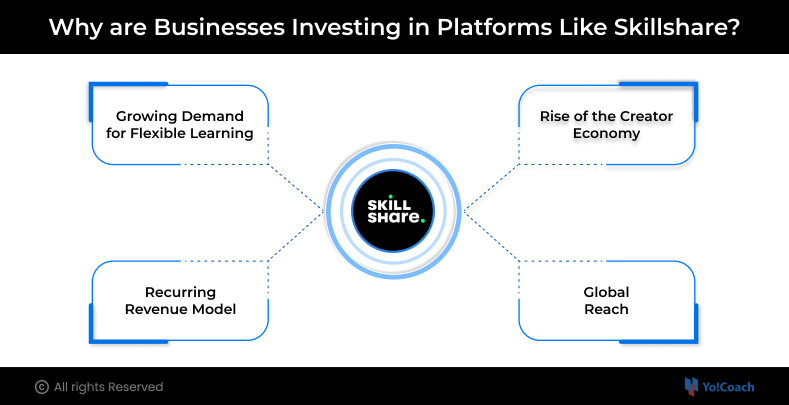
1. Growing Demand for Flexible Learning
Modern learners prefer on-demand education that fits around their schedules. Instead of attending physical classes, they expect access to high-quality video courses anytime, anywhere, and across multiple devices.
2. Rise of the Creator Economy
More professionals are turning their expertise into a source of income through online teaching. A multi-instructor marketplace enables educators to publish and monetize courses while allowing platform owners to continuously expand their content library without creating every course themselves.
3. Recurring Revenue Model
Subscription-based marketplaces generate predictable monthly recurring revenue (MRR), creating a stable and scalable business model. This recurring income makes online learning platforms particularly appealing to startups, entrepreneurs, and investors alike.
4. Global Reach
Unlike traditional education businesses limited by geography, online learning marketplaces can connect instructors and learners from around the world. This global accessibility expands the potential customer base and creates opportunities for sustainable business growth.
Turn Market Demand into a Profitable Marketplace
What Features are Required to Build a Platform Like Skillshare?
The cost of building a platform like Skillshare is directly influenced by the features you choose to include. Since the platform serves learners, instructors, and administrators, each user group requires a dedicated set of functionalities to ensure a seamless experience. The more advanced and customized these features are, the higher the overall development cost.
Let’s have a look at some of the required features:
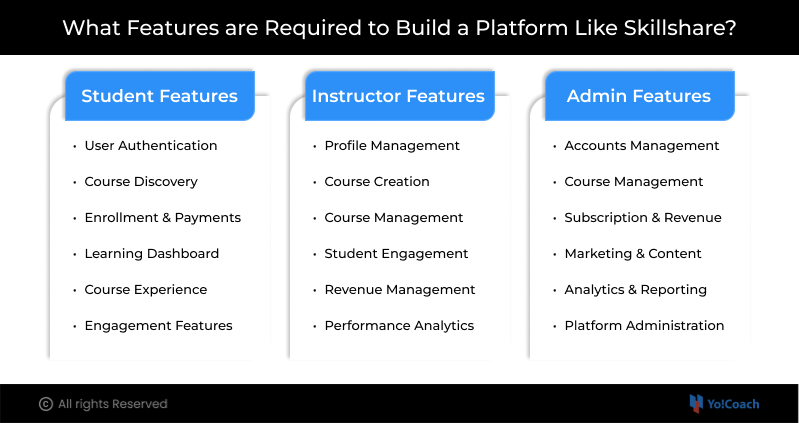
Student Features
Students expect an intuitive learning experience, from discovering courses to completing them successfully. A well-designed student interface should simplify course enrollment, enhance engagement, and help learners track their progress throughout their learning journey.
Essential student features include:
- User Authentication: Quick and easy registration, login, social sign-in, and profile management.
- Course Discovery: Advanced search, category-based browsing, filters, personalized recommendations, and wishlists.
- Course Enrollment & Payments: Secure checkout, subscription management, and payment processing.
- Learning Dashboard: Personalized dashboard with enrolled courses, learning progress, and course history.
- Course Experience: HD video streaming, downloadable resources, notes, bookmarks, quizzes, and assignments.
- Engagement Features: Ratings, reviews, certificates, notifications, and course recommendations based on learning behavior.
Instructor Features
A Skillshare-like platform thrives on quality content, making the instructor experience equally important. Instructors should have access to comprehensive tools for creating, managing, promoting, and monetizing their courses without relying on technical expertise.
Essential instructor features include:
- Profile Management: Instructor profiles should showcase expertise, ratings, and published courses.
- Course Creation: Curriculum builder, video uploads, lesson management, quizzes, assignments, and downloadable resources.
- Course Management: Edit existing courses, update content, manage pricing, and publish new lessons.
- Student Engagement: Messaging, discussion moderation, Q&A management, and assignment reviews.
- Revenue Management: Earnings dashboard, payout management, promotional coupons, and sales reports.
- Performance Analytics: Insights into enrollments, learner engagement, course ratings, and revenue performance.
Admin Features
The admin panel acts as the operational backbone of the platform, providing complete control over users, content, finances, and platform operations. A comprehensive dashboard enables administrators to efficiently manage the marketplace while maintaining security and compliance.
Essential admin features include:
- User & Instructor Management: User accounts, instructor approvals, role management, and account moderation.
- Course Management: Course approvals, category management, content moderation, and featured course management.
- Subscription & Revenue Management: Subscription plans, commission settings, payment gateway management, tax configuration, and financial reporting.
- Marketing & Content Management: CMS, email templates, coupon management, promotional campaigns, and SEO settings.
- Analytics & Reporting: User analytics, revenue reports, platform performance metrics, and business insights.
- Platform Administration: Multi-language support, security settings, permissions, notifications, and system configuration.
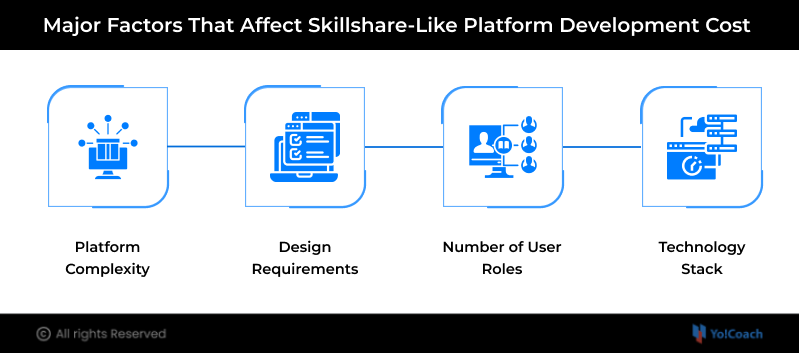
Major Factors That Affect Skillshare-Like Platform Development Cost
No two online learning platforms can have the same development cost. The overall cost depends on several factors, including the platform’s complexity, feature set, technology choices, and customization requirements.
Below are the key elements that significantly impact the final development cost.
1. Platform Complexity
Platform complexity is one of the biggest factors influencing development costs. A basic online course marketplace with essential learning features is far more affordable than a platform offering subscriptions, live classes, certifications, community forums, AI-powered recommendations, and enterprise learning capabilities. As you add advanced functionalities, both development time and the overall project cost increase.
2. Design Requirements
A professionally designed user interface enhances the learning experience while reinforcing your brand identity. Although pre-built templates can help reduce development costs, a fully customized UI/UX requires additional design and frontend development effort and user testing, resulting in an increased overall budget.
3. Number of User Roles
A Skillshare-like platform typically serves multiple user groups, such as students, instructors, administrators, organizations, moderators, and affiliates. Each role requires dedicated dashboards, permissions, and workflows, adding to the platform’s complexity and increasing development efforts and costs.
4. Technology Stack
The choice of technology stack also plays a crucial role in determining development costs. Selecting the right frontend and backend technologies, cloud infrastructure, databases, and third-party integrations ensures scalability, security, and reliability while influencing both initial development and ongoing maintenance costs.
Reduce Development Costs with the Right Strategy
How Much Does It Cost to Build a Platform Like Skillshare?
The total cost of building a Skillshare-like platform depends on the scope of your project and the technologies involved. From UI/UX design and core platform development to video streaming, payment integration, and mobile applications, each component contributes to the overall investment. Understanding these cost allocations helps businesses plan realistic budgets and prioritize features based on their goals.
| Development Component | Estimated Cost |
| UI/UX Design | $5,000 – $15,000 |
| Frontend Development | $10,000 – $30,000 |
| Backend Development | $20,000 – $70,000 |
| Database Architecture | $5,000 – $12,000 |
| Video Streaming Integration | $5,000 – $20,000 |
| Payment Gateway Integration | $3,000 – $10,000 |
| Subscription Management | $5,000 – $15,000 |
| Admin Dashboard | $8,000 – $25,000 |
| Mobile Applications (iOS & Android) | $25,000 – $80,000 |
| QA & Testing | $8,000 – $20,000 |
| Deployment & DevOps | $3,000 – $10,000 |
Estimated Total: $40,000-$300,000+, depending on the scope and level of customization.
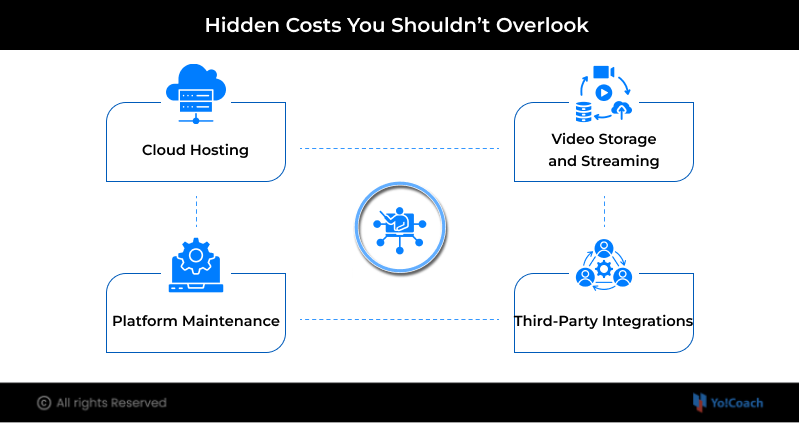
Hidden Costs You Shouldn’t Overlook
While development is a major investment, it’s only one part of the overall cost of running an online learning marketplace. Ongoing operational expenses such as hosting, maintenance, and third-party services can significantly impact your total cost of ownership. Planning for these recurring costs helps ensure long-term platform stability and scalability.
1. Cloud Hosting
Cloud hosting is one of the largest recurring expenses for video-based learning platforms. As your user base, course library, and streaming traffic grow, you all need additional storage, bandwidth, and computing resources to maintain a fast, reliable, and uninterrupted learning experience.
Estimated Annual Cost: $2,000-$20,000+
2. Video Storage and Streaming
High-quality video hosting requires scalable infrastructure for storing, processing, and streaming educational content. Expenses typically include video transcoding, content delivery networks (CDNs), streaming optimization, and backup storage, all of which increase as your platform expands.
Estimated Annual Cost: $3,000-$25,000+ (varies based on video usage and traffic)
3. Platform Maintenance
Regular maintenance keeps your marketplace secure, stable, and compatible with evolving technologies. This includes bug fixes, security updates, performance optimization, framework upgrades, and feature enhancements for both learners and instructors.
Estimated Annual Cost: 15-20% of the initial development cost.
4. Third-Party Integrations
Most modern learning platforms rely on external services for enhanced functionality, such as payment processing, video conferencing, email automation, analytics, CRM, marketing, and customer support. Since many of these tools operate on subscription-based pricing, they contribute to recurring operational expenses.
Estimated Annual Cost: $2,000-$15,000+ (depending on the number and scale of integrations)
Custom Development vs. White-Label Software
One of the biggest decisions you’ll make is whether to build your platform from scratch or launch with a ready-made solution. To make the decision, it is essential to understand both approaches. Let’s have a look at them:
Custom Development
Custom development gives you complete control over your platform’s design, features, and workflows, allowing you to build a solution tailored to your exact business requirements. However, this approach typically involves higher development costs, longer timelines, and ongoing responsibility for maintenance, updates, and technical support. It is best suited for enterprises with highly specialized needs that cannot be addressed by existing marketplace software.
White-Label Software
White-label software comes with essential marketplace features already built, allowing businesses to customize branding and configure the platform according to their requirements. This significantly reduces development time, lowers upfront investment, and enables entrepreneurs to focus on user acquisition and business growth rather than building core functionality from scratch. For startups and growing businesses, this approach often provides a faster path to market and a lower overall investment.
| Factor | Custom Development | White-Label Software |
| Initial Cost | High | 5x Lower |
| Time to Launch | 8–18 Months | Few Weeks |
| Customization | Extensive | High (Within Platform Capabilities) |
| Technical Risk | Higher | Lower |
| Maintenance Responsibility | Your Team | Software Provider |
| Scalability | Depends on Development | Built for Growth |
| Faster ROI | No | Yes |
Why Businesses are Choosing Yo!Coach Instead of Building from Scratch?
For entrepreneurs looking to launch an online learning marketplace similar to Skillshare, starting with a ready-made platform can significantly reduce both cost and time to market. Instead of investing months in building core marketplace functionality, businesses can focus on branding, acquiring instructors, and growing their learner community.
Purpose-built for online tutoring, coaching, and eLearning marketplaces, Yo!Coach includes the essential capabilities required to launch a scalable online learning platform, including:
- Multi-instructor support
- Course and session management
- One-on-one and group learning
- Secure payment integrations
- Instructor and learner dashboards
- Reviews and ratings
- Subscription-ready architecture
- Admin management tools
- Multi-language and multi-currency support
With these features already in place, businesses can customize the platform to align with their specific business model instead of building fundamental marketplace functionality from scratch, enabling a much faster launch.
Benefits of Choosing Yo!Coach
- Lower initial investment compared to full custom development.
- Faster time to market helps you capitalize on opportunities sooner.
- Scalable architecture designed to support business growth.
- Customization options to reflect your brand and unique workflows.
- Reduced technical risk with a solution that’s already tested and market-ready.
For startups, educational institutions, and SMBs, this approach provides a faster path from idea to revenue while minimizing development complexity and technical overhead.
See How Yo!Coach Accelerate Your Marketplace Launch
Conclusion
Building a platform like Skillshare presents a significant opportunity in today’s rapidly growing online learning market. However, the total development cost can range from $40,000 for a basic MVP to over $300,000 for an enterprise-grade marketplace, depending on your feature requirements, customization needs, and development approach.
While custom development offers complete flexibility, it also requires substantial time, budget, and ongoing technical resources. For many startups, educational institutions, and entrepreneurs, launching with a ready-made solution is a more practical way to enter the market quickly and validate their business idea.
If you are looking to launch a scalable online learning marketplace without the complexities of building from scratch, Yo!Coach provides a cost-effective, market-ready solution. With built-in capabilities such as multi-instructor support, course management, secure payments, learner and instructor dashboards, subscription readiness, and extensive customization options, it enables businesses to launch faster while significantly reducing development costs and technical risk.
Launch a Multi-Instructor Learning Platform with Lower Investment
Connect With Us