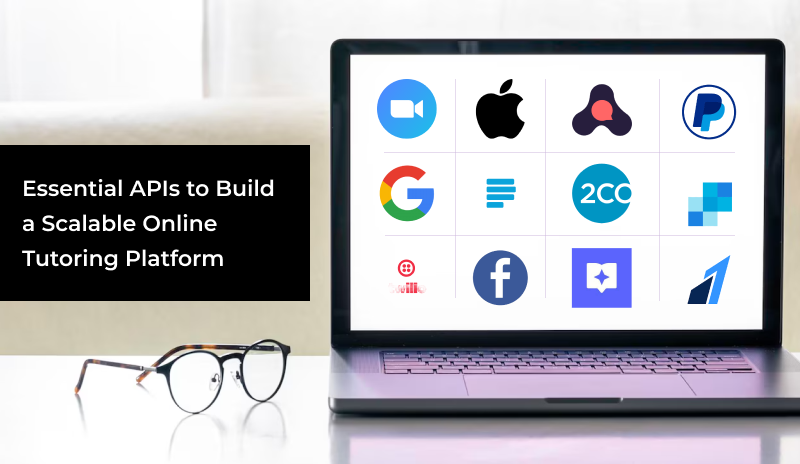
Building an online tutoring platform takes much more than hosting a website with course listings and tutor profiles. A modern EdTech platform must offer a complete learning experience, including live video classrooms, multi-currency payments, document sharing, real-time chat, automated scheduling, and seamless authentication.
The most efficient way to offer all these is through API integrations. APIs act as digital bridges that connect your platform with the services users rely on for learning and communication.
Without the right APIs, the platform risks poor usability, scalability issues, weak student engagement, and ultimately lost revenue. Let’s explore the most essential APIs that must be integrated into a future-ready tutoring platform.
Table of Contents
Top 20+ Must-Have APIs for a Competitive and Scalable Online Tutoring Platform
To build a modern tutoring website that delivers an interactive and scalable learning experience, integrating the following APIs is crucial. Each serves a specific purpose in boosting automation, engagement, increasing revenue, and improving user convenience across the platform.
1. Zoom API
The Zoom API is one of the most widely trusted solutions for hosting live, interactive online classes. It supports live 1-on-1 and group learning sessions. Further, it enables HD video calling, screen sharing, recording, breakout rooms, attendance tracking, and host controls.
- Why it matters: Makes online learning feel real-time and human, improving student engagement.
- Benefit: Tutors can teach from anywhere with full class management features, ensuring smooth and professional lessons.
2. Lessonspace API
Lessonspace is built specifically for education, offering collaborative whiteboards, code editors, math tools, and shared documents in a single virtual classroom interface. This transforms lessons into hands-on learning experiences.
- Why it matters: Supports multiple subjects, including math, coding, science, and languages.
- Benefit: Enhances learning outcomes by turning lessons into interactive learning experiences, leading to stronger understanding and improved outcomes.
3. Atomchat API
Atomchat enables seamless live communication through live video, audio, and chat for real-time interaction, both during and outside scheduled sessions. It keeps all communication within the platform, eliminating the need for third-party tools.
- Why it matters: Students and tutors can stay connected without needing WhatsApp, Zoom links, or third-party tools.
- Benefit: Increases trust, communication frequency, and repeat bookings, increasing student retention.
4. Google Calendar API
This API automatically syncs booked sessions with learners’ and tutors’ personal Google Calendars. Additionally, it supports reminders, updates, and scheduling adjustments in real time.
- Why it matters: Eliminates scheduling confusion and ensures reminders are automated.
- Benefit: Significantly reduces session drop-outs and missed lessons by keeping everyone on schedule.
5. iCalendar API
iCalendar makes it possible to export scheduled class sessions to any third-party calendar tool, such as iOS, Outlook, Android, and more.
- Why it matters: Supports users who do not depend on Google Calendar.
- Benefit: Ensures that learners across all devices and preferences stay informed effortlessly.
6. Stripe API
Stripe offers a secure and trusted platform for global card payments, subscriptions, automatic invoicing, and fraud prevention. Its flexibility makes it ideal for recurring education models.
- Why it matters: Enables recurring revenue models like monthly packages and memberships.
- Benefit: Students can pay conveniently in their preferred currency.
7. PayPal API
PayPal’s global recognition and digital wallet payments supporting 200+ markets and various local payment methods make it a powerful payment option for international learners.
- Why it matters: Many international learners already rely on PayPal for online transactions, especially for cross-border transactions.
- Benefit: Builds payment trust, adds credibility and increases global conversion rates.
8. Authorize.Net API
Authorize.Net is a leading U.S. payment gateway that supports cards, digital wallets, ACH transfers, and fraud detection. Other than that, it offers features like automated recurring billing, customer information management, and more.
- Why it matters: A High acceptance rate in North America improves enrollment for U.S.-focused platforms.
- Benefit: Ensure faster and safer payments for U.S. learners, which helps boost conversions and platform credibility.
9. Razorpay API
Razorpay offers a comprehensive suite of payment options, including UPI, cards, net banking, digital wallets, and BNPL. It is the most relevant payment system for the Indian edtech market, supporting instant refunds, automated settlements, and subscription billing.
- Why it matters: India is one of the fastest-growing eLearning regions in the world. Thus, integrating Razorpay is essential to capture the Indian audience.
- Benefit: Helps maximize conversions in the Indian student community, making the entire checkout process smooth and intuitive.
10. Paystack API
Paystack is the dominant payment leader across African markets with support for cards, mobile money, and bank payments. It is known for high success rates, intuitive integration, and strong anti-fraud features.
- Why it matters: Africa is emerging as a strong online tutoring consumer base. Thus, having an API tailored for African learners is essential.
- Benefit: Provides frictionless payments for African learners, removing barriers that global gateways often struggle with in the region.
11. 2Checkout API
2Checkout supports international payments in 45+ payment methods, including cards, PayPal alternatives, regional wallets, and bank transfers, and operates in 200+ countries. Beyond that, it also includes tax compliance tools, subscription management, and localized checkout pages.
- Why it matters: Platforms targeting global learners need broader reach than gateways like Stripe/PayPal alone to reach learners in Asia, Europe, the Middle East, and South America.
- Benefit: Supports both one-time payments and subscriptions worldwide, enabling broader market reach and higher revenue potential.
12. Mangopay API
Mangopay is designed for marketplace platforms offering multi-party transactions with escrow capabilities and tutor payout automation. It supports regulatory compliance (KYC/KYB), ensuring secure money movement between multiple parties.
- Why it matters: Ideal for marketplaces where the platform takes a commission from tutors.
- Benefit: Ensures transparent, secure, and automated revenue distribution, protecting both tutors and the platform, eliminating manual payout management.
13. SendGrid Email API
SendGrid provides reliable delivery of platform notifications, booking confirmations, password resets, and instructor updates. It offers analytics, A/B testing, and sender reputation tools.
- Why it matters: Timely communication drives student retention and avoids missed classes.
- Benefit: Ensures every important email reaches the inbox instantly, improving engagement, session attendance, and platform professionalism.
14. SMTP/Mailgun API
Mailgun and other SMTP services enable platforms to send authenticated, domain-branded transactional emails that build trust. These services provide detailed logs, spam-filter testing, analytics, and strong deliverability optimization.
- Why it matters: Improves brand trust and prevents email deliverability issues.
- Benefit: Notifies users without fail about schedules, payments, and messages.
15. Twilio SMS API
Twilio enables instant SMS delivery of booking reminders, OTPs, verification codes, and real-time alerts. It supports global coverage and advanced automation workflows.
- Why it matters: SMS reminders reach users instantly, drastically reducing missed sessions and no-shows.
- Benefit: Learners stay updated even without access to email or app notifications.
16. Google Login API
This API lets users sign in via Google without filling out lengthy registration forms. It supports OAuth 2.0 authentication and ensures secure identity verification.
- Why it matters: Removes onboarding friction, essential for conversion. Hence, users are less likely to abandon sign-up when they can join instantly.
- Benefit: Boosts sign-up rate, especially among first-time learners and among students who prefer fast, simplified login processes.
17. Facebook Login API
Facebook Login allows quick authentication using Facebook accounts. Moreover, it automatically pulls verified user information to create accounts quickly.
- Why it matters: Supports mobile-first and social-media-driven learners.
- Benefit: Saves time at registration, improves user retention, and removes friction during onboarding.
18. Apple Login API
Apple Login offers privacy-focused, secure authentication. It supports features like private email relay to protect user identity.
- Why it matters: Builds trust with iOS audiences and improves App Store acceptance.
- Benefit: Deliver a secure one-tap login that helps attract and retain all Apple (iPhone and iPad) users.
19. AWS S3 API
AWS S3 is an enterprise-grade cloud storage for files, lesson materials, homework, assignments, and shared folders. It offers high durability, encryption, access control, and fast retrieval.
- Why it matters: Secure and scalable, it handles millions of uploads efficiently. Additionally, it is essential to avoid data loss and performance issues.
- Benefit: Learners can access stored files anytime across devices, without lag, while the platform enjoys virtually unlimited storage capacity.
20. CometChat API
CometChat provides real-time messaging features, including 1-to-1 messaging with chat history, file transfer, emojis, and typing indicators.
- Why it matters: Community interaction strengthens tutor-student relationships and helps tutors provide guidance even outside lessons.
- Benefit: Helps sustain interest and improves long-term subscription retention.
21. WebRTC API
WebRTC powers high-quality, peer-to-peer real-time streaming technology for ultra-low latency audio and video. Further, it eliminates the need for plugins, runs in the browser, and adapts to varying network speeds.
- Why it matters: Guarantees smooth teaching even in low or inconsistent-bandwidth regions.
- Benefit: Students experience uninterrupted virtual lessons.
22. Geolocation API
This API detects user location automatically to personalize currency, time zone, localization, and tutor recommendations. It enhances the user experience by adapting the platform to regional needs.
- Why it matters: Hyper-personalization boosts conversion and increases trust.
- Benefit: Students instantly see relevant tutors and pricing in their context.
23. Currency Exchange API
This API auto-updates pricing using real-time global currency conversion rates. It ensures transparent pricing for global learners.
- Why it matters: Eliminates manual price guesswork for international students.
- Benefit: Higher enrollment due to transparent pricing visibility.
Looking for a Readymade Tutoring Software Equipped with These APIs?
How APIs Become the Backbone of a High-Performing eLearning Platform?
APIs don’t just add features to an eLearning platform; they define how smoothly every learning interaction works. The right combination of APIs ensures that teaching, learning, payments, communication, and engagement happen effortlessly in the background, without users ever thinking about the technology powering it.
Below is a clearer look at what each API category actually unlocks for the platform:
| API Category | Description |
| Virtual Classroom & Video APIs | Turn online sessions into an immersive learning space where tutors can collaborate with students through shared screens, interactive whiteboards, recordings, and real-time video. |
| Payment APIs | Simplify revenue flow by supporting international payments, wallets, promo codes, subscriptions, and automated tutor payouts, ensuring that selling and earning do not become a bottleneck. |
| Scheduling APIs | Remove the headache of manual scheduling with time-zone syncing, instant booking, automated reminders, attendance logs, and cancellation/rescheduling logic. |
| Messaging & Communication APIs | Keep learners and tutors connected throughout the learning journey with in-platform chat, alerts, notifications, assignment links, and support requests, all from one place. |
| Push & Email Notification APIs | Encourage consistent learning behavior through timely notifications, task reminders, session alerts, new course suggestions, progress prompts, and promotional messages. |
| Authentication & Identity APIs | Make onboarding friction-free and secure through Google/Apple sign-ins, SSO, OTP login, and role-based access control for admins, students, parents, and tutors. |
| Content & Storage APIs | Allow users to upload and access course files, recorded sessions, notes, and study material securely from any device without storage limitations. |
| Localization & Globalization APIs | Make the platform expansion-ready with support for multiple languages, dynamic currency conversion, time-zone detection, and geo-based personalization. |
Why Yo!Coach Outperforms Custom Development & WordPress Solutions
While entrepreneurs often explore custom development or WordPress plugins to build an online tutoring portal, these routes often come with hidden limitations, such as long development timelines, constant plugin conflicts, and expensive maintenance cycles. On the other hand, Yo!Coach removes all of these barriers by offering a platform that is specifically designed for tutoring and consultation marketplaces. Moreover, it comes equipped with essential features and APIs, making the solution an ideal choice for edupreneurs ready to enter the eLearning landscape. Further, mentioned below are the key factors that make Yo!Coach is a better choice than custom development and WordPress solutions.
Here’s what truly differentiates it:
- No months-long development, launch in weeks, not years
Custom platforms can take 8-14 months to build and stabilize an eLearning platform. Whereas, Yo!Coach is pre-equipped with core tutoring features and ready APIs, enabling faster go-to-market with full reliability. - No dependency on plugins or third-party themes
WordPress relies heavily on external plugins for video conferencing, payments, scheduling, and learning tools. This leads to compatibility issues and constant updates. In comparison, Yo!Coach ships with these capabilities built-in and deeply integrated. - Purpose-built for tutoring & 1-on-1 learning workflows
Unlike generic LMS solutions that require heavy customization, Yo!Coach is designed specifically for live learning, session bookings, tutor availability rules, lesson packages, student progress tracking, commissions, and multi-role dashboards. - Scalability without technical limitations
Custom and CMS-based solutions often struggle when the user base grows. However, Yo!Coach is architected to scale, whether hosting 100 or 10,000 concurrent sessions, without performance drop. - Full ownership and extensibility
Unlike SaaS tools that lock business owners into subscription pricing models, Yo!Coach provides lifetime ownership with the freedom to customize and integrate additional APIs as the business evolves. - Lower total cost of ownership
A custom-built tutoring website can easily cross $50,000-$100,000 in development and upgrades. Alternatively, Yo!Coach delivers all premium tutoring features at a fraction of the investment, without compromising performance, security, or flexibility.
Unlock the Full Potential of Yo!Coach
Quick Comparison, Custom Development vs WordPress vs Yo!Coach
The comparison clearly shows that Yo!Coach removes the uncertainty of development, plugins, and scalability challenges that slow down most tutoring startups. With everything pre-engineered for online learning workflows, it enables founders to launch confidently, reduce total ownership cost, and focus on acquiring learners rather than fixing technology.
| Key Metric | Custom Development | WordPress Plugins / LMS Themes | Yo!Coach |
| Development Time | 8-14 months | 3-6 months | 2-8 weeks |
| Upfront Cost | Very high | Moderate | Low & one-time license |
| Scalability | Depends on internal team | Limited, plugins slow performance | High, built for large marketplaces |
| Stability | Requires continuous QA & fixes | Breaking changes after updates | Stable, pre-tested & enterprise grade |
| API Integrations | Build from scratch | Decentralized, plugin dependent | All essential tutoring APIs pre-integrated |
| Ownership | Yes, with high maintenance costs | No, theme & plugin dependency | Yes, lifetime source code ownership |
| Customization | Possible, but expensive | Limited to theme/plugin structure | Flexible & developer-friendly |
| Security | Depends on coding quality | High risk due to plugins | Secure, GDPR-compliant architecture |
| Support & Maintenance | Paid + team required | Community-based, slow | Dedicated product support |
Conclusion
Building a modern tutoring marketplace is no longer just about listing tutors online; it’s about providing a seamless, engaging, and reliable learning ecosystem. API-powered capabilities such as virtual classrooms, automated scheduling, multi-currency payments, communication tools, and analytics play a significant role in delivering that experience.
Instead of building each of these components from scratch or relying on unstable plugin-based solutions, Yo!Coach offers a shortcut to success with a pre-integrated, scalable, and feature-rich tutoring platform. With faster launch time, lower ownership cost, and the flexibility to customize, it empowers entrepreneurs to focus on marketing and global expansion rather than platform development.
FAQs
Q 1. Why are APIs important for an online tutoring platform?
Ans. APIs enable different systems, such as video conferencing, payments, scheduling, messaging, and localization, to work together smoothly. Without APIs, delivering uninterrupted online learning at scale becomes extremely difficult and expensive.
Q 2. Can I integrate additional APIs later if my business grows?
Ans. Yes, you can integrate additional APIs later. Solutions like Yo!Coach provides complete access to the source code, allowing businesses to expand and integrate new APIs based on evolving market needs and growing business.
Q 3. Are third-party API subscriptions included in Yo!Coach’s cost?
Ans. Yo!Coach comes pre-integrated with APIs, but their subscription charges (if applicable) depend on the provider, such as Zoom, Google APIs, Stripe, etc. You only pay for the services you choose to activate.
Q 4. How fast can I launch a tutoring website using Yo!Coach?
Ans. Depending on branding and customization needs, your tutoring website can typically go live within 2-8 weeks, compared to several months (or even a year) with custom development.
Q 5. Is Yo!Coach scalable for enterprise-level tutoring businesses?
Ans. Yes, Yo!Coach is scalable for an enterprise-level tutoring business. It is architected to support high traffic, thousands of tutors, and large volumes of live sessions, making it suitable for both startups and large global tutoring brands.
Q 6. How is Yo!Coach different from WordPress plugins or LMS themes?
Ans. Unlike plugin-driven systems, where every feature depends on a separate third party, Yo!Coach offers an all-in-one architecture with pre-integrated APIs for payments, virtual classrooms, notifications, scheduling, and security, eliminating conflicts and performance issues.
Q 7. Can I fully customize Yo!Coach for my niche?
Ans. Yes, you can customize Yo!Coach as per your business niche. It is a white-label and customizable solution, enabling businesses to tailor user journeys, designs, workflows, and monetization models to any tutoring niche.
Q 8. Do I get full ownership after purchase?
Ans. Yes, with Yo!Coach, you get full ownership after purchase. It is a one-time license system that offers lifetime source-code ownership, unlike SaaS platforms that lock users into monthly subscription fees.
Ready to Turn Your Tutoring Idea Into a Live Platform
Get In Touch