
Education has crossed a permanent threshold. What began as a necessity during the pandemic has evolved into the dominant delivery model for supplemental learning worldwide. The global online tutoring market is valued at $152.76 billion in 2026 — growing at a staggering CAGR of 23.26% — and the global private tutoring market has reached $131 billion in the same year (Global Growth Insights; The Business Research Company, 2026). For entrepreneurs, educators, and EdTech founders, the opportunity to create an online tutoring platform has never been more compelling.
GoStudent is the benchmark for this category. Founded in Vienna, Austria, in 2016, it has grown into Europe’s most valuable EdTech company — raising over $779M in funding, achieving a $3 billion valuation, connecting 23,000+ certified tutors with 11 million families, and facilitating over 1.5 million tutoring sessions every month across 23 countries.
If you are planning to build a tutoring website, replicate the GoStudent model in your market, or create your own online tutoring platform, this guide breaks down everything: what makes GoStudent work, the features you need, the technology options available, and how readymade tutoring website software like Yo!Coach dramatically reduces your time-to-market.
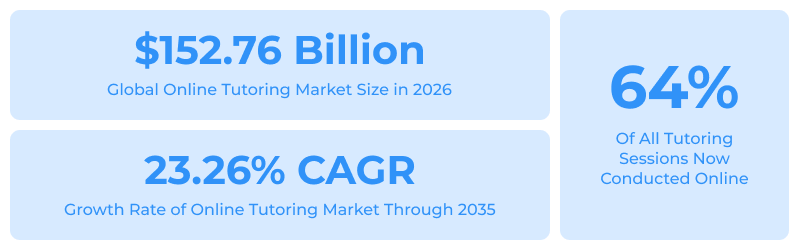
Table of Contents
- Why GoStudent is the Blueprint for Online Tutoring Platform Development
- The 2026 Market Opportunity for Online Tutoring Platforms
- Essential Features to Build a Tutoring Website Like GoStudent
- How to Build an Online Tutoring Platform: Your Technology Options
- Why Yo!Coach is the Smart Choice for Building a Platform Like GoStudent
- Step-by-Step Guide: How to Create an Online Tutoring Platform Like GoStudent
- 2026 Trends Every Tutoring Platform Founder Must Know
- Conclusion: Build Smarter, Launch Faster
- FAQs
Why GoStudent is the Blueprint for Online Tutoring Platform Development
Before you build an online tutoring platform like GoStudent, it pays to understand precisely what has made GoStudent’s model both scalable and profitable — and what challenges you should be prepared to navigate.
GoStudent by the Numbers (2025–2026)
- Total funding raised: $779M+ across 9 rounds from investors including SoftBank Vision Fund 2, DST Global, Prosus, and Tencent
- Peak valuation: $3.21 billion (as of mid-2024; subsequently recalibrated as the company focused on profitability)
- Active tutor network: 23,000+ certified self-employed tutors
- Customer base: 11 million families served across 23 countries
- Session volume: Over 1.5 million tutoring sessions booked per month
- Employees: ~2,747 full-time staff as of early 2026 (Tracxn)
- Subject coverage: 30+ school subjects from primary through secondary education (K-12)
- Recognition: GoStudent named to the 2026 GSV 150 list and won the Personalized Education Solution of the Year at the 2025 EdTech Breakthrough Awards
The GoStudent Model: What Makes It Work
GoStudent is not a generic tutoring directory — it is a structured, subscription-first online learning marketplace. Its model is built on three pillars:
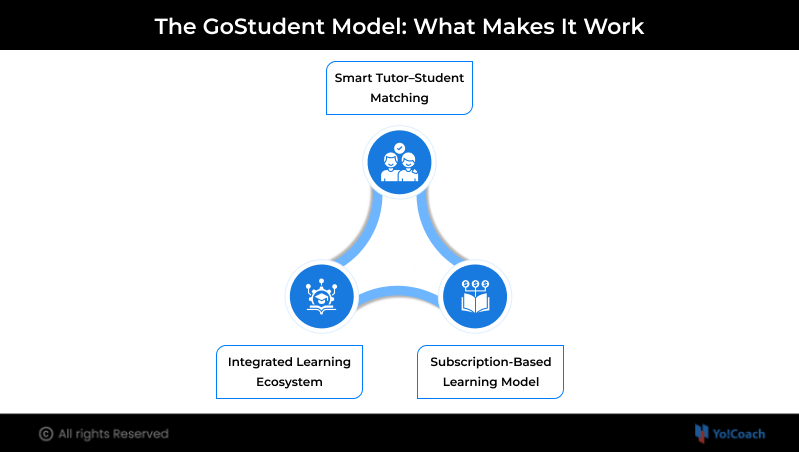
1. Smart Tutor–Student Matching
- GoStudent removes the “search burden” by assigning tutors based on academic needs and personality fit.
- A guided consultation ensures better alignment from day one.
- Leads to higher satisfaction and lower churn compared to open marketplaces.
2. Subscription-Based Learning Model
- Students subscribe to monthly learning plans instead of booking individual sessions.
- Encourages consistency and long-term engagement.
- Creates predictable recurring revenue for the platform.
3. Integrated Learning Ecosystem
- All sessions are conducted within a built-in virtual classroom.
- Includes scheduling, video lessons, whiteboard, and performance tracking in one place.
- Ensures a seamless and controlled learning experience without third-party tools.
Key insight: GoStudent’s profitability turnaround — confirmed by CEO Felix Ohswald in 2025 — came from focusing on its core markets, eliminating unprofitable geographies, and doubling down on subscription economics. Any founder building a tutoring website should design for sustainable unit economics from day one, not just growth.
The 2026 Market Opportunity for Online Tutoring Platforms
The timing for online tutoring platform development has never been stronger. Here are the key data points shaping the landscape:
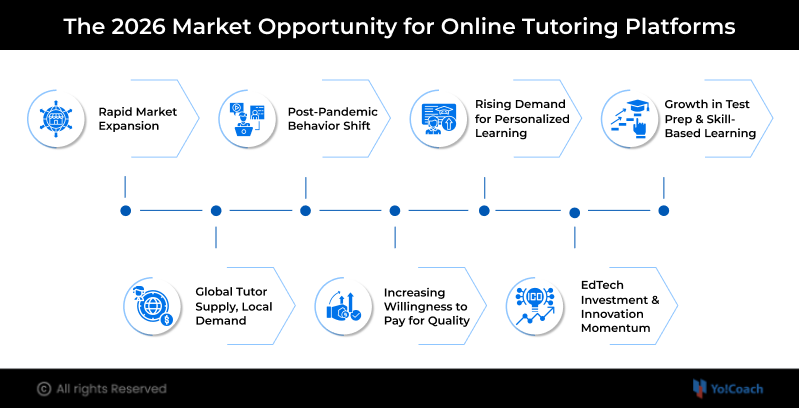
1. Rapid Market Expansion
- The global online tutoring market continues to grow at a double-digit CAGR, driven by digital adoption.
- Increased internet penetration and affordable devices are fueling access across emerging markets.
2. Post-Pandemic Behavior Shift
- Online learning is no longer a backup—it’s a preferred mode for many students and parents.
- Hybrid learning models (online + offline) are becoming the new normal.
3. Rising Demand for Personalized Learning
- One-size-fits-all education is losing relevance.
- Students and parents are actively seeking tailored, one-on-one or small group tutoring solutions.
4. Growth in Test Prep & Skill-Based Learning
- Demand is expanding beyond academics into competitive exams and skill development.
- Categories like coding, languages, and professional upskilling are seeing strong traction.
5. Global Tutor Supply, Local Demand
- Platforms can tap into a global pool of educators while serving localized student needs.
- Enables cost optimization and wider subject availability.
6. Increasing Willingness to Pay for Quality
- Parents are more open to subscription-based learning if outcomes are visible.
- Premium tutoring models are gaining acceptance, especially in urban markets.
7. EdTech Investment & Innovation Momentum
- Continued investor interest is accelerating platform innovation.
- AI-driven learning, analytics, and automation are becoming key differentiators.
Essential Features to Build a Tutoring Website Like GoStudent
Tutoring website development requires a careful balance of student experience, tutor management, and platform administration. Here is a comprehensive breakdown of the features your platform must include:
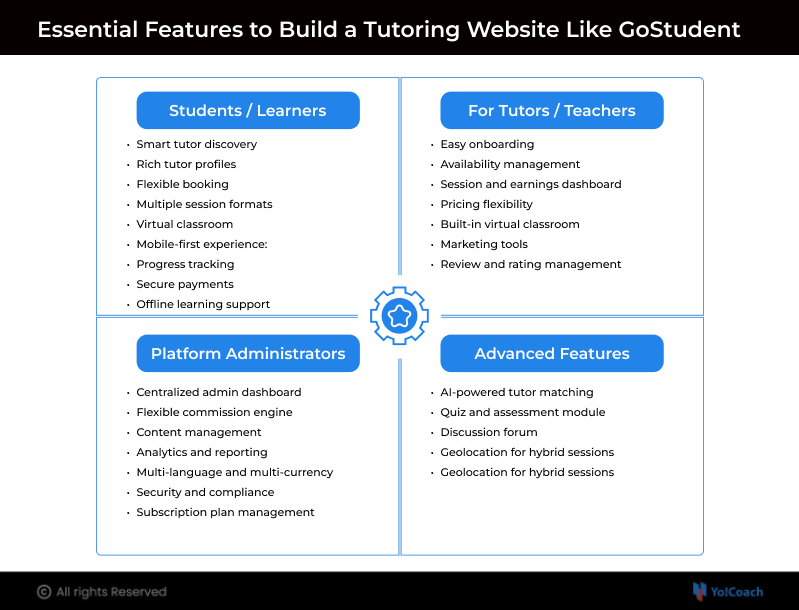
For Students / Learners
- Smart tutor discovery: Search and filter by subject, language, availability, price, rating, and teaching style
- Rich tutor profiles: Qualifications, experience, video introductions, subject specializations, reviews, and ratings
- Flexible booking: Real-time availability calendar, instant booking, session rescheduling, and cancellation management
- Multiple session formats: One-on-one live sessions, group classes, pre-recorded courses, and instant consultation options
- Virtual classroom: Video conferencing, interactive whiteboard, screen sharing, and session recording
- Mobile-first experience: Native iOS and Android apps for learning on the go
- Progress tracking: Session history, learning milestones, quiz performance, and tutor feedback
- Secure payments: Multiple gateway options, wallet functionality, subscription plans
- Offline learning support: For hybrid platforms that combine online sessions with physical attendance
For Tutors / Teachers
- Easy onboarding: Profile creation, document verification, qualification uploads, and approval workflows
- Availability management: Set weekly schedules, block unavailable slots, and sync with Google Calendar
- Session and earnings dashboard: Real-time session notifications, completed session history, and payout tracking
- Pricing flexibility: Set hourly rates, package prices, group class fees, and promotional offers
- Built-in virtual classroom: Whiteboard, screen sharing, recording, and chat tools for effective online teaching
- Marketing tools: Coupons, featured listings, referral programs, and subscription packages to attract and retain students
- Review and rating management: Respond to student feedback and build platform credibility
For Platform Administrators
- Centralized admin dashboard: Full control over users, sessions, payments, commissions, and platform content
- Flexible commission engine: Flat-fee or percentage commissions per session, with tutor-specific rates
- Content management: Blog, FAQ, homepage customization, and SEO management tools
- Analytics and reporting: Revenue reports, tutor performance, student engagement, and platform KPIs
- Multi-language and multi-currency: Essential for global or multi-market platforms
- Security and compliance: GDPR compliance, SSL, 2FA, and safe payment card data handling (PCI-DSS)
- Subscription plan management: Define, activate, and manage tiered subscription packages for learners and tutors
Advanced / Differentiating Features
- AI-powered tutor matching: Diagnostic quiz to assess student needs, then algorithmically match with the best-fit tutor
- Quiz and assessment module: In-built quizzes linked to sessions and courses for progress evaluation
- Discussion forum: Community space where students and tutors can share knowledge and build engagement
- Geolocation for hybrid sessions: Detect student location and suggest nearby tutors for in-person or hybrid bookings
- Gift cards and coupons: Promotional tools for acquisition campaigns and seasonal drives
Ready to Build Your Tutoring Platform?
How to Build an Online Tutoring Platform: Your Technology Options
When evaluating tutoring website development, every founder faces the same fundamental build-vs-buy decision. Here is an honest assessment of each approach:
Option 1: Build from Scratch (Custom Development)
A fully custom-built platform gives complete architectural control. However, this comes with significant time, cost, and risk:
- Timeline: 12–18 months for a production-ready platform
- Cost: $50,000–$100,000+ depending on team, features, and geography
- Risk: High — technical debt, post-launch maintenance, and a long runway before market validation
- Best for: Well-funded ventures with highly unique requirements that readymade solutions cannot meet
Option 2: Open-Source LMS + Custom Development
Platforms like Moodle or WordPress-based solutions can be extended for tutoring use cases, but significant customisation is required:
- Timeline: 4–8 months for a functional tutoring platform
- Cost: $15,000–$60,000+ including development and ongoing maintenance
- Risk: Medium — plugin fragmentation, security vulnerabilities, and limited tutoring-specific features
- Best for: Tech-savvy teams with in-house development resources
Option 3: Readymade Tutoring Platform Software (Recommended)
Readymade solutions like Yo!Coach deliver a complete, tutoring-specific platform that can be live in 3–4 working days. This is the fastest, most economical path for entrepreneurs looking to create an online tutoring platform and validate their model quickly.
- Timeline: Live in 3–4 working days
- Cost: Starting at $1999 (one-time, no recurring fees)
- Risk: Low — battle-tested codebase, active support, and regular feature updates
- Best for: Entrepreneurs, educators, and startups seeking rapid market entry with professional-grade infrastructure
| Approach | Timeline | Cost Range | Best For |
| Custom Development | 12–18 months | $50K–$100K+ | Funded ventures |
| Open Source + Plugins | 4–8 months | $15K–$60K+ | Tech teams |
| Yo!Coach | 3–4 working days | From $1999 | Startups, SMEs & Enterprises |
Why Yo!Coach is the Smart Choice for Building a Platform Like GoStudent
Yo!Coach is a white-label online tutoring software developed by FATbit Technologies — specialists in marketplace software with over 1,000 successfully delivered EdTech projects. Yo!Coach is designed specifically for entrepreneurs who want to build a tutoring website without the cost or complexity of custom development.
Here is a detailed look at what sets Yo!Coach apart from generic solutions:
1. Supports Multiple Business Models Out of the Box
Unlike LMS platforms that focus on course delivery or generic marketplace tools that lack tutoring-specific features, Yo!Coach natively supports:
- One-to-one live tutoring sessions
- Group tutoring classes (scheduled and recurring)
- Pre-recorded self-paced video courses
- Subscription and package-based lesson bundles
- Instant consultation sessions (on-demand tutoring)
- Offline and hybrid session management
2. Built-In Virtual Classroom
Yo!Coach comes pre-integrated with industry-leading video conferencing and collaboration tools:
- Zoom and Lessonspace integrations for high-quality live sessions
- Interactive whiteboard with pen, shapes, highlights, and text tools for real-time collaboration
- Screen sharing, session recording, and live chat
- MUX video streaming for pre-recorded course content — delivering high-quality playback regardless of internet speed
3. One-Time Payment with Lifetime License
Yo!Coach operates on a one-time payment model — no monthly SaaS fees, no per-session charges:
- GoQuick Lite (non-white label): Starting at $999 — ideal for MVPs and early-stage startups
- GoQuick (white label): Starting at $1,999 — full branding control, customizable source code ownership, 1 year free technical support
- GoCustom: For businesses requiring custom design and feature development on top of the base platform
- GoEnterprise: Fully bespoke enterprise-level solution
4. Complete White-Label and Customization Capabilities
Yo!Coach is a fully customizable, white-label solution. From homepage design and colour schemes to deep feature-level modifications, you can build a platform that is 100% your own brand — with no Yo!Coach signature in white-label packages. Customizable source code ownership gives you full control.
5. Multi-Language and Multi-Currency for Global Reach
GoStudent operates across 23 countries. If your ambitions are similarly international, Yo!Coach supports multiple languages (with auto-translation capabilities), real-time currency conversion, and timezone-specific notifications — enabling you to serve learners and tutors across any geography from day one.
6. Advanced Admin Controls and Analytics
Yo!Coach’s admin panel gives platform operators complete visibility and control:
- Set flexible, tutor-specific commission rates (flat fee or percentage)
- Tutor Hour Reports, Wallet Balance Reports, and Teacher Payout Reports for financial management
- Full user management: view tutor specializations, session history, earnings, and reviews
- SEO tools: meta tag management, URL management, XML sitemaps, and robots.txt control
- Marketing features: affiliate module, referral program (Refer and Earn), coupons, and gift cards
7. GDPR Compliance and Enterprise-Grade Security
Yo!Coach is GDPR-compliant, comes with SSL, and supports secure payment processing — making it suitable for platforms operating in Europe and other highly regulated markets, just as GoStudent does.
8. Tutoring Niche Versatility
Yo!Coach supports 12+ tutoring niches, including:
- Academic tutoring (K-12, university)
- Language learning platforms (similar to Cambly, Preply, and italki)
- Test preparation (SAT, GRE, professional certifications)
- Music, arts, and creative coaching
- Corporate training and professional upskilling
- Health and wellness coaching
- Nursing and medical exam preparation
See Yo!Coach in Action
Step-by-Step Guide: How to Create an Online Tutoring Platform Like GoStudent
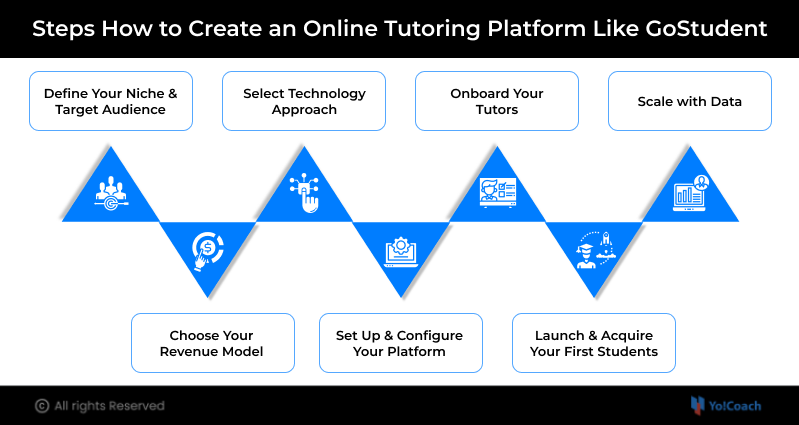
Step 1: Define Your Niche and Target Audience
GoStudent succeeded by focusing tightly on K-12 students in Europe. Your first decision is defining who you serve:
- Age group: K-12, university, adult learners, or professionals?
- Subject focus: STEM, languages, test prep, creative subjects, or multi-subject?
- Geography: Local city, national, regional, or global?
- Session model: Live 1-on-1, group classes, self-paced courses, or a hybrid?
Step 2: Choose Your Revenue Model
The most resilient tutoring platforms combine multiple revenue streams:
- Commission per session: Take a percentage of every session fee (typically 15–30%)
- Subscription plans for learners: Monthly packages of a set number of sessions — replicating the GoStudent membership model
- Subscription plans for tutors: Monthly/annual fees for premium visibility, featured listings, or reduced commission rates
- Featured listings and advertising: Tutors pay for premium placement in search results
- Course marketplace revenue: Percentage of pre-recorded course sales
Step 3: Select Your Technology Approach
For most EdTech entrepreneurs building a tutoring website for the first time, a readymade solution like Yo!Coach is the right choice. It eliminates the 12–18 month development cycle and provides tutoring-specific features that a generic platform cannot offer.
Step 4: Set Up and Configure Your Platform
With Yo!Coach, the launch process is streamlined:
- Purchase your Yo!Coach package and receive the platform
- Free installation and setup on your server of choice (completed by the Yo!Coach team)
- Configure your platform: tutoring categories, commission rates, subscription plans, payment gateways, languages, and branding
- Set up your virtual classroom integrations (Zoom, Lessonspace) and payment gateways (Stripe, PayPal, Authorize.Net)
Step 5: Onboard Your Tutors
Tutor quality is your most important competitive differentiator. GoStudent verifies all tutors. Your platform should:
- Require document verification (qualification certificates, ID, background checks)
- Allow tutors to record a short introduction video for their profile
- Review and approve tutor profiles before they go live
- Provide onboarding resources: session best practices, virtual classroom tutorials, and pricing guidance
Step 6: Launch and Acquire Your First Students
- SEO content: Blog posts targeting high-intent queries like ‘online math tutor for Grade 9’ or ‘English tutoring for exam prep’
- Google Ads and Meta Ads: Run parent-targeted performance campaigns in your launch geography
- School and institutional partnerships: Partner with schools to offer supplemental tutoring to their students
- Social media: Instagram,and YouTube are highly effective for reaching students and parents
- Referral programs: Use Yo!Coach’s built-in Refer and Earn module to drive word-of-mouth growth
Step 7: Scale with Data
Use Yo!Coach’s built-in analytics to monitor tutor performance, student retention, session completion rates, and revenue per user. Optimize your commission structures, featured listing pricing, and subscription packages based on real platform data.
2026 Trends Every Tutoring Platform Founder Must Know
1. AI-Driven Personalization Is Table Stakes
68% of online learners now use AI-based tutoring tools. Platforms that offer AI-powered tutor matching, adaptive learning paths, and automated progress tracking will outperform those that rely solely on manual search-and-book models. GoStudent’s AI diagnostic matching is a core differentiator.
2. The Hybrid Learning Model
GoStudent’s acquisition of Studienkreis and its expansion into physical pop-up locations signals a broader industry shift. The most successful tutoring platforms in 2026 offer both online sessions and offline/in-person options — giving students flexibility and increasing platform stickiness. Yo!Coach supports offline session management natively.
3. Mobile-First Delivery
48% of EdTech growth globally is driven by mobile education apps. Students expect to book sessions, join classes, and review materials on their smartphones. A platform without a polished mobile app is immediately at a disadvantage.
4. Group Classes and Cohort Learning
On-demand one-on-one tutoring still leads (76% of sessions by revenue), but structured group sessions are growing at 18.9% CAGR through 2030. Group classes dramatically improve platform margins and enable tutors to earn more per hour while keeping prices accessible for students.
5. Professional and Adult Upskilling
While K-12 remains the largest segment, professional and adult learning is growing fastest at 16.2% CAGR. Corporate upskilling, professional certification prep, and language learning for career advancement represent massive untapped market segments for new tutoring platforms.
6. Subscription and Package Economics
GoStudent’s subscription model is its commercial foundation. Families spend an average of $2,400 per year on tutoring (SchedulingKit, 2026). Platforms that convert one-off sessions into monthly subscriptions — with automatic renewal — build far more predictable, defensible revenue than session-by-session marketplaces.
Launch Your Tutoring Platform Faster with Yo!Coach
Conclusion: Build Smarter, Launch Faster
GoStudent’s journey from a Vienna startup to a $3 billion EdTech giant — funded by SoftBank, DST, and Prosus, serving 11 million families across 23 countries — illustrates the enormous potential of the online tutoring market. But the core of what they built is not proprietary technology. It is a well-designed platform, a subscription business model, quality tutors, and relentless focus on the student experience.
In 2026, the global online tutoring market is worth $152.76 billion and growing at 23%+ annually. The question is not whether to build — it is how fast you can get your platform live and into the market.
For entrepreneurs and educators who want to create an online tutoring platform without spending $100K and waiting 18 months, Yo!Coach offers the most practical path to market: a feature-complete, white-label, fully customizable tutoring software with a one-time investment, lifetime license, and a support team that has delivered 1,000+ EdTech platforms worldwide.
Frequently Asked Questions (FAQs)
Here are the most common questions from entrepreneurs planning to build a tutoring website or online tutoring platform:
Q 1. How much does it cost to build an online tutoring platform like GoStudent?
Ans. The cost varies significantly by approach. Custom development from scratch typically costs $50,000–$100,000 and takes 12–18 months. Open-source solutions with customisation range from $15,000–$60,000. The most cost-effective path is a readymade solution like Yo!Coach, which starts at $999 for the GoQuick Lite package and $1,999 for the full white-label GoQuick package — both with one-time payments and no recurring SaaS fees. The total cost of ownership over 3–5 years is significantly lower with Yo!Coach.
Q 2. What features are essential to build a tutoring website like GoStudent?
Ans. At minimum, your platform needs: tutor profiles with search and filtering, real-time availability booking, one-on-one live video sessions (with virtual whiteboard), payment processing with commission management, student and tutor dashboards, session history and progress tracking, review and rating systems, and mobile-friendly access. Advanced features to add over time include: AI-powered tutor matching, group classes, pre-recorded course delivery, subscription plans, and geolocation for hybrid sessions. Yo!Coach includes all of these features natively.
Q 3. How long does it take to launch an online tutoring platform with Yo!Coach?
Ans. With Yo!Coach, your platform can be installed and ready in 3–4 working days. The Yo!Coach team handles setup and installation on your server. The total time to full launch — including configuring your categories, payment gateways, branding, and onboarding your first tutors — typically takes 2–4 weeks for most businesses, compared to 12–18 months for a custom-built platform.
Q 4. Can I use Yo!Coach to build a platform specifically for language learning, test prep, or professional coaching?
Ans. Yes. Yo!Coach supports 12+ tutoring and coaching niches, including K-12 academic tutoring, language learning (similar to Cambly and Preply), test preparation, music and creative coaching, corporate training, health and wellness coaching, and professional certification preparation. The platform is fully customizable to suit your specific niche, audience, and session format.
Q 5. Does Yo!Coach support mobile apps for students and tutors?
Ans. Yes. Yo!Coach comes with pre-built native iOS and Android learner apps, enabling students to search for tutors, book sessions, join live classes, and access course materials on their smartphones. Given that 48% of EdTech growth globally is driven by mobile education apps, a polished mobile experience is critical to competing in 2026.
Q 6. What revenue models can I implement on a tutoring platform built with Yo!Coach?
Ans. Yo!Coach supports all major tutoring platform revenue models: (1) Commission per session — admin earns a percentage of every tutor payout; (2) Subscription plans for learners — monthly or annual packages of sessions; (3) Subscription plans for tutors — monthly fees for premium features or reduced commissions; (4) Featured listings — tutors pay for priority placement in search results; (5) Course marketplace commissions — percentage of pre-recorded course sales; (6) Gift cards and coupons — promotional tools for acquisition and retention campaigns.
Q 7. Is Yo!Coach GDPR compliant — important for European markets like GoStudent’s?
Ans. Yes. Yo!Coach is fully GDPR-compliant and comes with SSL security and secure payment card data handling. This makes it suitable for platforms operating in Europe, the UK, and other highly regulated markets. Given that GoStudent operates across 23 European and international markets, GDPR compliance is a non-negotiable requirement for any tutoring platform targeting similar geographies.
Q 8. Can Yo!Coach support both online and offline (hybrid) tutoring sessions?
Ans. Yes. Yo!Coach includes built-in offline session management. Admin can enable or disable offline sessions with a single click. The platform also includes geolocation functionality that automatically detects a learner’s location and suggests tutors within a specified radius for in-person sessions. This directly mirrors the hybrid model that GoStudent has invested in through its Studienkreis acquisition.
Q 9. What makes Yo!Coach different from a generic LMS or other tutoring software?
Ans. Yo!Coach is purpose-built for tutoring and consultation marketplace models — unlike generic LMS platforms (Moodle, Teachable) that focus on course delivery, or generic marketplace tools that lack tutoring-specific features. Key differentiators include: one-to-one and group live session management, virtual whiteboard and video conferencing integration, flexible commission and payout management, tutor onboarding and verification workflows, subscription and package management, mobile apps for learners, GDPR compliance, 12 months free technical support, and a one-time pricing model with lifetime license.
Launch Your Tutoring Platform Like GoStudent
Explore Yo!Coach