
Last Published Date: 14th September, 2026
Canada’s tutoring market is becoming increasingly attractive for entrepreneurs, education companies, tutors, and technology businesses looking to build an enterprise around offering a digital learning experience. This transition towards online education has made it possible to seamlessly connect learners with qualified tutors without being restricted by classroom location. Moreover, digital scheduling, payments, video classes, and learning management tools have made the underlying business much easier to operate at scale and target a global consumer base.
The market opportunity is substantial as Canada’s online tutoring services market generated approximately US$971 million in 2024 and is projected to reach around US$2.25 billion by 2030, growing at a CAGR of 14.8% between 2025 and 2030. During this period, Canada is also projected to be the fastest-growing country-level market in North America. Moreover, indicating a strong demand for flexible, booking-based learning experiences, on-demand tutoring accounted for approximately 90.55% of Canadian online tutoring services revenue in 2024.
However, a growing market does not automatically translate into a successful tutoring platform. The real challenge is building a business model around a specific audience, creating enough tutor supply, designing a convenient learning experience, selecting the right technology, and developing a sustainable customer acquisition strategy.
To assist with the initiation of your business, this guide explains how to build an online tutoring platform in Canada, from choosing the business model and defining the target audience to selecting features, technology, monetization methods, marketing channels, and development approaches.
Table of Contents
- Key Takeaways
- What Is an Online Tutoring Platform?
- Why Build an Online Tutoring Platform in Canada?
- Finding Your Best Fit: Online Tutoring Business Models
- Elaborate Steps to Build an Online Tutoring Platform in Canada
- Can Yo!Coach Be Used to Build an Online Tutoring Platform?
- How Much Does It Cost to Build an Online Tutoring Platform in Canada?
- Common Mistakes When Building an Online Tutoring Platform
- Final Thoughts
- Frequently Asked Questions
Key Takeaways
- Canada’s online tutoring services market was worth approximately US$971 million in 2024 and is projected to reach US$2.25 billion by 2030.
- A tutoring platform can operate as a marketplace, single-provider platform, subscription service, or hybrid business.
- Choosing a specific tutoring niche can make customer acquisition and tutor recruitment easier than launching as a generic platform.
- The MVP should focus on the core transaction between learner and tutor rather than trying to launch every possible feature.
- Tutor profiles, search, scheduling, bookings, payments, online classes, reviews, and administration form the foundation of most tutoring marketplaces.
- Canadian considerations such as English/French support, CAD pricing, multiple time zones, privacy, and provincial market differences should be considered during planning.
- Businesses can choose between custom development, customized ready-made software, and an out-of-the-box platform depending on their budget, timeline, and requirements.
- SEO, AEO, and GEO can help establish long-term organic visibility for a Canadian tutoring business, particularly when content is built around genuine Canadian search intent.
- Marketplace liquidity—the balance between tutor availability and learner demand—is one of the most important factors to address before scaling.
What Is an Online Tutoring Platform?
An online tutoring platform is a digital system that enables virtual learning by students or learners, where they can discover tutors, evaluate profiles, schedule sessions, make payments, attend classes, and continue their learning online.
Furthermore, depending on the business model, the platform can either connect independent tutors with learners or allow a tutoring company to manage its own operations with multiple instructors and students.
1. Aggregate Tutoring Platform
A marketplace model generally has two primary user groups. First, tutors, who create profiles, specify their subjects and availability, set prices, and manage bookings. Second, learners, they search for tutors based on factors such as subject, experience, language, price, availability, ratings, or location. The business owner, platform operator or administrator sits in the middle of this transaction. It provides the technology, manages payments, dictates platform policies, facilitates communication, and usually earns revenue through commissions, subscriptions, listing fees, or other monetization methods.
2. Single-provider tutoring platform
On the other hand, a single-provider tutoring platform works somewhat differently. In this case, the business owns the tutor network and controls the service delivery. Overall, the students use the platform to browse the company’s tutors, book classes, make payments, and manage their learning experience.
The distinction is important because the technology, operating model, and marketing strategy can change significantly depending on the tutoring marketplace model chosen by the business owner.
Why Build an Online Tutoring Platform in Canada?
Canada offers a combination of market size, digital adoption, a large education ecosystem, and demand for flexible learning services that makes it an interesting market for tutoring businesses.
According to Grand View Research, Canada’s online tutoring services market and broader EdTech ecosystem provide another indication of the opportunity. The country’s EdTech content market was estimated at approximately USD 2.85 billion in 2023 and is projected to reach approximately USD 8.03 billion by 2030. The projected CAGR of 15.9% between 2024 and 2030 indicates that the market is expected to expand considerably during the forecast period.
The opportunity also extends beyond traditional school tutoring. A platform can serve several categories, including K-12 education, university subjects, language learning, exam preparation, coding, professional development, music, test preparation, and specialized skills.
- Overview of the Growing Canadian Tutoring Sector
Canada’s education base is expanding significantly. Statistics Canada reported approximately 5.5 million students enrolled in Canadian public schools during the 2023-24 school year, recording an increase of approximately 125,200 students or 2.3% compared with the previous year. These numbers should not be interpreted as a guarantee of demand for any particular tutoring business.
Entrepreneurs should investigate specific segments within the market. To illustrate, a platform specializing in high-school mathematics may have a very different economic landscape from a platform focused on English-language learning for adults. One may rely heavily on seasonal demand around examinations, while the other could potentially generate recurring monthly revenue.
This is why market selection should happen before software development, and you must decide the next step to be taken in online tutoring marketplace development.
Finding Your Best Fit: Online Tutoring Business Models
Before discussing technology, decide how the business will actually operate. Therefore, this section uncovers all the popular tutoring business models. The most common models include tutoring marketplaces, single-provider platforms, subscription-based platforms, and hybrid models.
1. Online Tutoring Marketplace
The tutoring marketplace connects multiple tutors with multiple learners. Tutors can create profiles, list their subjects, establish pricing, define availability, and receive bookings from learners. Moreover, the platform owner facilitates the transaction and earns a percentage or fee.
This model can be attractive because the business does not necessarily need to employ every tutor directly. However, it introduces the classic marketplace challenge, and the business owner needs both sides of the market to grow together.
A platform with thousands of registered tutors but very few students will struggle to retain quality instructors. Likewise, attracting students before there is sufficient tutor availability can result in poor search experiences and low conversion rates.
For this reason, marketplace businesses often need to start with a focused geography, subject category, or learner segment before expanding.
2. Single-Provider Tutoring Platform
A tutoring company that already has instructors can build its own digital platform rather than relying entirely on third-party marketplaces. The company controls the tutor network, pricing, curriculum, customer relationships, and service quality.
This model can be easier to operate because there is no need to build an open marketplace from day one. The platform mainly needs to support the company’s existing operations.
It can also strengthen brand ownership. Customer information, booking history, learning activity, and communication remain within the company’s own ecosystem rather than being dependent on an external marketplace.
3. Subscription-Based Tutoring Platform
A subscription model allows learners to pay monthly or annually for access to certain services. A business owner could provide a fixed number of tutoring sessions per month, access to selected tutors, learning resources, group classes, or a combination of these services.
In this business model, the admin needs careful management of tutor availability and customer usage. The admin must equip their tutoring marketplace with features such as session limits, fair-use policies, tutor compensation, and package structures to easily manage subscribers and their tutoring hours. Overall, the subscription business model can make revenue more predictable
4. Hybrid Model
A hybrid model combines multiple revenue mechanisms. By leveraging this business model, the admin can use the following revenue streams: pay-per-session tutoring, prepaid tutoring packages, monthly subscriptions, group classes, premium tutor listings, corporate learning programs, and more.
This model can provide greater flexibility, but it also threatens an increase in operational complexity. For a new business, it is usually better to start with one core revenue model and add additional monetization options after the platform begins generating meaningful usage data.
Launch Your Competitive Business & Stand Out in Canada’s Tutoring Market!
Elaborate Steps to Build an Online Tutoring Platform in Canada
Step 01: Define Your Target Tutoring Niche
One of the biggest strategic mistakes is launching with a positioning such as: online tutoring for everyone.
The market may be large, but such positioning creates a difficult customer-acquisition problem. You are competing across hundreds of subjects, multiple age groups, different learning goals, and different price expectations.
A more focused approach can make the initial launch considerably easier. You could build a platform around the following industry niches,
- K-12 tutoring
- University tutoring
- Mathematics and science
- English or French language learning
- IELTS or other test preparation
- Coding and programming
- Professional certification
- Music education
- Specialised academic subjects
- Adult learning
- Corporate training
The right niche depends on the combination of demand, competition, tutor availability, pricing potential, and repeat usage. A platform focused on a specialized professional certification may have a smaller audience but potentially higher customer value. The objective is not necessarily to find the biggest market. It is to find a market where demand, supply, and commercial viability overlap.
Step 02: Research the Canadian Tutoring Market Before Development
Start by identifying existing competitors in the segment you intend to target. Look at their business structure, tutor profiles, the tutor information they provide, how learners search for instructors, whether they offer trial sessions, how pricing is presented, how cancellations work, and what happens after a learner completes a class.
The payment experience is equally important. A platform can have an excellent interface but still lose conversions if the checkout process is complicated.
You should also investigate the tutor side of the marketplace.
- How easy is tutor onboarding?
- What commission does the platform charge?
- How quickly can tutors receive payments?
- Can tutors control their availability?
- How are cancellations handled?
- What information do tutors need to submit?
- How are disputes resolved?
- What motivates tutors to remain active?
This research gives you something more valuable than a feature list, as it helps identify gaps in the existing market.
Step 03: Define the MVP Before Building the Full Platform
The MVP should not mean launching a poorly developed product. It means launching the smallest commercially viable version that allows you to test the business model with real users.
For a tutoring marketplace, the core transaction might look like this
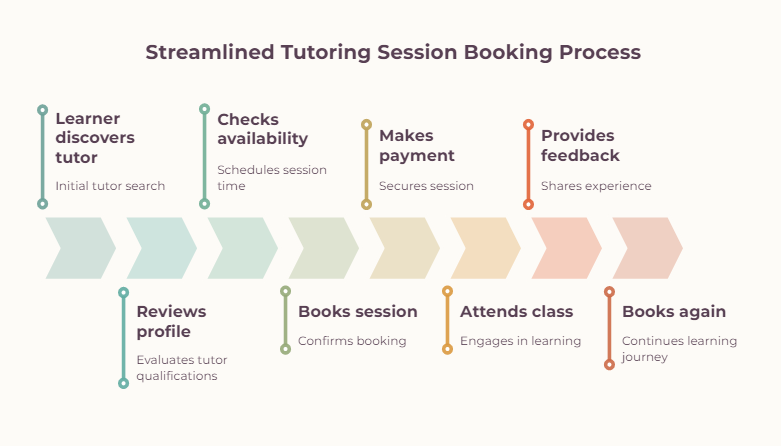
The platform needs to support this journey smoothly. The admin should also be able to manage users, tutors, bookings, payments, content, disputes, and platform settings.
Advanced features such as AI recommendations, loyalty programs, sophisticated analytics, gamification, complex integrations, or extensive automation can be added after the core business demonstrates demand. A common mistake is spending months building features that users never request.
Therefore, a better approach is to identify the minimum feature set required to complete a successful tutoring transaction and build from there.
Step 04: Decide Essential Features of an Online Tutoring Platform
The feature set will vary according to the business model, but several components form the foundation of most tutoring platforms.
1. Tutor Registration and Profiles
Tutor profiles are effectively the product pages of a tutoring marketplace. Learners need enough information to decide whether a tutor is appropriate for their learning requirements. The platform should make important information easy to compare. If learners need to open several pages just to understand basic differences between tutors, the discovery experience becomes unnecessarily difficult.
Therefore, a useful profile can include:
- Name and profile photo
- Subjects taught
- Qualifications
- Teaching experience
- Languages spoken
- Hourly rate
- Availability
- Teaching methodology
- Student reviews
- Introduction video
- Number of completed sessions
- Verification status
The platform should make important information easy to compare. If learners need to open several pages just to understand basic differences between tutors, the discovery experience becomes unnecessarily difficult.
2. Tutor Search and Filtering
A marketplace with hundreds or thousands of tutors needs an effective discovery system. A small marketplace can rely on category pages and basic filters. A larger marketplace may eventually need ranking algorithms or recommendation systems that consider learner preferences, tutor performance, availability, and historical booking behaviour. Learners may want to filter tutors based on:
- Subject
- Price
- Rating
- Experience
- Language
- Availability
- Age group
- Teaching format
- Tutor location
Search becomes increasingly important as the platform grows.
3. Scheduling and Availability Management
Scheduling is one of the most important operational components of a tutoring platform. Tutors should be able to define when they are available without manually responding to every booking request. A learner in Vancouver and a tutor in Toronto should not have to manually calculate the difference between their local times. The platform should handle this automatically.
The system may need to support:
- One-time availability
- Recurring schedules
- Multiple time zones
- Booking buffers
- Rescheduling
- Cancellation windows
- Holidays
- Calendar synchronization
This is particularly relevant for Canada because the country spans multiple time zones.
4. Online Classes
The platform needs a reliable mechanism for conducting tutoring sessions. Depending on the business model, you can either integrate a video-conferencing service or build the classroom experience directly into the platform. The technology should be selected based on the learning experience rather than simply the number of available features. Therefore, a virtual classroom may include:
- Video and audio
- Screen sharing
- Text chat
- Whiteboard
- File sharing
- Lesson notes
- Session recording
- Class reminders
Not every tutoring business needs all these capabilities at launch.
5. Online Booking and Payments
The booking and payment workflow should require as few unnecessary steps as possible. The actual commercial model should therefore be designed carefully rather than simply choosing an arbitrary commission percentage.
The platform should also consider refunds, failed payments, cancellations, invoices, transaction history, and payout management. A typical flow could be:
Select tutor → Select time → Confirm session → Pay → Receive confirmation
For marketplace businesses, the payment system may also need to calculate the platform’s commission and the tutor’s share.
For example, if a learner pays C$60 for a session and the platform retains a 15% commission, the platform’s gross commission would be C$9 before payment-processing fees, refunds, discounts, incentives, and other operating expenses.
6. Reviews and Ratings
Trust is particularly important in a marketplace where learners are choosing an individual tutor they may have never met. Reviews provide social proof and help new users compare instructors. Over time, reviews can also contribute to tutor discovery and ranking. Therefore, a tutoring platform should have policies around,
- Who can leave reviews
- When reviews can be submitted
- Fake or manipulated reviews
- Inappropriate content
- Review disputes
- Tutor responses
Over time, reviews can also contribute to tutor discovery and ranking.
7. Packages and Subscriptions
Tutoring businesses often have opportunities to generate more value from existing customers rather than relying entirely on new bookings.
For example, instead of purchasing one C$60 session, a learner could purchase a package of ten sessions at a discounted rate. Packages can improve retention because the learner has already committed to multiple sessions.
Subscriptions can take this further by offering recurring access to tutoring or learning resources. However, pricing should reflect actual tutor costs and customer usage. A heavily discounted package may increase bookings while reducing profitability.
8. Administration and Platform Management
The administrator needs visibility into the entire marketplace. Analytics are particularly useful once the platform starts generating meaningful traffic. A typical administration panel may include:
- Tutor management
- Student management
- Booking management
- Payment management
- Commission configuration
- Reviews
- Categories
- Coupons
- Content
- Reports
- Notifications
- Disputes
- Platform settings
Explore Enterprise-grade Featuresto Launch your Tutoring Platform in Canada!
9. Make the Platform Suitable for the Canadian Market
Building a platform for Canada should involve more than changing the currency symbol.
- English and French Support
Depending on your target audience, bilingual functionality may be commercially important. This can affect more than the main interface. If the platform intends to serve French-speaking users, consider localization across:
- Navigation
- Tutor profiles
- Search
- Registration
- Emails
- Notifications
- Payment pages
- Help content
- Customer support
- Legal pages
- Canadian Dollar Pricing
If your primary audience is Canadian, prices should be displayed clearly in CAD. Avoid forcing users to mentally convert prices from another currency. The same principle applies to invoices, payment confirmations, packages, discounts, and tutor earnings.
- Multiple Time Zones
Canada’s geographic size makes time-zone management particularly important. A tutor’s availability should be displayed according to the learner’s local time, while the tutor should continue managing their schedule in their own time zone.
This becomes especially important for platforms serving users across provinces or international learners.
- Privacy and Data Handling
Tutoring platforms can collect considerable user information, including names, contact details, payment information, educational information, tutor qualifications, reviews, and communication history.
Privacy and data-handling requirements should therefore be considered during architecture and product planning.
Businesses should review the privacy obligations applicable to their specific operating model and provinces, and obtain appropriate legal advice rather than assuming that a generic privacy policy is sufficient.
Step 05: Custom Development vs Ready-Made Tutoring Software
Once the business model and feature requirements are clear, the next decision is how to build the technology. There are generally three practical approaches.
1. Custom Development
Custom development provides the greatest control over the product. But it is a cost- and time-intensive investment. The downside is that custom development generally requires greater upfront investment, more planning, longer development cycles, and ongoing technical maintenance. It can make sense when the platform requires:
- Unique business workflows
- Proprietary matching algorithms
- Complex integrations
- Highly customized user experiences
- Unusual monetization models
- Specialized learning functionality
- It is most appropriate when the differentiation of the business depends heavily on technology.
2. Ready-Made Software
Ready-made tutoring software provides an existing technology foundation with already developed common marketplace features and functionalities. This approach can significantly reduce the amount of foundational development required.
However, ready-made software should not be selected simply because it has a long feature list.
Businesses should evaluate:
- Customization options
- Source-code access or licensing model
- Payment integrations
- Scheduling
- Mobile support
- Scalability
- APIs
- Third-party integrations
- Security
- Localization
- Support
- Upgrade policies
- Total ownership cost
Looking for a Ready-made Tutoring Software with high Customisation Abilities?
Step 06: Integrate and Monetize an Online Tutoring Platform in Canada
A tutoring marketplace can generate revenue in several ways.
1. Commission on Bookings
The platform retains a percentage of each transaction. This model aligns platform revenue with tutor activity and can be relatively straightforward for marketplace users to understand.
The challenge is balancing platform revenue with tutor economics. Excessively high commissions can make it difficult to attract experienced tutors.
2. Tutor Subscription
Tutors can pay a monthly or annual fee for access to marketplace tools, leads, visibility, or premium features.
This approach can generate recurring revenue but may be difficult to introduce before the platform has established sufficient learner demand.
3. Featured Listings
Tutors can pay to receive greater visibility in relevant searches. This can work when the marketplace has enough traffic and the ranking mechanism remains transparent and useful to learners.
4. Student Packages
The platform can sell prepaid session packages. Packages can increase customer retention and reduce the need to repeatedly convince the learner to make another purchase.
5. Hybrid Monetization
A mature platform may eventually combine commissions, subscriptions, packages, and premium services.
However, introducing too many monetization mechanisms at launch can make the business unnecessarily complicated. Start with the model that best fits the core transaction and expand after understanding actual customer behaviour.
Step 07: How to Recruit Tutors for Your Canadian Platform
A tutoring marketplace cannot succeed without a reliable supply of quality tutors. Tutor acquisition should therefore begin before large-scale student acquisition. The onboarding process should also be straightforward. A tutor provides qualifications, teaching experience, subject information, availability, pricing, profile details, and identity or credential information depending on the platform’s policies.
Potential channels include:
- Teacher communities
- Universities
- Professional associations
- Tutor referrals
- Educational institutions
- Subject-specific communities
- Direct outreach
- Referral incentives
The objective is to balance quality control with onboarding convenience. If the verification process is too weak, students may lose trust. If it is unnecessarily complicated, qualified tutors may abandon registration.
Step 08: How to Attract Students and Learners
Once sufficient tutor supply exists, the focus shifts toward demand generation. The acquisition strategy should combine paid and organic channels.
1. SEO
SEO can build long-term visibility for searches related to tutoring subjects, locations, learning goals, and platform-based tutoring. However, location pages should not simply replace the city name in identical templates. Each page should contain useful local information and a genuine reason for the page to exist.
2. Paid Advertising
PPC can generate demand faster than SEO but requires careful economics.
Rather than targeting broad terms such as “tutor,” consider high-intent searches associated with specific subjects and learning requirements. Landing pages should also match the search intent.
Someone searching for “online IELTS tutor Canada” should not be sent to a generic tutoring homepage.
3. Content Marketing
Content can support both organic acquisition and conversion. The objective should be to answer genuine questions rather than publish large quantities of generic AI-generated articles.
Step 08: Launch a Unique Online Tutoring Platform In Canada
The tutoring market is already competitive, so simply launching another platform may not be enough. Differentiation can come from several directions.
The business can differentiate through the experience or specialization in the given marketplace niches.
- Test preparation
- Academic segment
- Specific age group
- Bilingual tutoring
- Professional learning
- Premium tutors
- Affordable tutoring
- Small-group classes
- Specialized subjects
A business can offer to help students find tutors; the platform could also make tutor selection easier through detailed profiles, structured learner requirements, trial sessions, availability matching, personalized recommendations, and progress tracking.
Can Yo!Coach Be Used to Build an Online Tutoring Platform?
Businesses looking for a ready-made technology foundation can evaluate Yo!Coach for launching tutoring, coaching, consultation, mentoring, and online learning businesses.
The platform is designed around workflows such as tutor and learner management, profiles, scheduling, bookings, online sessions, payments, packages, reviews, and administration.
For a business entering the Canadian market, the decision should still be based on its specific requirements.
For example, a business should assess how the software handles its preferred payment workflow, localization requirements, tutor management process, scheduling model, mobile requirements, integrations, and future customization needs.
A ready-made solution can provide a faster starting point than developing every foundational component from scratch, while customization can be used where the business needs its platform to behave differently from a standard tutoring marketplace.
The objective should be to use ready-made technology to reduce unnecessary development effort while preserving enough flexibility to create a differentiated business.
Experience the Advanced Functionalities of the Customizable Ready-Made Solution!
How Much Does It Cost to Build an Online Tutoring Platform in Canada?
There is no single development cost because the scope can vary considerably.
A basic tutoring platform with user registration, profiles, search, bookings, payments, and administration will have very different requirements from a large marketplace with mobile applications, sophisticated matching, integrated classrooms, multiple payment workflows, AI functionality, and extensive third-party integrations.
Major cost components can include:
- Business analysis
- UI/UX design
- Web development
- Backend development
- Admin panel
- Payment integration
- Video integration
- Mobile applications
- Third-party APIs
- Quality assurance
- Deployment
- Security
- Maintenance
A ready-made platform can reduce the initial development workload because many of the core components already exist.
A customized ready-made solution sits between the two approaches: the business starts with an existing foundation and invests in modifications where differentiation is required.
Suggested Read: Start-Up Costs for Tutoring Business: A Concise Financial Guide
The most sensible approach is to determine the MVP first and obtain a development estimate against that scope rather than choosing a budget before defining what needs to be built.
Common Mistakes When Building an Online Tutoring Platform
Building an online tutoring platform or business is exciting, but it is easy to stumble on a few common operational and technical traps. Whether you are building custom software or launching an independent tutoring service, avoiding these frequent mistakes will save you time, money, and frustration.
1. Trying to Serve Everyone
A broad target audience may sound attractive, but it often creates weak positioning.
Start with a clearly defined audience and expand once the initial model works.
2. Building Too Many Features
More features do not automatically create a better product.
Prioritize features that improve discovery, booking, payment, learning, and retention.
3. Ignoring the Tutor Experience
A marketplace is only as strong as its supply.
If tutors find onboarding, scheduling, payouts, or profile management frustrating, the platform will struggle to retain quality instructors.
4. Treating Payments as an Afterthought
Payment failures, refunds, commissions, and payouts can become significant operational problems if the system is not designed properly from the beginning.
5. Launching Without Enough Tutor Supply
A student who searches for mathematics tutors and finds only two poorly matched profiles is unlikely to return.
Supply should be developed strategically before aggressive demand generation.
5. Publishing Generic SEO Content
Producing hundreds of articles that simply repeat information available elsewhere is unlikely to create a meaningful competitive advantage.
Canadian content should contain genuine local context, useful research, original analysis, and practical advice.
Final Thoughts
Building an online tutoring platform in Canada can be a significant business opportunity, but the technology itself is only one part of the equation.
The more important decisions happen before development begins: identifying the right audience, selecting a viable business model, understanding tutor and learner behaviour, validating demand, defining the MVP, and determining how the platform will acquire users.
Canada’s growing online tutoring and broader EdTech markets provide a strong backdrop for these businesses. However, sustainable growth will depend on how effectively the platform solves a specific learning problem and creates value for both sides of the marketplace.
For a new venture, the practical approach is usually to start focused, build the core transaction well, measure user behaviour, and expand based on evidence.
Whether you choose custom development or a ready-made technology foundation such as Yo!Coach, the objective should remain the same: create a tutoring experience that makes it easier for learners to find the right instructors and easier for tutors to build sustainable teaching businesses.
Frequently Asked Questions
Q 1. How much does it cost to build an online tutoring platform in Canada?
Ans. The cost depends on the scope, technology approach, integrations, mobile requirements, and level of customization. A ready-made platform generally requires less foundational development than a fully custom solution, while a highly customized platform requires greater design and development investment.
Q 2. What features are required for an online tutoring platform?
Ans. The core features typically include tutor profiles, search and filtering, scheduling, bookings, payments, online classes, reviews, notifications, and an administration dashboard. Additional features can be added based on the business model.
Q 3. Can I build a tutoring marketplace instead of a single-provider platform?
Ans. Yes. A tutoring marketplace can connect multiple independent tutors with learners. The platform can manage tutor profiles, availability, bookings, payments, reviews, commissions, and other marketplace operations.
Q 4. Can the platform support English and French?
Ans. Yes, bilingual functionality can be incorporated depending on the technology selected. Businesses targeting French-speaking users should consider localization across the interface, content, tutor profiles, notifications, customer support, and transactional communications.
Q 5. Should I build custom tutoring software or use ready-made software?
Ans. Ready-made software can be more practical when the business wants to launch faster using established tutoring and marketplace functionality.
Custom development is generally more suitable when the business requires highly unique functionality or workflows and has a large budget to develop features from scratch.
Q 6. How does an online tutoring platform make money?
Ans. Common revenue models include booking commissions, subscriptions, tutor listing fees, featured profiles, student packages, and premium services. A hybrid model can also be used once the platform has sufficient traction.
Q 7. How long does it take to launch an online tutoring platform?
Ans. The timeline depends on the scope. A ready-made solution can generally provide a faster starting point than building a platform entirely from scratch. Custom functionality, mobile applications, integrations, and complex workflows increase development time.
Q 8. Should I launch across all of Canada immediately?
Ans. Not necessarily. Starting with a specific audience, province, subject category, or learner segment can make it easier to establish tutor supply and validate customer acquisition economics before expanding.
Start Your Canadian Tutoring App Today
Get Yo!Coach