How to Build a Marketplace for Admissions Advisors: A Complete Guide for Entrepreneurs


Over the past decade, the global education industry has undergone a profound transformation. The increasing competition for university placements and growing international mobility among students have made the admissions advisors and education consultants an essential part of the higher-education journey.
Local consultations are no longer enough for students today. This leads to students actively searching for experienced advisors online who can guide them through college selection, application strategy, visa preparation, and interview readiness.
Now, due to this shift, a new business opportunity has emerged, i.e., creating a marketplace for admissions advisors. Instead of running a traditional consultancy, entrepreneurs can build a digital platform where multiple admissions experts offer their services to students worldwide.
For entrepreneurs willing to build such a marketplace, this guide explores what an admissions advisor marketplace is, why more students are turning to these platforms, the key features that make them work, different ways to monetize the platform, the steps involved in building and launching it, and how solutions like Yo!Coach can help you get started faster.
Table of Contents
- What is an Admissions Advisor Marketplace?
- Why the Demand for Admissions Advisory Marketplaces is Growing?
- Key Features Required in an Admissions Advisor Marketplace
- Monetization Strategies for an Admissions Advisor Marketplace
- Steps to Build a Marketplace for Admissions Advisors
- Challenges in Building an Admissions Advisory Marketplace
- How Yo!Coach Helps Launch an Admissions Advisor Marketplace
- Final Thought
- FAQs
What is an Admissions Advisor Marketplace?
An admissions advisor marketplace is an online platform that enables students to discover, compare, and book consultation sessions with counselors. These marketplaces provide students with access to multiple experts who have a specialization in various areas, instead of depending on a single consultancy firm.
Specialized areas include:
- Undergraduate admissions
- MBA admissions consulting
- Graduate school applications
- Scholarship guidance
- Test preparation strategies
- Visa application support
For students, this means more choice and better-fit guidance. Alternatively, admissions advisors get a platform where they can build their professional profiles, set pricing, schedule sessions, and connect with students from different parts of the world.
At the backend, the platform owner manages the ecosystem by handling operations such as profile verification, appointment scheduling, secure payments, reviews, and rating systems.
This model is gaining traction in the US and Europe, where students prefer flexible, personalized admissions guidance rather than rigid consultancy packages.
Why the Demand for Admissions Advisory Marketplaces is Growing?
The growing demand for admissions advisory marketplaces is due to changing student behaviour, global education trends, and preferences toward digitalization and convenience. In addition to these, a few of the major factors driving the demand for admissions advisory marketplaces are given below:
1. Rising Competition for Top Universities
Getting accepted into the top universities is getting tougher day by day. With acceptance rates dropping, students applying to institutions in the US, UK, Canada, and Europe are now putting more effort into their applications and are seeking the help of admission advisors. They help students with application essays, profile evaluation, interview preparation, and application strategy.
As a result, this demand creates an opportunity for platforms that connect students with experienced mentors.
2. Increase in International Student Mobility
As per a report by UNESCO, approximately 6.9 million students study in international universities, away from their home country. The majority of students apply to the U.S., Canada, the UK, Australia, and Germany. Every country has its own process, requirements, and timelines, and navigating all of this requires expert support.
Admission advisor marketplaces make it easier for students to find advisors familiar with specific countries and universities.
3. Preference for Personalized Guidance
Traditional consultancy models often follow a standardized approach, but students increasingly prefer one-on-one advisory sessions tailored specifically to their goals. Online advisory platforms meet these expectations by enabling students to select advisors based on experience, past results, or even shared academic paths. This level of personalization builds trust and leads to better outcomes.
4. Remote Consulting is Now the Norm
The shift to remote services has made online advisory platforms widely accepted. Advancements like video consultations, digital document reviews, and remote mentoring have removed geographical barriers and made it possible for students to work with advisors located anywhere in the world.
Key Features Required in an Admissions Advisor Marketplace
The success of an admissions advisor marketplace comes down to the features and user experience it provides. Students look for a platform that is easy to navigate, trustworthy, and capable of connecting them with the right advisors. At the same time, advisors need tools that help them manage consultations, communicate with students, and grow their professional presence online.
To help decide a reliable feature set, some of the essential features for an admissions advisory marketplace are given below:
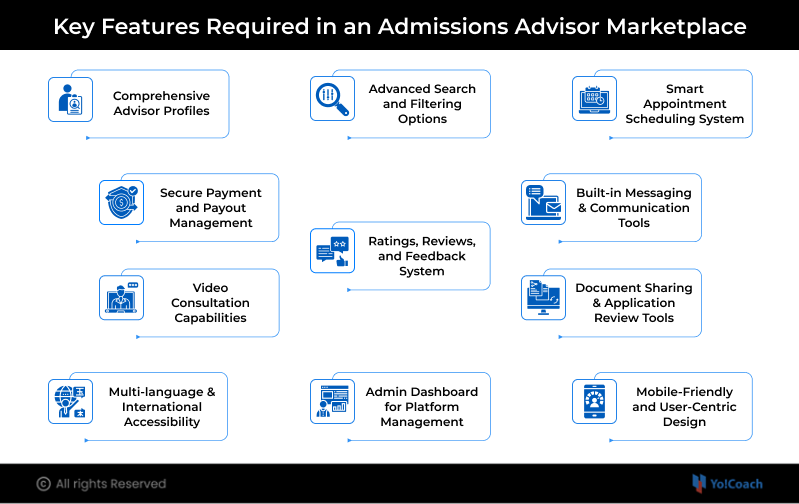
1. Comprehensive Advisor Profiles
Advisor profiles are the first thing students look for, and it is where trust starts to build. Before selecting a consultant, students need detailed information about advisors, like academic qualifications, professional experience, universities attended, and previously worked with, areas of specialization, such as MBA admissions, undergraduate applications, scholarships, etc.
Moreover, a detailed profile should have additional information, such as universities associated with, pricing, session formats, and student reviews and ratings. A detailed profile enables students to compare advisors and select the one who aligns with their educational goals.
2. Advanced Search and Filtering Options
When a platform hosts dozens or even hundreds of advisors, finding the right consultant quickly becomes crucial. No student wants to scroll endlessly through profiles that do not match their needs. This is where integrating an advanced search system improves the user experience by allowing students to filter advisors. Typically, filtering criteria include target country, degree level, specialization areas, price range, advisor ratings and reviews, language preferences, and session availability. It helps students identify suitable advisors in a few clicks, improving both engagement and booking rates.
3. Smart Appointment Scheduling System
A reliable scheduling system eliminates the hassle of manual coordination between students and advisors. Your marketplace should enable students to view real-time advisor availability, book sessions directly through the platform, choose between consultation formats, and receive automated reminders before the session. In contrast, advisors should be able to manage their calendars, update availability, and prevent scheduling conflicts.
4. Secure Payment and Payout Management
Since the marketplace will handle transactions between students and advisors, a secure and transparent payment system is essential. Therefore, it is necessary for your platform to support multiple payment methods, secure checkout processes, escrow payment options, automated commission deduction, and timely payouts to advisors. Moreover, for platforms targeting students from the US and Europe, support for international transactions and currency conversion is especially important.
5. Built-in Messaging and Communication Tools
Before booking a session, students may want to ask a few questions, clarify expectations, or share context, which makes it essential to integrate communication tools. Additionally, a built-in messaging system helps during and after consultations, especially when documents or follow-ups are involved. Real-time messaging also encourages ongoing interaction and relationship building, which often leads to repeat consultations.
6. Video Consultation Capabilities
Only text is not sufficient for managing consultations efficiently. Since admissions consulting often requires in-depth discussions, video consultation capabilities become essential. Built-in video tools allow advisors and students to review documents together and work through strategies in real time. Moreover, built-in tools eliminate the need for external tools and create a more seamless experience.
7. Ratings, Reviews, and Feedback System
A transparent review system is crucial for building credibility. Students rely heavily on the ratings, reviews, and feedback to get a clear idea about the credibility of the advisor. Moreover, a transparent feedback system helps highlight strong advisors while also encouraging others to maintain quality.
8. Document Sharing and Application Review Tools
A big part of admissions guidance involves reviewing documents like essays, resumes, or transcripts, and without proper tools, this can become complex. Secure document sharing makes it easier for students to upload files and for advisors to review and provide feedback. It improves the overall quality of sessions and makes the platform more practical to use.
9. Multi-language and International Accessibility
Since the platform may serve students from different countries, international accessibility features are highly valuable. Supporting multiple languages, currencies, and time zones helps make the platform usable for a global audience. Furthermore, it removes friction and makes it easier for students to connect with advisors from different parts of the world.
10. Admin Dashboard for Platform Management
While students and advisors interact on the front end, a lot happens at the back end. The admin dashboard is what keeps everything running smoothly. From verifying advisor profiles and managing bookings to handling payments and tracking performance, these tools are essential for maintaining control and scaling the platform.
11. Mobile-Friendly and User-Centric Design
Most students prefer browsing and booking on their phones, so your marketplace needs to be mobile-friendly. A clean, responsive design with fast loading and simple navigation makes a big difference. When the experience feels smooth, users are more likely to stay, explore, and complete bookings.
Build a Feature-Rich Marketplace for Admissions Advisors
Monetization Strategies for an Admissions Advisor Marketplace
Before launching an admissions advisor marketplace, it is important to define a clear revenue model. A well-planned monetization strategy ensures that the platform remains financially sustainable while still delivering value to both students and advisors. It is also worth noting that most successful marketplace platforms combine multiple revenue streams that allow them to scale revenue as the platform grows.
Below are some of the most effective monetization strategies for an admissions advisory marketplace.
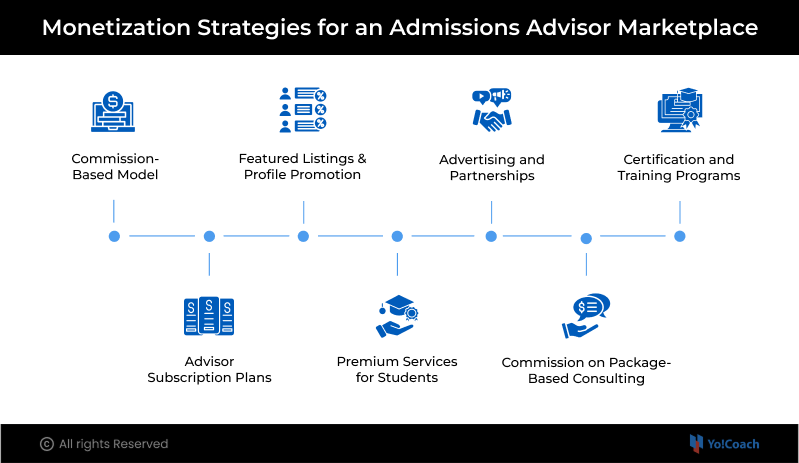
1. Commission-Based Model
The commission model is one of the most common revenue strategies used by online marketplaces. In this approach, every time a student books a session, the platform takes a small percentage as a commission before paying the advisor. It works well because it feels fair to both sides. Advisors only pay when they earn, and students are not charged extra just to access the platforms. As bookings increase, revenue grows alongside it, which makes this model easy to scale.
2. Advisor Subscription Plans
Another approach is to charge advisors a recurring fee to be part of the platform. This could be monthly or yearly, depending on how you structure it. In return, advisors get access to features like profile creation, visibility to students, lead generation, and booking management tools. You can also introduce different pricing tiers, where higher plans offer better visibility or additional features. This creates a steady and predictable revenue stream for the platform.
3. Featured Listings and Profile Promotion
As more advisors join, standing out becomes important. Moreover, many advisors are willing to pay a little extra to get noticed. You can offer options like featured listings, homepage placements, or priority ranking in search results. These small upgrades can make a big difference in bookings for advisors, while adding another revenue layer for the platform.
4. Premium Services for Students
Beyond just connecting students with advisors, there is room to offer additional services that support their journey. This could include things like essay reviews, CV editing, mock interviews, or detailed profile evaluations. These can be sold as standalone services or bundled into packages. It not only increases revenue but also makes the platform more valuable from a student’s perspective.
5. Advertising and Partnerships
As the platform gains traction and attracts a large student audience, it may open opportunities for strategic partnerships and advertising. Potential partners could include test prep companies, language learning platforms, study abroad agencies, or even student housing providers. Sponsored listings or targeted promotions can generate revenue while also introducing students to services they might already be looking for.
6. Commission on Package-Based Consulting
Some advisors prefer offering bundled consulting services rather than individual sessions. These packages usually include price points, which means higher commissions per transaction. Supporting this model allows you to increase revenue without needing a large number of bookings.
7. Certification and Training Programs
As the marketplace grows, you can also expand into training. There is often demand from aspiring advisors who want to enter this space but need guidance. Offering certification programs or training modules, such as application strategy or essay evaluation, creates an entirely new revenue stream. At the same time, it helps maintain a certain quality standard across advisors on your platform.
Steps to Build a Marketplace for Admissions Advisors
Creating a successful marketplace for admissions advisors requires a clear strategy, the right technology, and a strong network of experienced consultants. Entrepreneurs who plan to enter this space should focus on building a platform that makes it easy for students to discover trusted advisors while allowing consultants to manage their services efficiently.
Below are the key steps involved in launching a scalable admissions advisor marketplace.
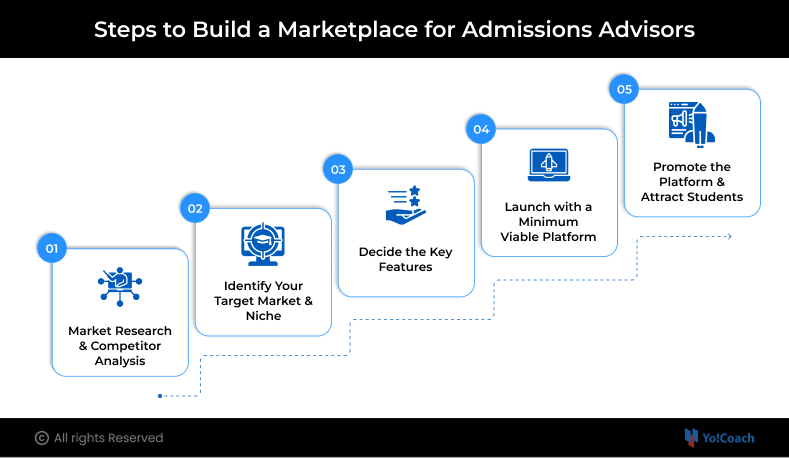
Step 1: Conduct Market Research and Competitor Analysis
The first step in building an admissions advisory marketplace is understanding the competitive landscape. Conducting detailed market research helps you identify opportunities and avoid common mistakes made by other platforms.
Analyze existing admissions consulting platforms and advisory services by examining:
- The types of services they offer
- Their pricing models
- Advisor profiles and credentials
- Booking and consultation systems
- Customer reviews and feedback
This research will help you identify gaps in the market and determine how your marketplace can provide additional value.
For example, some platforms may lack transparent pricing, while others may not provide flexible scheduling or personalized advisory services. By addressing these gaps, you can create a platform that offers a better experience for students and advisors alike.
Step 2: Identify Your Target Market and Niche
The next step is identifying the specific audience you want to serve. The global education consulting industry is broad, and choosing a clear niche will help your platform stand out in a competitive market.
For example, your marketplace could focus on:
- Undergraduate admissions consulting
- MBA and graduate school admissions guidance
- Study abroad advisory services
- Scholarship and financial aid consulting
- Country-specific admissions support, such as US, UK, or European universities
Defining your niche allows you to design a platform that addresses the specific needs of your target audience. Additionally, understanding your audience helps determine important platform decisions such as pricing models, service formats, and consultation types.
Step 3: Decide the Key Features
Your platform should include essential features that allow students and advisors to interact efficiently. These typically include:
- Advisor profile management
- Student registration and dashboards
- Advanced search and filtering options
- Appointment scheduling
- Secure payment processing
- Messaging and communication tools
- Video consultation capabilities
- Ratings and review systems
While developing the platform, it is also important to focus on designing a seamless user experience. Students should be able to search for advisors, compare profiles, and book consultations without confusion or unnecessary steps.
Step 4: Launch with a Minimum Viable Platform
Instead of spending months developing a highly complex platform, many successful startups begin with a Minimum Viable Product (MVP).
An MVP includes only the core features necessary to connect students with advisors and facilitate consultations. These may include:
- Advisor profiles
- Session booking capabilities
- Basic payment integration
- Messaging functionality
Launching with an MVP allows entrepreneurs to test their business idea in the real market and gather feedback from early users.
This approach reduces development risks and provides valuable insights into which features students and advisors actually need. Over time, the platform can be improved with additional tools and capabilities based on user behavior and feedback.
Want To Build An MVP For Your Admissions Marketplace?
Step 5: Promote the Platform and Attract Students
Once the platform is live, the next step is attracting students who need admissions guidance.
Digital marketing plays a crucial role in generating traffic and building credibility for the marketplace. Some effective strategies include:
- Publishing educational blog content about university admissions
- Creating guides on study abroad and application strategies
- Leveraging search engine optimization (SEO) to attract organic traffic
- Promoting services through social media platforms
- Collaborating with education communities and student forums
Sharing success stories and testimonials from students who have benefited from admissions guidance can also build credibility and encourage new users to explore the platform.
Consistent marketing efforts help establish your marketplace as a reliable destination for students seeking professional admissions advice.
Challenges in Building an Admissions Advisory Marketplace
While the opportunity to build an admissions advisor marketplace is promising, launching and managing such a platform comes with its own set of challenges. From earning user trust to managing operations at scale, there are several moving parts that founders need to get right early on.
Understanding these potential challenges early can help founders plan better strategies and ensure smoother platform growth.
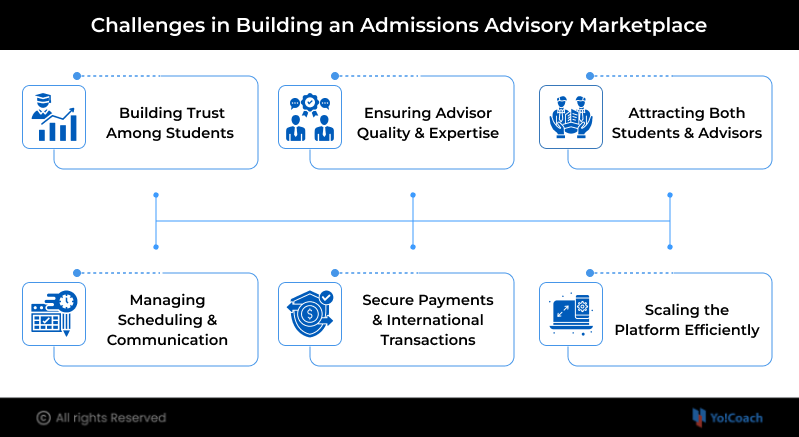
1. Building Trust Among Students
One of the biggest challenges in the admissions consulting industry is building trust. Students are making decisions that directly impact their future, so they are naturally cautious about who they take advice from. If the platform does not feel credible, they will hesitate to book sessions.
Solution: Start by putting trust-building features at the core of your platform. Verified profiles, detailed credentials, and a transparent review system should not feel like add-ons. Using a pre-built foundation with these elements already in place can help you establish credibility early, instead of trying to fix trust issues later.
2. Ensuring Advisor Quality and Expertise
If advisor quality is inconsistent, student experiences become unpredictable. Poor guidance or lack of expertise can quickly damage your platform’s reputation. Without proper screening and ongoing quality checks, negative reviews can increase, reducing trust and making it harder to retain both students and high-performing advisors.
Solution: Create a structured onboarding and monitoring process from day one. This includes verifying credentials, setting clear quality benchmarks, and regularly reviewing performance through feedback. Platforms that come with built-in moderation and tracking tools can make this much easier to manage at scale.
3. Attracting Both Students and Advisors
A marketplace needs both advisors and students to function, but attracting them at the same time is challenging. Without enough advisors, students lose interest. Without students, advisors see no value. This imbalance can slow early growth and make it difficult to build initial momentum.
Solution: Focus on launching quickly with a niche audience rather than waiting for a perfect, large-scale setup. Starting with a smaller, high-quality advisor base and early users helps build initial traction. Leveraging a ready-to-launch platform setup can speed this up and help you validate demand sooner.
4. Managing Scheduling and Communication
Admissions consulting often involves multiple interactions, document sharing, and follow-ups. Without structured tools, scheduling conflicts, missed sessions, and scattered communication can occur. This creates frustration for both students and advisors, ultimately affecting the overall experience and reducing repeat usage on the platform.
Solution: Centralize everything in one place. Integrated scheduling, messaging, and session management tools reduce manual coordination and confusion. Choosing a solution that already brings these features together can save time and avoid operational chaos later.
5. Handling Secure Payments and International Transactions
Operating across countries introduces payment complexities like currency differences, transaction security, and delayed payouts. If payments fail or feel unreliable, users may drop off before booking. Poor financial handling can quickly erode trust and create operational challenges for both students and advisors.
Solution: Set up a reliable payment system that supports multiple currencies, secure transactions, and automated payouts. Using a system that already supports global transactions can help you avoid technical complexities and build trust from the start.
6. Scaling the Platform Efficiently
As your platform grows, managing more users, sessions, and data becomes increasingly complex. Without a scalable setup, performance issues, slow loading times, or system breakdowns can occur. This can negatively impact user experience and limit your ability to expand into new markets or services.
Solution: Plan for scale early, even if you are starting small. Choose a flexible setup that can handle increasing traffic, users, and features without requiring major changes later. Starting with a scalable foundation makes growth smoother and more predictable.
How Yo!Coach Helps Launch an Admissions Advisor Marketplace
Building an admissions advisor marketplace from scratch can quickly become resource-heavy. Between development, integrations, testing, and ongoing maintenance, it often takes months before you are ready to go live. For most entrepreneurs, that delay can slow down validation and early growth.
This is where a solution like Yo!Coach becomes practical.
Yo!Coach is built specifically for consultation-driven platforms, which means it already aligns with how admissions advisory marketplaces operate. Instead of piecing together multiple tools, you get a system where core interactions between students and advisors are already structured.
With Yo!Coach, you can set up a fully functional marketplace that supports advisors’ onboarding, profile management, session bookings, and real-time communication. Features like scheduling, secure payments, video sessions, messaging, and reviews are already part of the system, so you are not starting from a blank slate.
Key Capabilities and Benefits
- Faster Time to Launch: You can go live much quicker since the core functionality is already in place. Instead of spending months in development, you can start testing your idea and acquiring users early.
- Streamlined Operations: Day-to-day management becomes simpler with built-in tools for bookings, payments, and communication. Everything works together, which reduces manual effort and keeps operations organized.
- Flexible Customization: Yo!Coach is not rigid. You can tailor it as per your niche, whether that means focusing on MBA admissions, study abroad guidance, or a broader advisory model.
- Built for Scalability: As your user base grows, the solution can handle more advisors, sessions, and transactions without requiring major changes. This makes it easier to scale without disruptions.
- Focus on Growth, Not Development: With the technical groundwork already handled, you can focus on what actually drives the business, building your advisor network, attracting students, and improving user experience.
Schedule a One-on-One Demo to See Yo!Coach in Action
Final Thoughts
The way students approach admissions has clearly shifted. With more people applying across countries and competition getting tighter, the need for expert guidance is only increasing. This creates a strong opportunity for entrepreneurs to build platforms that bring students and experienced advisors together in a more flexible way.
That said, building a successful marketplace is not just about connecting two sides. It requires thoughtful planning, the right set of features, and a strong network of credible advisors. If the experience feels smooth and trustworthy, students are far more likely to engage and come back.
Focusing on usability, maintaining advisor quality, and building steady demand are what make the difference over time. Starting with a solid, ready-to-launch foundation can also help you move faster, test your idea early, and spend more time on growth instead of technical complexity.
Frequently Asked Questions (FAQs)
Q 1. What is an admissions advisor marketplace?
Ans. An admissions advisor marketplace is an online platform where students can find and connect with admissions experts for guidance on university applications. Through such platforms, instead of relying on one consultant, students can explore advisor profiles, compare expertise, schedule consultation sessions, and receive personalized guidance for applications, essays, interviews, and visa processes.
Q 2. Why is there a growing demand for admissions advisory platforms?
Ans. The demand for admissions advisory platforms is increasing due to the rising competition for top universities and the growing number of students applying for international education opportunities. Students often seek expert guidance to strengthen their applications. Online advisory marketplaces provide convenient access to experienced consultants who can offer personalized support throughout the application journey.
Q 3. What services do admissions advisors typically offer?
Ans. Admissions advisors provide a wide range of services to help students prepare strong university applications. These services often include:
- Profile evaluation and university selection guidance
- Application strategy planning
- Personal statement and essay review
- Resume or CV editing for applications
- Interview preparation sessions
- Scholarship and financial aid guidance
Some advisors also specialize in particular programs, such as MBA admissions or graduate research applications.
Q 4. What features are essential for an admissions advisor marketplace?
Ans. A successful admissions advisor marketplace should include features that support smooth interaction between students and advisors. Some key features include:
- Detailed advisor profiles
- Advanced search and filtering options
- Appointment scheduling systems
- Secure payment processing
- Messaging and communication tools
- Video consultation capabilities
- Ratings and review systems
These features ensure a seamless and trustworthy experience for both students and advisors.
Q 5. How can an admissions advisor marketplace generate revenue?
Ans. There are multiple monetization models that marketplace owners can implement. Common revenue strategies include:
- Commission on consultation bookings
- Advisor subscription plans
- Featured listings or promoted profiles
- Premium consulting packages for students
- Advertising or partnerships with education-related services
Using a combination of these revenue streams can help create a sustainable business model.
Q 6. How long does it take to build an admissions advisor marketplace?
Ans. The timeline for building a marketplace depends on the development approach. If you build everything from scratch, it can take several months due to the number of features involved. Whereas leveraging a readymade solution enables you to enter the market faster and reduce development cost and time.
Q 7. How can entrepreneurs attract advisors to their marketplace?
Ans. Advisors are more likely to join when they see clear value. Offering visibility, access to students, easy scheduling, and reliable payments makes the platform more appealing. Transparent policies and a smooth onboarding process also help attract experienced professionals.
Q 8. What challenges should entrepreneurs consider before launching an admissions advisor marketplace?
Ans. Entrepreneurs should consider several factors when planning to launch an advisory marketplace. Some common challenges include:
- Building trust with students
- Recruiting experienced advisors
- Managing international payments
- Maintaining service quality
- Scaling the platform as user demand increases
Addressing these challenges early can help create a reliable and scalable marketplace.
Q 9. How can technology help simplify the process of launching such a platform?
Ans. Technology plays a crucial role in managing consultations, scheduling sessions, processing payments, and facilitating communication between students and advisors. Using specialized marketplace software designed for consultation-based platforms can help entrepreneurs launch faster and manage operations more efficiently while focusing on growing their advisor network and student community.
Thinking of Creating an Admissions Advisor Marketplace?
Get In Touch