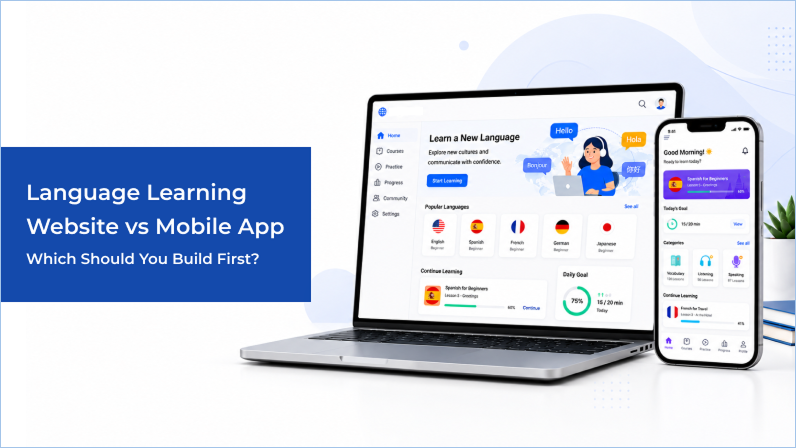
Published date 31st July, 2026
Before diving into the detailed comparison, here’s the recommended launch sequence for building a successful language learning platform.
| Business Goal | Recommended Starting Point |
|---|---|
| Launch quickly | Website |
| Validate business idea | Website |
| Attract organic traffic | Website |
| Generate leads through Google | Website |
| Enable tutor onboarding | Website |
| Manage bookings and payments | Website |
| Reach mobile users immediately | Progressive Web App (PWA) |
| Improve learner retention | Native Mobile App (after validation) |
Recommended Roadmap:
Website → Progressive Web App (PWA) → Android & iOS Apps
Introduction
The online language learning industry has experienced remarkable growth over the past decade. Traditional classroom instruction has evolved into a thriving digital ecosystem powered by live tutoring, AI-driven personalization, self-paced learning, and virtual classrooms. As internet access expands and demand for flexible education continues to rise, businesses have a significant opportunity to build scalable online language learning platforms.
According to industry research, the global language learning market is projected to surpass $100 billion by the early 2030s. This shift has also created significant opportunities for entrepreneurs, educational institutions, corporate training providers, and language schools. Instead of relying solely on physical classrooms, businesses can now build scalable digital platforms that connect tutors with learners worldwide.
However, one critical question often arises at the beginning of the journey:
Should you build a language learning website first, or launch a mobile app before anything else?
While many founders assume that launching a mobile app is the fastest way to attract users because smartphones dominate daily life. Leading platforms like Preply, italki, Cambly, and AmazingTalker established robust web experiences before significantly expanding their mobile ecosystems.
In this guide, we’ll compare language learning websites and mobile apps across cost, development time, scalability, SEO, learner experience, tutor management, monetization, and long-term business growth. Whether you’re launching an online tutoring marketplace, a language coaching platform, or a virtual language school, this guide will help you decide where to invest first.
Table of Contents
- The Strategic Importance of Your First Platform
- What is a Language Learning Website?
- What is a Language Learning Mobile App?
- Language Learning Website vs Mobile App: A Quick Comparison
- Why Do Many Successful Language Learning Platforms Start with a Website?
- Website First Doesn’t Mean Mobile Last
- Language Learning Website vs Mobile App: A Feature-by-Feature Comparison
- The Recommended Roadmap: Website → Progressive Web App (PWA) → Native Mobile Apps
- Common Mistakes Businesses Make
- Real-World Learning Platforms Follow a Similar Growth Journey
- How Yo!Coach Supports a Website-First Strategy
- Final Thoughts
- Frequently Asked Questions (FAQs)
The Strategic Importance of Your First Platform
Choosing between a website and a mobile app is a strategic business choice that can shape your platform’s long-term success. Your initial launch platform influences:
- Development costs
- Time to launch
- Customer acquisition channels
- Marketing opportunities
- Search engine visibility
- User onboarding
- Feature prioritization
- Future scalability
Many startups invest heavily in mobile app development, only to discover they still need a website for marketing, tutor management, SEO, customer support, and administrative operations. On the other hand, businesses that launch with a responsive website often establish their digital presence, gather user feedback, and generate revenue before extending the experience to mobile devices.
The goal isn’t to choose one over the other forever. It is to determine which platform delivers the greatest business value at the earliest stage.
What is a Language Learning Website?
A language learning website is a browser-based platform that connects learners, tutors, administrators, and organizations through a single online interface accessible from desktops, laptops, tablets, and smartphones.
Depending on the business model, a language learning website can support:
- One-on-one live tutoring
- Group language classes
- Self-paced learning modules
- Tutor discovery
- Booking and scheduling
- Video conferencing
- Assessments
- Certificates
- Subscription plans
- Corporate language training
Unlike native apps, websites don’t require installation and can be accessed instantly from virtually any internet-connected device. For businesses, they also serve as a central hub for SEO, content marketing, learner acquisition, tutor onboarding, bookings, and overall platform management.
Launch a Website That Attracts Learners Worldwide
What is a Language Learning Mobile App?
A language learning mobile app is a dedicated application built for Android and iOS devices, offering learners a convenient and personalized way to access lessons on the go.
Apps are particularly effective for:
- Daily learning streaks
- Push notifications
- Offline lessons
- Gamification
- Personalized reminders
- Microlearning sessions
- Voice practice
- Mobile-first experiences
Since they are installed directly on users’ devices, mobile apps often provide smoother interactions and stronger engagement for existing users. However, apps also require separate development for multiple platforms, ongoing maintenance, app store approvals, and regular updates, increasing both development time and long-term costs.
Language Learning Website vs Mobile App: A Quick Comparison
Before deciding which platform to build first, it’s important to understand how websites and mobile apps compare across key business and technical factors. The table below highlights the difference in cost, development time, SEO, accessibility, user acquisition, and engagement, helping you choose the right launch strategy for your language learning business.
| Feature | Website | Mobile App |
| Installation Required | No | Yes |
| Available on Google Search | Yes | Limited |
| SEO Benefits | Excellent | Minimal |
| Development Cost | Lower | Higher |
| Time to Launch | Faster | Slower |
| Accessibility | Any browser | Installed devices only |
| Updates | Instant | Requires app updates |
| Organic Traffic | High | Limited |
| Push Notifications | Limited (Web Push/PWA) | Excellent |
| Offline Learning | Limited (Improved with PWA) | Excellent |
| Discoverability | Search engines | App stores |
| Content Marketing | Excellent | Limited |
Key Takeaway: Websites are generally better for acquiring new users, while mobile apps excel at engaging and retaining existing ones.
Why Do Many Successful Language Learning Platforms Start with a Website?
Most successful language learning businesses share a common launch strategy. They start with a website before expanding to mobile apps. A website does much more than host learning sessions. It serves as the operational, marketing, and growth engine of the business, helping founders attract users, manage daily operations, and validate their business model before making larger technology investments.
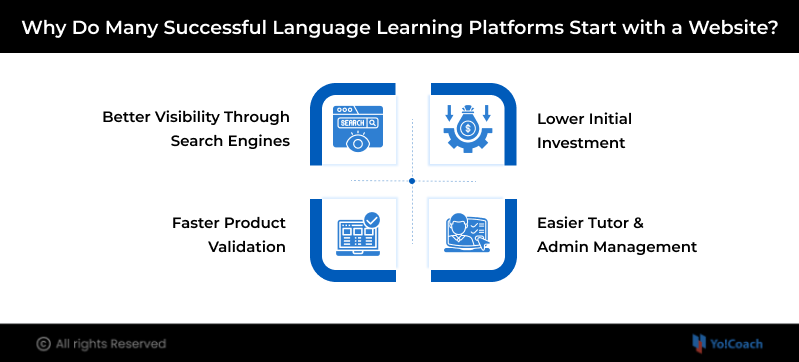
1. Better Visibility Through Search Engines
Most learners begin their journey with a Google search rather than an app store. Whether they’re searching for learn Spanish online, online English tutor, or IELTS speaking tutor, a well-optimized website can rank for these queries and attract highly targeted organic traffic. This makes SEO one of the most sustainable and cost-effective customer acquisition channels, while mobile apps have limited visibility in traditional search results.
2. Lower Initial Investment
Building a responsive website typically requires less investment than developing separate Android and iOS apps. By adopting a website-first approach, businesses can launch faster, validate market demand, and generate early traction before allocating additional resources to native mobile app development.
3. Easier Tutor and Admin Management
Running a language learning platform involves much more than delivering lessons. Tutors need to create profiles, manage schedules, upload learning materials, communicate with learners, and track earnings. At the same time, administrators must oversee users, bookings, payments, reports, disputes, and platform settings. These operational workflows are generally easier to manage through a web-based interface.
4. Faster Product Validation
Launching a website allows businesses to test pricing models, onboarding flows, course formats, and user engagement with real customers. The insights gathered during this phase help refine the platform and identify the features that matter most, making future investments in native mobile apps more strategic and reducing the risk of unnecessary development.
Launch a Website First, Then Scale to Mobile Apps
Website First Doesn’t Mean Mobile Last
Choosing a website-first strategy doesn’t mean delaying or overlooking mobile apps. Instead, it’s about investing in the right platform at the right stage of your business. Many successful language learning platforms follow a phased approach that balances speed, cost, and long-term growth.
A modern roadmap often looks like this:
- Launch a responsive website to establish your online presence, attract learners, onboard tutors, and validate your business model.
- Enhance it into a Progressive Web App (PWA) to deliver app-like features such as home-screen installation, faster loading, and web push notifications, without requiring users to visit an app store.
- Develop native Android and iOS apps once you’ve validated demand, refined your feature set, and built a loyal user base.
This phased approach reduces upfront development costs, accelerates time to market, and ensures every investment is guided by real user feedback rather than assumptions, creating a stronger foundation for sustainable growth.
Language Learning Website vs Mobile App: A Feature-by-Feature Comparison
Both websites and mobile apps play an important role in building a successful language learning business. However, each contributes differently at various stages of growth. Instead of asking which platform is better, the real question is: Which platform delivers the greatest value at your current stage of business?
Let’s compare them across the factors that matter most when building a successful language learning business.
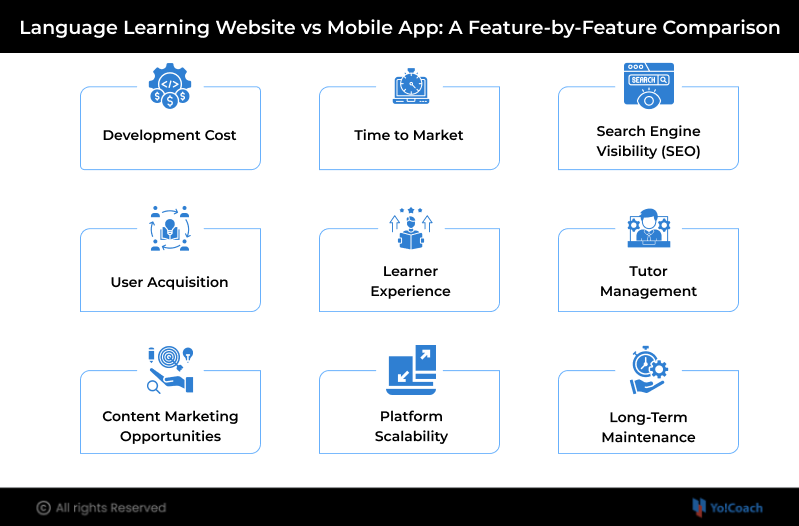
1. Development Cost
Budget is often one of the biggest deciding factors for startups and educational businesses.
Website
A responsive web platform requires a single codebase that works across desktops, laptops, tablets, and mobile browsers. This offers several advantages, including:
- Lower development cost
- Faster maintenance
- Easier upgrades
- Single deployment process
Since all users access the same platform through a browser, businesses avoid maintaining separate applications.
Best suited for:
- Startups
- MVPs
- Language schools
- New tutoring marketplaces
- Entrepreneurs validating a business idea
Mobile App
Launching native mobile apps generally involves:
- Android development
- iOS development
- Backend API integration
- App Store deployment
- Google Play compliance
- Regular OS compatibility updates
In addition, if your business also requires a website, overall development costs increase further.
Key Takeaway: A website-first approach allows businesses to launch cost-effectively while investing more in customer acquisition and product refinement before expanding to native mobile apps.
2. Time to Market
Speed is critical in the competitive EdTech industry, especially for businesses looking to validate their idea quickly.
Website
A responsive platform can typically be launched much faster because there’s only one primary interface to develop and test. This enables businesses to:
- Onboarding tutors
- Publishing educational content
- Running SEO campaigns
- Accepting bookings
- Collecting learner feedback
All without waiting for app store approvals.
Mobile App
Launching native apps involves additional steps, including:
- Additional UI optimization
- Platform-specific testing
- App Store review processes
- Compliance with marketplace policies
Even future updates often require another approval cycle before reaching users.
Key Takeaway: A website allows you to launch earlier, that help businesses acquire users, generate revenue, and gather real-world insights sooner.
3. Search Engine Visibility (SEO)
For most language learning businesses, search engines are among the largest sources of high-intent traffic. When learners search for terms like “Learn English online,” “Spanish tutor,” or “IELTS speaking lessons,” they typically discover websites rather than mobile apps.
Website Advantages
A website allows you to:
- Publish blogs and learning resources
- Create optimized landing pages
- Rank for long-tail keywords
- Build topical authority
- Earn quality backlinks
- Optimize structured data
- Target local and global searches
Every new article becomes another opportunity to attract potential learners.
Mobile App Limitations
Apps primarily rely on:
- App Store Optimization (ASO)
- Paid advertising
- Existing brand awareness
- Direct downloads
Although app listings can appear in some search results, they don’t provide the same SEO opportunities as a content-rich website.
Key Takeaway: For businesses planning long-term organic growth, SEO is a major competitive advantage, which is possible via launching a website.
4. User Acquisition
Consistently attracting new learners is one of the biggest challenges for any online education business.
Website
A website supports multiple customer acquisition channels, including:
- Organic search
- AI search engines
- Content marketing
- Email marketing
- Referral traffic
- Social media
- Paid advertising
- Local SEO
- Educational partnerships
Prospective learners can also explore your platform before committing to sign up.
Mobile App
Apps usually depend on:
- App Store searches
- Paid campaigns
- Existing website traffic
- QR codes
- Brand recognition
- Referral programs
Since downloading an app requires a greater commitment than visiting a website, user acquisition can be more challenging.
Key Takeaway: Websites with lower barriers to entry often translate into higher visitor volume.
5. Learner Experience
When it comes to day-to-day learning and engagement, mobile apps have a clear advantage.
Website
Modern language learning websites can deliver:
- Live classes
- Interactive quizzes
- Video conferencing
- Digital whiteboards
- Progress tracking
- Learning resources
Responsive design also ensures a consistent experience across desktops, tablets, and smartphones.
Mobile App
Native mobile apps enhance learning with features such as:
- Push notifications
- Offline lessons
- Daily reminders
- Better gesture support
- Native camera access
- Voice recording
- Faster loading
These capabilities encourage regular learning habits and improve long-term engagement.
Key Takeaway: Websites are ideal for launching and managing a learning platform, while native mobile apps excel at increasing learner engagement and retention.
6. Tutor Management
A successful language learning platform must support tutors just as effectively as learners. From managing classes to handling day-to-day operations, tutors require tools that help them work efficiently.
Website
Tutors often need to:
- Create detailed profiles
- Set schedules
- Manage availability
- Upload learning materials
- Track earnings
- Review bookings
- Respond to students
These administrative tasks are generally more convenient on larger screens, making websites the preferred choice for daily tutor operations.
Mobile App
Mobile apps are useful for managing basic tasks while on the go. However, activities such as scheduling, reports, and profile management are often easier on a desktop interface.
Key Takeaway: Websites provide a more practical and productive workspace for tutors and administrators managing everyday operations.
7. Content Marketing Opportunities
Trust plays a vital role in attracting and converting learners. Publishing educational content helps establish authority while answering prospective learners’ questions before they enroll.
Website
A website enables businesses to publish:
- Language guides
- Grammar tutorials
- Vocabulary articles
- Pronunciation tips
- Exam preparation content
- Cultural insights
- Learning resources
- Case studies
Each piece of content creates a new opportunity to rank on search engines and attract organic traffic over time.
Mobile App
Mobile apps are designed primarily for learning and engagement rather than content discovery. They offer limited opportunities for SEO-driven content marketing.
Key Takeaway: A website supports long-term organic growth by turning valuable educational content into a sustainable customer acquisition channel.
8. Platform Scalability
As your language learning business expands, your platform must accommodate increasing users, features, and operational complexity.
Growth often includes:
- More learners
- More tutors
- More classes
- Additional languages
- New payment gateways
- Corporate clients
- Certifications
- AI-powered features
Website
Scaling a centralized web platform is generally more straightforward because updates are deployed once and become immediately available to all users.
Mobile App
Scaling apps involves coordinating backend improvements with app updates, testing, and app store releases.
Key Takeaway: Websites simplify scaling by enabling faster feature rollouts and easier platform management.
9. Long-Term Maintenance
Maintaining a digital learning platform involves far more than fixing bugs. It includes security updates, performance improvements, compatibility testing, and continuous feature enhancements.
Website
With a single web platform:
- Updates are deployed instantly.
- Users always access the latest version.
- No download is required.
- Feature releases are easier to coordinate.
Mobile App
Mobile apps require:
- Version management
- OS compatibility testing
- Store submissions
- User updates
- Device-specific troubleshooting
Supporting multiple app versions can add complexity over time.
Key Takeaway: Lower maintenance requirements of a website allow businesses to focus more on innovation and learner experience instead of ongoing platform management.
Progressive Web Apps (PWAs): The Best of Both Worlds
A major advantage of adopting a website-first strategy is the ability to evolve your platform into a Progressive Web App (PWA). PWAs combine the discoverability of a website with many of the convenience features users expect from a mobile app.
Benefits include:
- Installable from the browser
- Home-screen shortcut
- Fast loading
- Offline support for selected content
- Web push notifications (browser support varies by platform)
- Responsive experience
- Single codebase
- No App Store approval required
For startups and growing businesses, a PWA provides an excellent middle ground. It delivers an app-like experience while preserving the SEO, accessibility, and cost advantages of a responsive website.
Enhance Your Website Without Native App Costs
Website vs PWA vs Native App
| Feature | Website | Progressive Web App | Native Mobile App |
| Google SEO | 5/5 | 5/5 | 1/5 |
| Installation Required | No | Optional | Yes |
| Push Notifications | Limited | Supported on many modern browsers | Excellent |
| Offline Learning | Limited | Partial | Excellent |
| Development Cost | Low | Moderate | High |
| Time to Launch | Fast | Fast | Slower |
| App Store Approval | No | No | Yes |
| Cross-Platform Reach | Excellent | Excellent | Separate Android & iOS builds |
Expert Insight: A PWA can help bridge the gap between web and mobile, making it an effective intermediate step before investing in native apps.
The Recommended Roadmap: Website → Progressive Web App (PWA) → Native Mobile Apps
By now, it’s clear that both websites and mobile apps serve different purposes in a language learning business. The real question isn’t whether you need both; it’s when you should invest in each.
For most startups, language schools, tutoring businesses, and EdTech entrepreneurs, the most practical roadmap is:
Responsive Website → Progressive Web App (PWA) → Native Android & iOS Apps
This phased approach allows businesses to launch faster, validate their business model, optimize the learner experience, and scale strategically without making large upfront investments.
Let’s understand why this sequence works:
Phase 1: Launch a Responsive Website
A responsive website acts as the operational, marketing, and growth foundation of your language learning platform. At this stage, you can:
- Launch your marketplace quickly.
- Onboard tutors.
- Acquire learners through SEO.
- Accept bookings and payments.
- Publish educational content.
- Build brand credibility.
- Test pricing models.
- Collect user feedback.
- Analyze learner behavior.
Instead of investing heavily in multiple applications from day one, you can focus on achieving product-market fit and building a sustainable business.
Phase 2: Enhance the Platform with a Progressive Web App (PWA)
Once your website gains traction, the next step is enhancing it with Progressive Web App capabilities. A PWA delivers a more app-like experience while retaining the flexibility and discoverability of the web.
A PWA enables users to:
- Install the platform directly from their browser.
- Access the platform using a home-screen icon.
- Experience faster loading times.
- Receive web push notifications (where supported).
- Continue browsing selected content with limited connectivity.
This phase improves convenience and user engagement without the additional cost and complexity of native app development.
Phase 3: Build Native Mobile Applications
Native Android and iOS apps become a worthwhile investment once you’ve validated your business model and built a loyal user base.
- You have an established learner base.
- Daily engagement becomes a priority.
- You understand which features users value most.
- You have validated your revenue model.
- Mobile usage consistently grows.
At this stage, native apps can introduce features such as:
- Offline learning
- Voice practice
- AI-powered pronunciation analysis
- Push notifications
- Learning streaks
- Widget support
- Better device integration
Because these features are introduced after gathering real user insights, businesses can invest confidently in capabilities that enhance learner engagement, improve retention, and deliver long-term value.
Common Mistakes Businesses Make
Many entrepreneurs assume that launching a mobile app is the fastest way to build a successful language learning business. While mobile apps are important, beginning with an app alone can create unnecessary challenges.
Here are some common mistakes to avoid
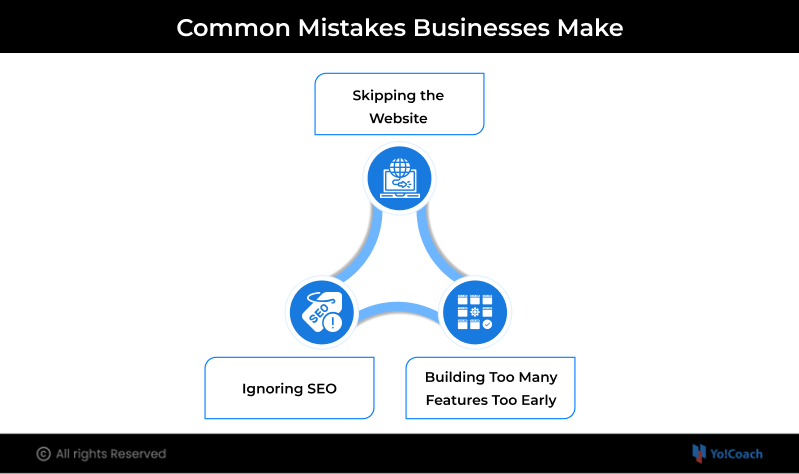
Mistake #1: Skipping the Website
Some founders invest most of their budget in developing native mobile apps without building a comprehensive website. As a result, they miss valuable opportunities to:
- Rank on Google.
- Publish educational blogs.
- Build backlinks.
- Capture search traffic.
- Generate inbound leads.
- Showcase tutor profiles.
- Explain pricing and services.
For many learners, a website is the first point of interaction with your brand, making it an essential part of your customer acquisition strategy.
Mistake #2: Ignoring SEO
Relying solely on paid advertising or app store downloads can become expensive over time. A well-optimized website enables businesses to attract consistent organic traffic by answering learners’ questions through helpful, search-friendly content.
For example, articles targeting queries such as:
- “How to learn Spanish online”
- “Best English tutor for IELTS”
- “French conversation classes”
- “Japanese language lessons for beginners”
can continue driving qualified traffic and generating leads long after they’re published.
Mistake #3: Building Too Many Features Too Early
Many startups try to launch with every feature imaginable:
- AI tutors
- Gamification
- Social learning
- Live streaming
- Communities
- Advanced analytics
- Native apps
- Corporate dashboards
While these features add value, building them all upfront often increases development costs and delays market entry. A phased development strategy allows businesses to validate demand first, prioritize features based on real user feedback, and scale more efficiently over time.
Avoid Costly Mistakes When Launching Your Marketplace
Real-World Learning Platforms Follow a Similar Growth Journey
Many successful language learning businesses have evolved gradually instead of launching every feature on day one. Instead, they adopted a phased approach, expanding their capabilities as their user base and business matured. This strategy enables businesses to validate demand, optimize operations, and invest in new features at the right time.
A common growth path looks like this:
| Growth Stage | Primary Focus |
| Stage 1 | Launch a responsive website |
| Stage 2 | Build visibility through SEO and content marketing |
| Stage 3 | Onboard tutors and grow course offerings |
| Stage 4 | Streamline bookings and payment optimization |
| Stage 5 | Enhance the platform with a Progressive Web App |
| Stage 6 | Launch a native Android app |
| Stage 7 | Expand with a native iOS app |
| Stage 8 | Introduce AI-powered personalization and automation |
| Stage 9 | Scale into enterprise and corporate learning |
By following this incremental roadmap, businesses can reduce development risks, prioritize investments based on real user demand, and build a scalable language learning platform that supports sustainable long-term growth.
How Yo!Coach Supports a Website-First Strategy
Choosing the right technology platform is essential when launching a language learning marketplace. Rather than building every feature from scratch, many businesses look for software that enables faster deployment while remaining flexible enough to grow over time.
Yo!Coach is a white-label online tutoring and consultation marketplace software designed for one-on-one tutoring, group classes, corporate training, and online coaching. It provides the essential features businesses need to launch quickly and expand as demand grows.
Here’s how it aligns with a website-first approach
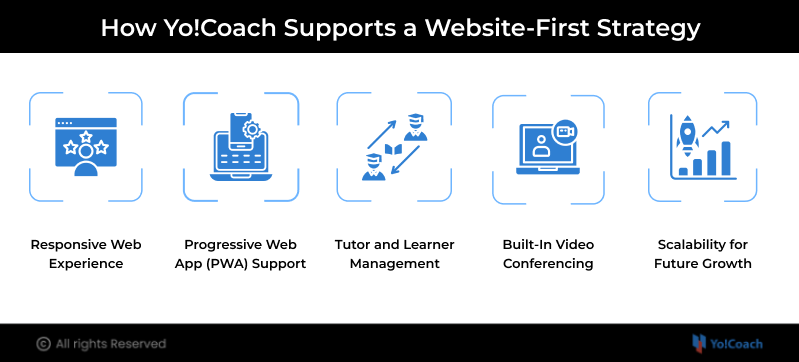
1. Responsive Web Experience
Yo!Coach provides a responsive web interface that works across desktops, tablets, and mobile browsers. This enables learners and tutors to access the platform from any device without requiring an app download.
2. Progressive Web App (PWA) Support
The platform includes Progressive Web App capabilities, allowing businesses to deliver app-like experiences while maintaining the advantages of a web platform. This enables users to install the platform from supported browsers and access it more conveniently.
3. Tutor and Learner Management
Running a language learning platform involves much more than conducting online classes. Yo!Coach streamlines daily operations with features such as:
- Tutor profiles
- Learner dashboards
- Calendar management
- Class scheduling
- Booking management
- Payment processing
- Reviews and ratings
- Session history
These workflows are particularly well suited to a web-based environment where users often need to perform detailed administrative tasks.
4. Built-In Video Conferencing
Since live interaction is fundamental to language learning, Yo!Coach comes with integrated video conferencing capabilities. Businesses can conduct virtual classes without relying on multiple third-party communication tools, creating a more seamless learning experience.
5. Scalability for Future Growth
As your business evolves, the platform can support additional tutors, learners, languages, and business models without requiring a complete rebuild. This flexibility allows businesses to focus on expanding their services rather than replacing their technology stack.
Why this matters: A responsive, website-first platform like Yo!Coach helps businesses launch faster, validate their business model, and establish a strong digital presence. As demand grows, they can seamlessly extend the experience with Progressive Web App capabilities and native mobile applications, ensuring long-term scalability and sustained business growth.
Experience Yo!Coach Firsthand
Final Thoughts
Launching a language learning platform is a journey, and the right launch sequence can make all the difference.
A responsive website gives you the foundation to acquire users through search engines, publish educational content, onboard tutors, manage operations, and validate your business model with lower upfront investment. As your platform grows, you can enhance the experience with a Progressive Web App (PWA), offering app-like functionality while retaining the reach and flexibility of the web. Once you’ve established traction and understand your users’ needs, native mobile apps become a strategic investment to deepen engagement and support advanced mobile features.
This staged approach reduces risk, improves return on investment, and aligns technology decisions with business growth rather than assumptions. With scalable software like Yo!Coach, businesses can launch efficiently today while building a strong foundation for future expansion.
Frequently Asked Questions (FAQs)
1. Should I build a language learning website or mobile app first?
For most startups and growing businesses, launching a responsive website first is the more practical approach. It helps you enter the market faster, attract users through search engines, manage tutors and learners efficiently, and validate your business model before investing in native Android and iOS apps.
2. Why is a website important for SEO?
A website allows you to rank for relevant search queries, attract organic traffic, publish educational content, and build authority over time. Unlike mobile apps, websites can build long-term search visibility, helping you generate leads and grow your language learning without relying solely on paid marketing.
3. What is a Progressive Web App (PWA)?
A Progressive Web App combines the accessibility of a website with many app-like features. Users can install it directly from their browser, enjoy faster loading, recieve push notifications where supported, and access selected content offline without downloading it from an app store.
4. Can I launch mobile apps later?
Yes, many successful EdTech/language learning businesses begin with a website to validate demand, refine their features, and build a user base. Once the platform gains traction, they expand with native Android and iOS apps to improve learner engagement and retention.
5. Are mobile apps better for learner engagement?
Native mobile apps are well suited for features such as push notifications, offline learning, daily reminders, and personalized mobile experiences, making them valuable for improving long-term engagement.
6. Does a website work on mobile devices?
Yes, a responsive website automatically adapts to different screen sizes, including smartphones, tablets, laptops, and desktops. This ensures learners and tutors can access your platform from virtually any device without installing an app.
7. Is Yo!Coach suitable for building a language learning platform?
Yes, Yo!Coach is a white-label solution designed for online tutoring marketplaces. It includes features such as tutor management, scheduling, video sessions, payments, and PWA support, making it suitable for businesses launching and scaling online language learning marketplaces.
8. Can I support one-on-one and group language classes?
Yes, modern tutoring marketplace software supports both individual sessions and group classes. This flexibility allows you to offer personalized coaching, collaborative classes, corporate training, and different pricing models to meet diverse learner needs.
Ready to Turn Your Language Learning Business Idea into Reality?
Get In Touch