Cost to Develop an Online Coaching Website & Platform in 2026: Complete Pricing Guide


Published 17th July, 2026
The cost to develop an online coaching website typically ranges from $8,000 to over $200,000, depending on the platform’s complexity, features, technology stack, and development approach. While custom development offers maximum flexibility, it often requires a significant investment and a longer time to market.
Alternatively, a white-label coaching platform like Yo!Coach enables businesses to launch faster, reduce development costs, and retain complete ownership of their platform without compromising on essential features.
Quick Answer
Developing an online coaching website can cost anywhere between $8,000 and $200,000+.
Here’s a quick estimate:
| Platform Type | Estimated Cost | Development Time |
| Basic Coaching Website | $8,000 – $20,000 | 1-2 Months |
| Custom Coaching Platform | $25,000 – $70,000 | 3-6 Months |
| Enterprise Coaching Marketplace | $80,000 – $200,000+ | 6-12 Months |
| White-Label Coaching Software | Significantly Lower than Custom Development | Few Days to Weeks |
The final investment depends on your business model, user roles, integrations, mobile applications, live session capabilities, payment gateways, and scalability requirements.
Introduction
The coaching industry has undergone a remarkable digital transformation over the last decade, with businesses and independent professionals increasingly taking their services online. By offering virtual coaching, they can reach a global audience, streamline operations, and create scalable, recurring revenue streams. Whether it’s executive coaching, business consulting, wellness, fitness, career development, language learning, or life coaching, online platforms have become the preferred way to deliver personalized coaching experiences.
According to industry reports, the global coaching market continues to grow as organizations invest more in employee development, leadership coaching, and digital learning solutions. At the same time, individuals are increasingly seeking personalized guidance through virtual coaching sessions, making online coaching platforms a profitable business opportunity.
As a result, many entrepreneurs and enterprises ask the same question:
How much does it cost to develop an online coaching website or platform?
The answer depends on your business model, target audience, and feature requirements. A solo coach may only need a branded website with appointment booking, while coaching agencies often require multiple coach profiles, subscription plans, and CRM integrations. Large enterprises, on the other hand, may need a scalable coaching marketplace supporting thousands of users across regions.
In this guide, we’ll explore the major factors affecting online coaching website development costs, compare custom development with white-label software, discuss hidden expenses, and explain how businesses can launch a professional coaching platform while optimizing their investment.
Table of Contents
- Why Are Businesses Investing in Online Coaching Platforms?
- What Determines the Cost of an Online Coaching Website?
- Online Coaching Website Development Cost Breakdown
- Hidden Costs Businesses Often Overlook
- Essential Features Every Online Coaching Platform Should Have
- How Long Does It Take to Develop an Online Coaching Platform?
- Custom Development vs. White-Label Coaching Software: Which Is More Cost-Effective?
- How to Reduce Online Coaching Platform Development Costs
- Why Are Businesses Choosing White-Label Coaching Software
- Why Yo!Coach Is a Cost-Effective Choice for Launching an Online Coaching Platform
- Final Thoughts
- FAQs
Why Are Businesses Investing in Online Coaching Platforms?
The popularity of digital coaching is driven by evolving customer expectations, increasing demand for personalized learning, and advancements in online collaboration technologies. Businesses are leveraging online coaching platforms to expand their reach, improve operational efficiency, and create sustainable revenue streams while delivering seamless coaching experiences.
Modern coaching platforms enable businesses to:
- Expand globally without geographical limitations.
- Deliver one-on-one and group coaching sessions online.
- Automate scheduling, payments, and communication.
- Generate recurring revenue through subscriptions and coaching packages.
- Build scalable coaching marketplaces with multiple coaches.
- Offer flexible learning experiences across web and mobile devices.
Unlike traditional coaching businesses that rely on fixed schedules and physical locations, online coaching platforms operate around the clock, allowing businesses to serve more clients, scale efficiently, and maximize profitability.
What Determines the Cost of an Online Coaching Website?
The cost of developing an online coaching website is not fixed because every coaching business has different goals, operational requirements, and growth plans. A platform designed for an individual life coach will naturally require a smaller investment than an enterprise coaching marketplace that supports thousands of users, multiple coaches, subscription plans, and AI-powered recommendations.
Several factors influence the total investment, including your business model, the number of features you require, the complexity of the user experience, technology stack, integrations, security requirements, and scalability goals. Understanding these factors early helps you estimate a realistic budget, prioritize essential functionalities, and avoid unexpected development costs later.
Let’s explore the major factors that influence the cost of developing an online coaching website or platform:
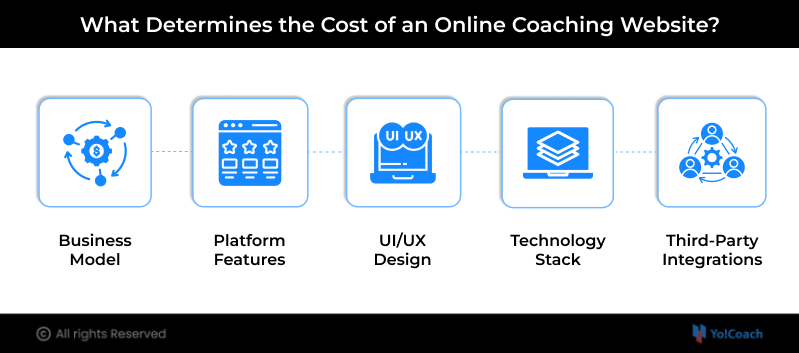
1. Business Model
Your business model is one of the biggest cost drivers affecting development costs because it determines how your platform will operate, who your users are, and what functionality you’ll need. Whether you’re building a website for yourself, managing a team of professional coaches, or launching a marketplace that connects coaches and learners globally, every business model requires a different level of development effort.
Before starting development, clearly define your revenue model, target audience, and future expansion plans. This ensures you invest in the right features from day one and avoid expensive redesigns or redevelopment as your coaching business grows.
- Single Coach Website
Designed for individual coaches, consultants, trainers, and mentors, a single coach website focuses on building a professional online presence while allowing clients to discover services and book sessions with ease. Since there is only one coach managing appointments, payments, and communication, the platform remains relatively simple. This makes it the most affordable option for professionals entering the online coaching industry.
Typical Features
- Personal profile
- Appointment scheduling
- Online payments
- Video meeting integration
- Blog
- Testimonials
- Contact forms
Estimated Cost: $8,000-$20,000
- Coaching Agency Platform
A coaching agency platform supports businesses working with multiple coaches. In addition to learner-facing functionality, it requires centralized administration, coach management, reporting tools, scheduling, and collaboration features. Multiple user roles and dedicated dashboards increase development complexity compared to a single coach website.
Additional Features
- Multiple coach profiles
- Team management
- Admin dashboard
- Session management
- Reporting
- Subscription plans
- Performance analytics
Estimated Cost: $20,000-$60,000
- Coaching Marketplace
A coaching marketplace is the most feature-intensive business model, enabling independent coaches to create profiles, offer services, and connect with learners through a single platform. Similar to marketplaces like Preply or CoachHub, the platform acts as an intermediary and generates revenue through commissions, subscriptions, featured listings, or service fees. Due to its scalability requirements and advanced workflows, this model demands the highest development investment.
Marketplace Features
- Coach onboarding
- Commission management
- Availability calendars
- Ratings and reviews
- Secure payments
- Marketplace administration
- Automated payouts
- Multi-language support
- Advanced search filters
Estimated Cost: $60,000-$200,000+
2. Platform Features
The number and complexity of features directly influence your development budget. Every additional feature requires additional design, development, testing, integration, and ongoing long-term maintenance, which increases both development time and cost.
A practical approach is to launch with essential features first and introduce advanced capabilities as your platform grows. This phased approach helps businesses launch faster while managing development costs effectively.
Core Features
These are the essential features expected from any modern coaching platform. They provide the basic functionality required for coaches and learners to interact, schedule sessions, and complete payments securely.
- User registration
- Coach profiles
- Learner dashboards
- Appointment scheduling
- Secure payments
- Calendar management
- Notifications
- Messaging
- Reviews and ratings
Advanced Features
As your coaching platform grows, advanced features can significantly enhance user experience, improve engagement, and create a competitive advantage. These capabilities are particularly valuable for businesses targeting enterprise clients or scaling internationally.
Examples include:
- Live video coaching
- Group coaching sessions
- Memberships
- Coaching packages
- AI-powered coach recommendations
- Interactive whiteboards
- File and resource sharing
- Progress tracking
- Mobile applications
- Multi-language support
- Multi-currency payments
- Analytics dashboards
- Enterprise reporting
While these features enhance the user experience and business value, they also increase development costs. Prioritizing them based on your growth strategy helps you maximize return on investment.
3. UI/UX Design
An intuitive and visually appealing interface plays a crucial role in the success of an online coaching platform. A well-designed coaching platform directly influences user engagement, trust, and conversion rates. Coaches and learners expect intuitive navigation, seamless booking experiences, responsive layouts, and visually appealing dashboards that simplify their interactions.
Although UI/UX design typically represents 10-20% of the overall development budget, it delivers long-term value through improved usability, stronger brand recognition, and higher customer satisfaction.
Professional coaching platforms typically invest in:
- Custom branding
- Responsive layouts
- Mobile-first design
- Accessibility compliance
- Interactive dashboards
- Simple onboarding
- Conversion-focused landing pages
4. Technology Stack
The technology stack forms the foundation of your coaching platform and plays a critical role in its performance, scalability, and security. Choosing the right frontend, backend, database, and cloud infrastructure ensures your platform can handle increasing user traffic, integrate with third-party services, and support future feature enhancements without requiring major development.
Although advanced technologies may involve higher initial development costs, they often reduce maintenance expenses and make it easier to scale your platform as your coaching business grows.
A typical coaching platform includes technologies such as:
- Frontend frameworks
- Backend architecture
- Database management
- Cloud hosting
- Payment gateways
- Video conferencing APIs
- Calendar integrations
- Notification services
- Security infrastructure
Investing in a modern and scalable technology stack helps future-proof your platform and minimizes the need for costly redevelopment.
5. Third-Party Integrations
Modern coaching platforms rarely operate in isolation. Instead, they integrate with various third-party tools to enhance functionality, automate workflows, and improve the overall user experience. These integrations accelerate development time by leveraging proven services, although they may involve implementation costs, subscription fees, or ongoing maintenance expenses.
Before finalizing your development budget, it’s important to identify the integrations your business truly needs. This helps avoid unnecessary expenses while ensuring your coaching platform delivers a seamless experience for both coaches and learners.
Common integrations include:
- Video conferencing tools
- Payment gateways
- Email marketing platforms
- CRM systems
- Analytics tools
- SMS notification services
- Calendar synchronization
- Cloud storage
Although these services add recurring operational costs, they often improve productivity, automate repetitive tasks, and deliver a better customer experience, making them a worthwhile investment for growing coaching businesses.
Get Expert Guidance for Coaching Platform Development
Online Coaching Website Development Cost Breakdown
The overall cost of developing an online coaching platform extends beyond writing code. Building a reliable, scalable, and user-friendly solution involves multiple stages, including business planning, UI/UX design, frontend and backend development, third-party integrations, testing, deployment, and ongoing maintenance. Each phase requires dedicated resources and contributes to the overall total project cost.
The table below provides an estimated cost breakdown for developing a feature-rich online coaching platform. Actual costs may vary depending on your business requirements, platform complexity, technology choices, and development approach.
| Development Stage | Estimated Cost |
| Business Analysis & Planning | $1,000 – $5,000 |
| UI/UX Design | $2,000 – $10,000 |
| Frontend Development | $8,000 – $25,000 |
| Backend Development | $10,000 – $35,000 |
| Database Development | $2,000 – $8,000 |
| Video Calling Integration | $2,000 – $10,000 |
| Payment Gateway Integration | $1,000 – $4,000 |
| QA & Testing | $3,000 – $8,000 |
| Deployment & DevOps | $1,000 – $5,000 |
| Maintenance (Annual) | 15-20% of Development Cost |
Note: These estimates are indicative and may vary depending on the project’s scope, feature requirements, development team, location, and technology stack.
Hidden Costs Businesses Often Overlook
When estimating the cost of an online coaching platform, many businesses focus primarily on development expenses while overlooking the recurring expenses required to keep the platform running efficiently. However, there are several ongoing operational costs that are often overlooked during budgeting. Ignoring these expenses can significantly impact your long-term profitability.
Understanding these hidden costs early allows you to plan a more realistic budget and avoid unexpected financial surprises after launch.
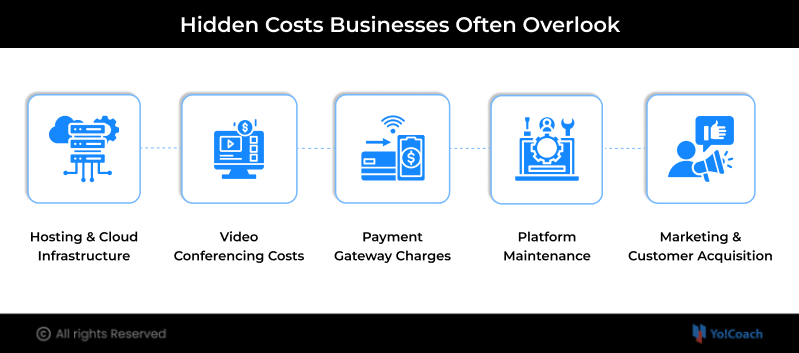
1. Hosting & Cloud Infrastructure
Reliable hosting is essential for delivering a fast, secure, and uninterrupted coaching experience. As your platform grows and attracts more users, you’ll need additional storage, bandwidth, and server capacity, which can gradually increase infrastructure costs.
Typical expenses include:
- Cloud hosting
- CDN services
- Database storage
- Backup solutions
- SSL certificates
Estimated Annual Cost: $500-$10,000+
2. Video Conferencing Costs
Since live coaching is a core feature of most online coaching businesses, integrating video conferencing solutions such as Zoom, Twilio, or Jitsi often comes with recurring costs. These expenses typically increase as your platform hosts more coaching sessions and serves a larger user base.
Expenses may include:
- API usage charges
- Video recording storage
- Streaming bandwidth
- Meeting minutes
- Webinar licenses
3. Payment Gateway Charges
Every online payment processed through your platform incurs transaction fees charged by payment service providers. While these charges may seem small initially, they can become substantial recurring expenses as booking volume increases, particularly for businesses serving international customers.
Typical costs include:
- Transaction fees
- Currency conversion charges
- International payment fees
- Chargeback processing fees
4. Platform Maintenance
Launching your coaching platform is only the beginning. Regular maintenance is essential to ensure optimal performance, security, and compatibility with evolving technologies. Ongoing updates also help improve performance and ensure a seamless experience for coaches and learners.
Maintenance activities include:
- Security updates
- Bug fixes
- Performance optimization
- Feature enhancements
- Server monitoring
- Software upgrades
Most businesses allocate 15-20% of the initial development cost annually for maintenance.
5. Marketing & Customer Acquisition
Even the most feature-rich coaching platform requires a strong marketing strategy to attract and retain users. Businesses should allocate a dedicated budget for SEO, paid advertising, social media campaigns, email marketing, and content creation.
Marketing expenses may include:
- Search engine optimization (SEO)
- Google Ads
- Social media advertising
- Content marketing
- Influencer partnerships
- Email marketing tools
A well-planned customer acquisition strategy helps maximize your return on investment and ensures a steady flow of coaches and learners to your platform.
Essential Features Every Online Coaching Platform Should Have
The success of an online coaching platform depends not only on its design but also on the features it offers. A well-rounded platform should simplify coaching operations, improve learner engagement, and create a seamless experience for all stakeholders. By investing in the right functionality from the outset, businesses can improve user satisfaction, streamline daily workflows, and build a platform that scales with future growth.
Below are the essential features businesses should consider while developing an online coaching website.
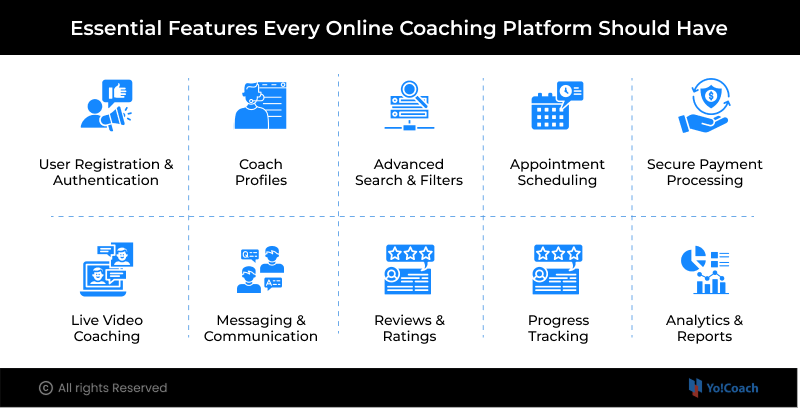
1. User Registration & Authentication
A secure registration and login system allows coaches and learners to create accounts, manage their profiles, and access personalized dashboards. Features such as social logins, email verification, and multi-factor authentication enhance both convenience and user security.
2. Coach Profiles
Detailed coach profiles help learners make informed decisions before booking sessions. Profiles should showcase professional experience, certifications, coaching specialties, availability, pricing, reviews, and ratings.
3. Advanced Search & Filters
As the number of coaches grows, users should be able to quickly find the right professional using advanced search and filtering options. Filters such as expertise, language, availability, pricing, industry, experience level, and ratings significantly improve the user experience.
4. Appointment Scheduling
An integrated scheduling system allows learners to view coach availability, book sessions, receive reminders, and manage appointments without manual coordination. This reduces administrative effort while creating a smoother booking experience for both coaches and clients.
5. Secure Payment Processing
Supporting multiple payment gateways, recurring subscriptions, discount coupons, and international currencies to provide a smooth payment experience. A reliable payment system also builds trust and simplifies revenue management.
6. Live Video Coaching
Video conferencing is one of the most important features of an online coaching platform. Built-in video conferencing enables one-on-one sessions, group coaching, webinars, and workshops without requiring users to switch to external applications.
7. Messaging & Communication
A built-in messaging system allows coaches and learners to communicate before and after sessions, share updates, answer queries, and stay connected throughout the coaching journey, resulting in better engagement and collaboration.
8. Reviews & Ratings
Ratings and reviews help establish trust within the coaching marketplace. They enable learners to evaluate coaching quality while encouraging coaches to maintain high service standards.
9. Progress Tracking
Tracking learner progress enables coaches to monitor goals, assignments, completed sessions, milestones, and performance over time. These insights support personalized coaching and keep learners motivated throughout their journey.
10. Analytics & Reports
Comprehensive analytics dashboards provide valuable insights into platform performance, bookings, revenue, user engagement, and coach productivity. These insights help businesses to monitor platform growth, measure key performance indicators, and make informed strategic decisions.
Equip Your Coaching Website with the Right Set of Features
How Long Does It Take to Develop an Online Coaching Platform?
The time required to develop an online coaching platform depends on several factors, including the project’s complexity, required features, customization level, and development methodology. A basic coaching website with essential functionality can be launched relatively quickly, whereas a fully customized coaching marketplace with advanced capabilities typically requires a much longer development cycle.
The table below provides a general estimate of development timelines for different types of coaching platforms:
| Platform Type | Estimated Timeline |
| Basic Coaching Website | 1-2 Months |
| Coaching Platform | 3-5 Months |
| Coaching Marketplace | 6-9 Months |
| Enterprise Coaching Solution | 9-12+ Months |
It’s important to note that actual timelines may vary based on factors such as UI/UX revisions, third-party integrations, quality assurance, mobile application development, and client feedback cycles.
Businesses looking to reduce their time to market often prefer ready-made white-label solutions, which can significantly shorten deployment timelines without sacrificing essential functionality. This approach significantly reduces development time while allowing businesses to customize the platform to match their brand and operational requirements.
Custom Development vs. White-Label Coaching Software: Which Is More Cost-Effective?
One of the most important decisions businesses face when launching an online coaching platform is choosing between custom development and white-label coaching software. While both approaches can help you build a successful coaching business, they differ significantly in terms of cost, development time, scalability, maintenance, and long-term ownership.
Custom development offers complete flexibility, allowing businesses to build a platform from scratch, tailored to their specific requirements. Although this approach offers maximum flexibility, it also demands a higher upfront investment, longer development timelines, and continuous maintenance expenses. On the other hand, white-label software provides a ready-made foundation that can be customized with your branding and business workflows, enabling faster deployment at a significantly lower cost.
The right choice depends on your business goals, available budget, time-to-market expectations, and technical resources.
1. Custom Development
Building a coaching platform from scratch gives you complete control over every aspect of the product. From the user interface and workflows to integrations and custom functionalities, every component is built specifically to meet your business requirements.
Custom development is generally preferred by organizations with highly specialized requirements or unique business models that cannot be supported by existing software solutions.
Advantages
- Complete customization
- Unique user experience
- Flexible architecture
- Full control over features
- Unlimited scalability
- Custom integrations
Challenges
- High development costs
- Longer development timeline
- Ongoing maintenance expenses
- Larger development team
- Higher project risks
- Continuous testing and upgrades
Custom development is an excellent option for organizations with substantial budgets and long-term product roadmaps. However, it may not be the most practical choice for startups or businesses looking to launch quickly.
2. White-Label Coaching Software
White-label coaching software provides a pre-built, feature-rich platform that can be customized with their own branding, domain, and business workflows. Instead of spending months developing core functionalities from scratch, businesses can focus on launching their platform, acquiring users, and growing revenue.
This approach has become increasingly popular among startups, coaching agencies, educational organizations, and enterprises because it significantly reduces both development time and investment while still offering extensive customization options.
Advantages
- Faster time to market
- Lower development cost
- Proven architecture
- Regular product updates
- Lower technical risk
- Easier maintenance
- Faster return on investment
Considerations
- Evaluate customization capabilities.
- Verify scalability and future feature expansion.
- Assess available technical support and documentation.
For many businesses, white-label software offers the ideal balance between flexibility, affordability, and speed, making it a practical choice for launching a competitive coaching platform.
Custom Development vs. White-Label Coaching Software
| Parameter | Custom Development | White-Label Software |
| Initial Investment | High | Lower |
| Development Time | 6-12+ Months | Days to Weeks |
| Time to Market | Slow | Fast |
| Technical Risk | High | Low |
| Maintenance | Self-managed | Simplified |
| Core Features | Built from Scratch | Pre-built |
| Scalability | High | High (Solution Dependent) |
| Branding | Fully Custom | Fully Brandable |
| Ownership | Full | Depends on License (e.g., Self-hosted solutions offer ownership) |
For businesses looking to validate their idea quickly or establish a market presence without waiting several months, white-label software is often the more practical and cost-effective option. It enables faster deployment with proven functionality while allowing businesses to invest more in marketing, customer acquisition, and long-term growth.
How to Reduce Online Coaching Platform Development Costs?
Developing an online coaching platform doesn’t have to require a six-figure investment. With careful planning and the right technology choices, businesses can significantly reduce development costs while still launching a feature-rich and scalable solution. By prioritizing essential functionality and leveraging proven solutions, you can optimize your budget without compromising on quality or user experience.
Here are five practical strategies to optimize your budget:
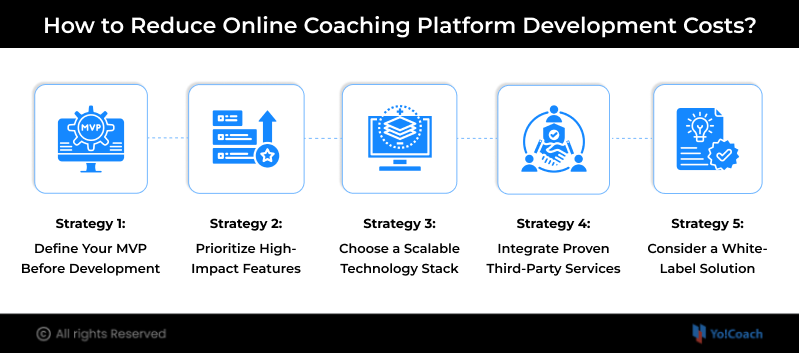
Strategy 1: Define Your MVP Before Development
One of the most common mistakes businesses make is trying to launch with every possible feature. This often increases development time, project complexity, and overall costs.
Instead, identify the core features your users need to solve their primary problems and launch a Minimum Viable Product (MVP). Once your platform gains traction, you can introduce advanced capabilities based on real user feedback.
An MVP approach helps you:
- Reduce initial investment
- Launch faster
- Validate market demand
- Minimize development risks
- Prioritize features that deliver the highest business value
Strategy 2: Prioritize High-Impact Features
Not every feature needs to be included in the first release. Focus on functionalities that directly improve user experience and support your revenue model, such as appointment scheduling, secure payments, coach profiles, and video conferencing.
Advanced features like AI-powered recommendations, gamification, or enterprise analytics can be introduced in future releases as your platform and customer base grow.
Strategy 3: Choose a Scalable Technology Stack
Selecting modern and scalable technologies during the initial development phase helps avoid costly migrations and redevelopment later. A well-planned architecture ensures that your coaching platform can accommodate higher user traffic, new integrations, and feature enhancements without significant performance issues.
Although scalable technologies may require a slightly higher initial investment, they usually reduce long-term maintenance costs.
Strategy 4: Integrate Proven Third-Party Services
Instead of building every functionality from scratch, businesses can integrate trusted third-party solutions for video conferencing, payment processing, email notifications, analytics, and cloud storage.
Leveraging reliable APIs accelerates development while reducing costs and ensuring access to regularly updated technologies.
Strategy 5: Consider a White-Label Solution
For many startups and growing businesses, choosing a white-label coaching platform is one of the most effective ways to reduce development costs. Since the core infrastructure and essential features are already developed and tested, businesses can launch the platform in a fraction of the time required for custom development.
This allows you to allocate more of your budget toward branding, marketing, customer acquisition, and business growth instead of rebuilding foundational platform functionality from scratch.
Reduce Development Costs Without Compromising Quality
Why Are Businesses Choosing White-Label Coaching Software?
As competition in the online coaching industry grows, businesses are looking for faster, more affordable ways to launch their platforms. Instead of investing months in custom development, many startups, coaching agencies, educational institutions, and enterprises are choosing white-label coaching software to accelerate their market entry while minimizing development costs and technical complexity.
By providing a ready-built foundation with essential features, white-label solutions allow businesses to focus on branding, customer acquisition, and business growth rather than building core functionality from scratch.
Some of the key reasons include:
- Faster deployment
- Lower upfront investment
- Proven and tested functionality
- Reduced technical complexity
- Easier maintenance
- Scalability for future growth
- Greater focus on marketing and customer acquisition
For startups, coaching agencies, educational institutions, and enterprises alike, white-label software offers a practical path to launching a competitive coaching platform without the delays and uncertainties associated with building from scratch.
Why is Yo!Coach a Cost-Effective Choice for Launching an Online Coaching Platform?
For businesses looking to launch an online coaching platform quickly and cost-effectively, Yo!Coach provides a compelling alternative to building a coaching platform from scratch. Developed specifically for coaching, mentoring, consulting, tutoring, and learning businesses, it comes equipped with the essential features required to launch and scale a professional coaching platform without the time and expense of building one from scratch.
Instead of investing significant resources in creating foundational functionalities, businesses can deploy a ready-made platform, customize it to reflect their brand identity, and begin onboarding coaches and learners in a fraction of the time required for custom development.
Key advantages of Yo!Coach include:
- Lifetime ownership with a self-hosted deployment model
- White-label solution with complete branding control
- One-on-one and group coaching capabilities
- Secure video session integration
- Appointment scheduling and calendar management
- Multi-language and multi-currency support
- Subscription plans and coaching packages
- Mobile-ready responsive design
- Scalable architecture suitable for startups and enterprises
Because the platform already includes these business-critical capabilities, organizations can redirect a larger portion of their budget toward marketing, customer acquisition, and business expansion rather than rebuilding commonly required features from scratch.
Additionally, Yo!Coach offers extensive customization options, making it suitable for a wide range of coaching niches, including executive coaching, business consulting, career coaching, wellness, fitness, language learning, corporate training, and mentoring. This flexibility enables businesses to tailor the platform to their unique requirements while accelerating their time-to-market.
Schedule a One-on-One Personalized Demo to See Yo!Coach in Action
Final Thoughts
Launching an online coaching website is no longer just about creating a digital presence. It’s about creating a scalable platform that delivers engaging coaching experiences, streamlines operations, and supports long-term business growth.
Although custom development provides complete flexibility, it also demands substantial investment, extended development timelines, and ongoing technical resources. For many organizations, especially startups, coaching agencies, educational institutions, and growing enterprises, these factors can delay market entry and increase project risks.
The key to building a successful coaching platform lies in balancing functionality, user experience, scalability, and budget. By carefully evaluating your business model, prioritizing essential features, and choosing the right development approach, you can build a platform that supports sustainable growth without overspending.
FAQs
1. How much does it cost to develop an online coaching website?
The cost of developing an online coaching website generally ranges from $8,000 to $200,000+. Your final investment depends on factors such as platform complexity, required features, integrations, user roles, scalability, and whether you choose custom development or a white-label solution for faster deployment.
2. How long does it take to build an online coaching platform?
Development timelines vary based on your project scope. A basic coaching website may take 1-2 months, while a feature-rich coaching platform or marketplace can take 3-12 months, depending on the scope and development approach.
3. What factors affect the cost of developing an online coaching platform?
Several factors determine development costs, including your business model, platform features, UI/UX design, technology stack, third-party integrations, mobile apps, and ongoing maintenance requirements. Planning these requirements early helps you estimate a realistic budget and avoid unexpected development expenses during the project.
4. Is white-label coaching software cheaper than custom development?
Yes, white-label coaching software is typically more cost-effective because it comes with pre-built features and a tested infrastructure. Businesses can customize the platform to match their brand while avoiding lengthy development cycles, reducing both upfront investment and overall time-to-market.
5. What are the essential features of an online coaching platform?
An effective coaching platform should include:
- Coach profiles
- Appointment scheduling
- Video conferencing
- Secure payments
- Messaging
- Reviews
- Progress tracking
- Analytics
- Subscription management
6. Can I launch an online coaching platform without coding?
Yes, entrepreneurs can launch a branded coaching platform without coding by choosing a white-label solution. These platforms include essential functionality, allowing businesses to customize branding, configure workflows, and start serving coaches and learners without building software entirely from scratch.
7. How do online coaching platforms make money?
Online coaching platforms generate revenue through commissions, subscription plans, membership fees, coaching packages, featured listings, and corporate coaching programs. Combining several revenue streams helps businesses increase profitability while creating recurring income opportunities.
8. Is an online coaching business profitable?
Yes, with growing demand for virtual coaching across industries, online coaching businesses can generate recurring revenue. By serving clients globally, offering flexible coaching packages, and creating recurring revenue through subscriptions or memberships, businesses can build a scalable and profitable coaching platform.
9. What is the best way to reduce coaching platform development costs?
You can reduce development costs by launching an MVP, prioritizing essential features, using third-party integrations, and choosing a white-label solution. This approach minimizes initial investment, shortens development timelines, and allows you to expand the platform as your business grows.
10. Why choose Yo!Coach for launching an online coaching platform?
Yo!Coach is a white-label coaching software that offers built-in scheduling, video sessions, payments, multilingual support, and marketplace features. It enables businesses to launch faster, reduce development costs, retain branding control, and focus on acquiring users instead of building core functionality from scratch.
Create Your Online Coaching Marketplace With Lower Development Costs
Contact Us