

The EdTech industry continues to evolve at a remarkable pace. At the same time, it creates new opportunities for entrepreneurs looking to launch online tutoring platforms, coaching websites, language learning marketplaces, and virtual education businesses.
While demand for online learning solutions is growing, so is the competition.
For most EdTech startups, speed is often the deciding factor between capturing market share and missing an opportunity altogether.
However, building a fully functional educational platform from scratch requires significant time, investment, and technical expertise.
Then, what is the best alternative?
The answer to the question is white-label software. It accelerates the development process. Especially for aspiring entrepreneurs and startups looking to validate their idea and tap into the market quickly and cost-efficiently, a white-label solution is the best alternative to custom development.
Instead of spending months or even years developing a platform from the ground up, startups can leverage readymade solutions to launch quickly and focus on growth.
Whether you’re planning to build a tutoring marketplace, online coaching platform, or language learning website, choosing the right white label tutoring software can help you mitigate risks.
In this article, we’ll explore how white label software helps EdTech startups launch faster, reduce costs, and gain a competitive edge in the rapidly growing online education market.
Table of Contents
- Understanding Time-to-Market in the EdTech Industry
- What is White-Label Software?
- Building an EdTech Platform from Scratch
- How White Label Software Reduces Time-to-Market
- Additional Business Benefits Beyond Faster Launches
- Why White Label Tutoring Software is an Ideal Choice
- Things to Consider When Deciding on a White-Label Tutoring Software
- Key Features to Look for
- 6 Mistakes EdTech Startups Should Avoid
- How Yo!Coach Helps
- Conclusion
- Frequently Asked Questions
Understanding Time-to-Market in the EdTech Industry
Always remember! Speed often determines whether they can capitalize on emerging opportunities or lose ground to competitors.
For startups entering the online education space, time-to-market (TTM) refers to the amount of time it takes for a business to transform an idea into a fully functional product that is available to customers.
In the EdTech industry, where innovation and user expectations evolve rapidly, launching at the right time can be just as important as launching with the right product.
Whether you’re planning to launch an online tutoring marketplace, a coaching platform, or a language learning website, reducing time-to-market can help you establish your presence before the market becomes saturated.
Time-to-market is particularly important in the EdTech sector because:
- Student learning preferences continue to evolve.
- Educational institutions are increasingly adopting digital solutions.
- New competitors and niche platforms emerge regularly.
- Technological advancements create opportunities for innovation.
- Investors often expect startups to validate their ideas quickly.
- Market demand can shift rapidly based on educational trends and economic conditions.
A delayed launch can have several consequences for an EdTech startup, including:
- Lost revenue opportunities
- Increased development and operational costs
- Reduced competitive advantage
- Missed market trends and customer demand
- Slower customer acquisition and brand recognition
- Delayed feedback is needed for product improvement
What is White-Label Software?
White-label software is a pre-built solution that businesses can rebrand as their own. The solution offers flexibility with customization. You can customize and align it with your brand identity.
It eliminated the need for custom development. Rather than developing every feature from scratch, entrepreneurs receive a readymade platform with all the essential features and functionalities already in-built. Moreover, choosing the right white-label solution brings pre-integrated tools and APIs alongside a thriving platform.
In addition, the software provider handles the core development, allowing businesses to focus on branding, customization, marketing, and customer acquisition.
The Traditional Way: Building an EdTech Platform from Scratch
When launching an educational business, many entrepreneurs initially consider custom software development. Building a platform from scratch offers complete control over design, functionality, and future enhancements.
However, this approach often requires substantial investments of time, money, and technical expertise.
Developing an online tutoring or coaching platform is far more complex than creating a standard website. Educational platforms require multiple interconnected systems that must work seamlessly together to deliver a smooth learning experience.
The development journey typically involves several stages:
- Planning and Requirement Analysis
- Design Phase
- Development Phase
- Testing and Deployment
- +Others
The Hidden Challenges of Custom Development
Beyond the planned stages, startups often encounter unexpected obstacles when developing a marketplace from scratch. As a result, building an EdTech platform from scratch can take anywhere from 6 to 18 months—or even longer for feature-rich marketplaces and enterprise-grade solutions.
For many startups, especially those looking to validate their ideas quickly, this timeline is simply too long. By the time the platform is ready, competitors may have already captured market share, customer expectations may have changed, and development costs may have exceeded initial projections.
Key Challenges of Custom Development
- Scope changes during development
- Integration challenges with third-party tools
- Resource shortages or developer turnover
- Budget overruns
- Delays caused by technical complexities
- Ongoing maintenance requirements
This challenge has led many entrepreneurs to explore faster alternatives, such as white-label tutoring software, which provides a ready-made foundation for launching educational platforms in a fraction of the time.
How White Label Software Reduces Time-to-Market?
One of the biggest challenges for EdTech startups is transforming an idea into a market-ready product before competitors capture the opportunity. Whether you’re launching an online tutoring marketplace, a language learning platform, or a coaching website, delays in development can significantly impact growth and profitability.
For startups operating with limited budgets and resources, every month spent in development can impact growth potential. Quick launch allows businesses to start attracting users, collecting feedback, generating revenue, and refining their offerings early based on real-world insights.
Many successful EdTech entrepreneurs prioritize solutions that help them enter the market faster without compromising on quality or user experience. This is where white-label tutoring software becomes a game-changer.
Unlike custom development, which requires extensive planning, coding, testing, and deployment, white label solutions provide a readymade foundation that can be customized and branded according to business requirements.
It eliminates many of the technical hurdles associated with software development, so startups can focus on launching faster, validating their business model, and acquiring customers.
Let’s explore how white label software helps EdTech startups reduce time-to-market.
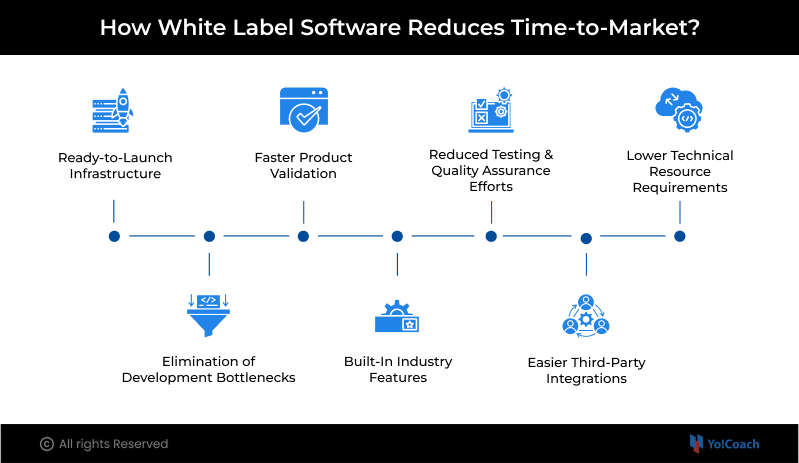
1. Ready-to-Launch Infrastructure
One of the biggest reasons startups choose white-label software is the availability of pre-built infrastructure. Instead of building these components individually, startups can launch using features that are already tested and optimized.
This can reduce development timelines from several months to a matter of weeks. More importantly, entrepreneurs don’t have to spend valuable time defining workflows, creating technical specifications, or coordinating multiple development teams.
The core architecture is already in place, allowing businesses to focus on branding, customization, and operational setup.
For example, a tutoring startup using white-label tutoring software can quickly onboard tutors, configure pricing structures, and begin accepting student bookings without waiting for months of development work. This accelerated launch process enables businesses to enter the market while demand is high and opportunities are still emerging.
Launch Your Online Tutoring Platform Using a White-Label Solution
2. Elimination of Development Bottlenecks
Development bottlenecks are particularly common in startups where budgets and technical resources are limited. A single delay in feature development or third-party integration can push launch dates back by weeks or even months. These delays often lead to increased costs and missed business opportunities.
White-label online tutoring and coaching marketplace software enables startups to bypass development roadblocks and focus on market entry. It draws many of these uncertainties by providing a stable and proven foundation.
With a white-label software for tutoring business operations, most essential functionalities are already available. Instead of worrying about coding challenges, startups can dedicate their efforts to refining their business strategy, recruiting tutors, and building partnerships. This streamlined approach significantly reduces operational stress and helps founders maintain momentum throughout the launch process.
3. Faster Product Validation
Product validation is one of the most critical stages of any startup journey. Before investing heavily in a business idea, startups need to validate market demand. This reduces business risk and supports data-driven decision-making.
The sooner a platform reaches real users, the sooner founders can understand what works and what needs improvement. Waiting months for a custom-built solution often delays this learning process.
By leveraging white label tutoring software, startups can launch a minimum viable product (MVP) much faster and begin collecting valuable insights. These insights can then be used to improve user experiences, optimize pricing models, and identify new revenue opportunities.
Ultimately, faster validation helps startups make smarter decisions while minimizing unnecessary investments in features that users may not actually need. In short, It can help an entrepreneur to determine product-market fit much earlier.
4. Built-In Industry Features
Educational businesses require specific functionalities that aren’t always available in generic website builders. Developing features such as tutor discovery, session scheduling, calendar management, virtual classroom, student progress tracking, assignment management, and many more from scratch requires extensive planning, coding, testing, and maintenance. Also, designing these features may lead to several complexities and challenges.
However, within a white-label solution, these features are already integrated. While getting started with a purpose-built white-label software, a startup can save months and years. It eliminates challenges one may encounter while building an online language learning marketplace from scratch by offering industry-specific features from day one.
This allows entrepreneurs to launch a professional platform that meets user expectations. Additionally, built-in educational features often reflect industry best practices, helping startups deliver a better learning experience while maintaining operational efficiency.
5. Reduced Testing and Quality Assurance Efforts
Undoubtedly, testing can consume a significant portion of development timelines. It’s critical to ensure quality, performance and workflow essential to an educational platform. Otherwise, even minor technical issues can negatively impact student satisfaction, tutor productivity, and damage a startup’s reputation.
However, choosing a reliable white-label solution can help you minimize the timeline. It usually undergoes extensive testing across multiple deployments, making the solution time-tested. This gives startups greater confidence in platform stability and performance.
Consequently, businesses can minimize time needed for troubleshooting technical problems and focus on customer acquisition and growth initiatives.
6. Easier Third-Party Integrations
Third-party integration is another time-consuming factor. Integrating tools and APIs necessary for delivering a seamless learning experience. However, integrating and testing multiple tools can significantly extend development timelines when building a platform from scratch.
White label software simplifies this process by providing pre-configured integrations that work out of the box. This means startups can quickly enable video conferencing, payment processing, notifications, and communication tools without requiring extensive technical expertise.
The result is a faster launch process and a more reliable user experience from the very beginning.
7. Lower Technical Resource Requirements
Hiring developers, designers, testers, and project managers can significantly extend project timelines. At the same time, finding the right experts for your project is also daunting and expensive. It’s not that easy.
Conversely, a white label software eliminates the need for hiring technical experts. It minimizes the dependency on technical resources and lets businesses focus on other areas.
Additional Business Benefits Beyond Faster Launches
While reducing time-to-market is one of the primary advantages of white-label software, the benefits extend far beyond launch speed. Startups also gain financial, operational, and strategic advantages that support long-term growth.
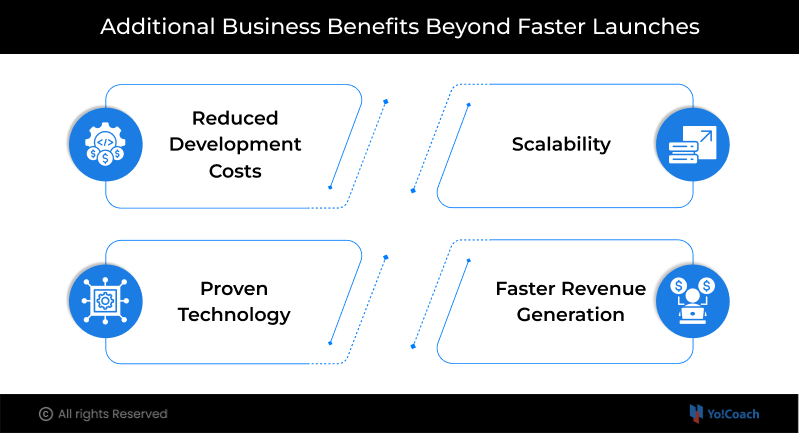
1. Reduced Development Costs
Custom platform development can cost tens of thousands of dollars or more. White label solutions typically provide predictable costs and lower initial investment requirements.
Instead of allocating large budgets to software development, startups can invest in marketing, customer acquisition, and platform expansion. This improves cash flow management and reduces financial risk during the early stages of business growth.
2. Proven Technology
Using software that has already been deployed in real-world educational businesses reduces technical risk. Rather than experimenting with untested systems, startups gain access to technology that has already demonstrated reliability and performance. This helps build trust among tutors, students, and stakeholders.
3. Scalability
As businesses grow, they can expand their offerings without rebuilding their infrastructure.
Whether adding new subjects, expanding into international markets, or introducing group classes, scalable white label tutoring software supports growth without requiring major redevelopment efforts.
4. Faster Revenue Generation
Launching earlier means generating revenue sooner, which can be critical for startup sustainability.
Every month spent in development is a month without customers, bookings, or income. By accelerating launch timelines, startups can begin monetizing their services much earlier and reinvest profits into future growth initiatives.
Why White Label Tutoring Software is Ideal for Modern Tutoring Businesses?
The tutoring industry has evolved significantly beyond traditional one-on-one lessons. Today’s educational businesses cater to diverse learning needs, ranging from academic tutoring and language instruction to corporate training, test preparation, professional coaching, and skill development programs.
As these services become more sophisticated, managing operations manually or through generic software solutions can quickly become challenging. At the same time, building an online tutoring platform from scratch requires significant time, money and resources, which are another challenge for startups, entrepreneurs and small-scale businesses.
This is where white label tutoring software becomes a valuable asset. Designed specifically for online education businesses, it provides the infrastructure needed to streamline daily operations, enhance learner experiences, and support business growth.
Instead of investing substantial time and resources into building a platform from scratch, entrepreneurs can leverage dedicated white-label software that includes the essential tools required to run a successful tutoring business.
Find the Best White-label Tutoring Software for Your EdTech Startup
Things to Consider When Deciding on a White-label Tutoring Software
As the online education market continues to expand globally, businesses need technology that can adapt to changing learner demands. Modern learners expect seamless digital experiences, flexible scheduling options, secure payment methods, and interactive virtual classrooms. Meeting these expectations through custom development can be both costly and time-consuming. A dedicated white label software for tutoring business operations helps address these demands while enabling businesses to launch and scale more efficiently.
For founders seeking a faster and more cost-effective route to launching an educational platform, white-label tutoring software offers the ideal balance of speed, functionality, and scalability. It enables businesses to enter the market quickly, validate their ideas, and focus on delivering educational value rather than managing technical complexities or lengthy development projects.
Some of the key capabilities typically offered by white label tutoring software include:
- Student management
- Tutor management
- Automated scheduling
- Virtual classrooms
- Payment automation
- Reporting dashboards
Key Features to Look for in White Label Tutoring Software
Choosing the right white label tutoring software is one of the most important decisions an EdTech startup can make. Many solutions claim to offer comprehensive functionality. But remember, not all platforms are built specifically for the unique requirements of tutoring and online learning businesses. To ensure faster deployment, better user experiences, and long-term scalability, startups should carefully evaluate the following features before making a decision.
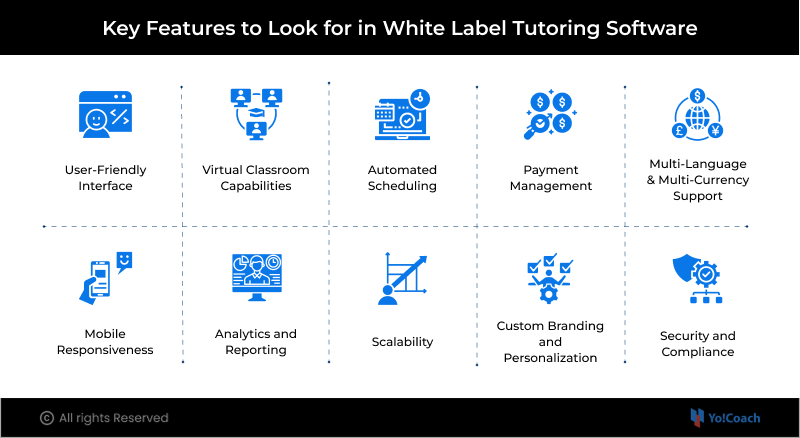
1. User-Friendly Interface
A platform’s usability directly impacts user adoption and retention. A user-friendly platform reduces friction, improves engagement, and encourages repeat usage, which is essential for growing educational businesses. Both tutors and students should be able to navigate the platform without requiring extensive training or technical support.
An intuitive interface should include:
- Easy registration and onboarding
- Simple profile management
- Clear navigation menus
- Quick access to bookings and schedules
- Streamlined communication tools
2. Virtual Classroom Capabilities
Virtual classrooms are at the heart of online tutoring and coaching platforms. Integrated video conferencing eliminates the need for users to switch between multiple applications and creates a seamless learning experience.
Look for features such as:
- HD video and audio conferencing
- Screen sharing
- Interactive whiteboards
- File sharing
- Session recording
- Chat functionality
3. Automated Scheduling
Managing schedules manually can quickly become overwhelming as the number of tutors and learners grows. The right white-label tutoring software automates the scheduling process, minimizing the need for manual efforts.
Automated scheduling features help businesses:
- Reduce administrative workload
- Prevent double bookings
- Manage tutor availability
- Send automated reminders
- Improve attendance rates
4. Payment Management
A reliable payment system is critical for any tutoring marketplace or coaching platform. It helps establish trust among users while simplifying financial operations for platform owners.
The ideal solution should support:
- Multiple payment gateways
- Secure transactions
- Automated tutor payouts
- Subscription plans
- Commission management
- Invoice generation
5. Multi-Language and Multi-Currency Support
Many EdTech startups aim to serve learners across different countries and regions. Multi-language and multi-currency capabilities make it easier to attract international users and expand into new markets.
Benefits include:
- Improved accessibility for global audiences
- Localized user experiences
- Simplified international transactions
- Increased market reach
6. Mobile Responsiveness
Mobile responsiveness is no longer optional today. Learners expect flexibility and convenience. Whether accessing lessons from a smartphone, tablet, or desktop computer, a mobile-friendly platform enables users to enjoy a consistent and enhanced user experience across all devices.
A mobile-responsive platform helps:
- Increase user engagement
- Improve accessibility
- Support learning on the go
- Enhance overall customer satisfaction
7. Analytics and Reporting
Insights help businesses identify opportunities for improvement and make informed strategic decisions. An advanced reporting and analytics tool is essential for sustainable business growth.
Comprehensive analytics tools allow platform owners to monitor:
- Student enrollment trends
- Tutor performance
- Revenue generation
- Session completion rates
- User engagement metrics
8. Scalability
Many startups begin with a small user base but plan to expand rapidly. The chosen platform should be capable of supporting growth without requiring major redevelopment. It helps avoid costly migrations and operational disruptions later.
Scalable white label software should accommodate:
- Increasing numbers of users
- Additional tutors and courses
- New business models
- Geographic expansion
- Enhanced feature requirements
9. Custom Branding and Personalization
Strong branding helps startups differentiate themselves in a competitive market while building trust and recognition among users. And one of the biggest advantages of white label software is the ability to establish a unique brand identity.
Look for solutions that allow customization of:
- Logos and brand colors
- Domain names
- User interfaces
- Email templates
- Landing pages
10. Security and Compliance
Educational platforms handle sensitive user information, payment details, and communication records. Security should therefore be a top priority. A secure platform protects both the business and its users while enhancing credibility.
Important security features include:
- SSL encryption
- Secure payment processing
- Role-based access controls
- Data backup systems
- GDPR and privacy compliance
6 Mistakes EdTech Startups Should Avoid When Choosing Software
Selecting the wrong software can delay launches, increase costs, and create operational challenges. Understanding common mistakes can help entrepreneurs make more informed decisions.
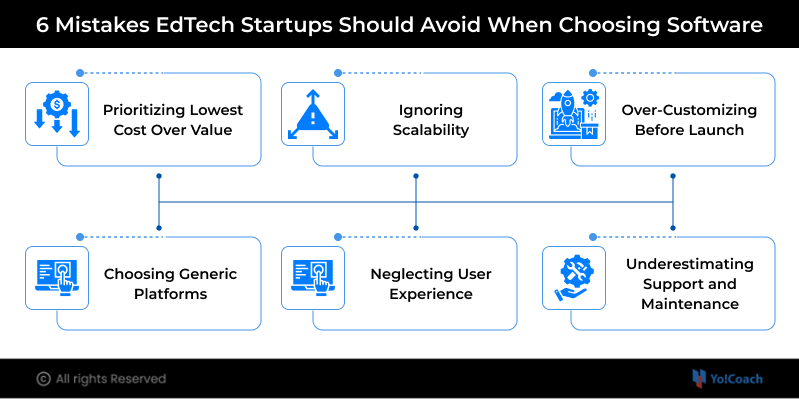
1. Prioritizing Lowest Cost Over Value
Many startups focus exclusively on upfront costs when evaluating software solutions. While budget considerations are important, choosing the cheapest option can often lead to limitations in functionality, scalability, and support. Moreover, it may cost extra, necessitating custom development or migrating to another.
2. Ignoring Scalability
Some entrepreneurs choose software based solely on their current needs without considering future growth. It may lead to several challenges when growing your business. Therefore, always choose a platform that is scalable. A platform must support growth and expansion, making the business future-proof.
3. Over-Customizing Before Launch
Many startups delay launches by attempting to perfect every detail before entering the market. While customization is valuable, excessive modifications can significantly extend timelines and increase costs. A faster launch often provides more value by enabling real-world feedback and market validation.
4. Choosing Generic Platforms
Generic website builders and marketplace solutions may appear attractive initially, but they often lack education-specific functionality. Industry-specific solutions typically provide better functionality, smoother user experiences, and faster deployment compared to generic alternatives.
5. Neglecting User Experience
A platform packed with features is ineffective if users struggle to navigate it. Poor user experience can lead to lower engagement, reduced retention, and negative reviews. Startups should prioritize usability and UX/UI alongside functionality.
6. Underestimating Support and Maintenance
Software implementation doesn’t end after launch. Ongoing support, updates, and maintenance are essential for long-term success. Choosing a provider with reliable technical support can help businesses resolve issues quickly and maintain platform performance.
How Yo!Coach Helps EdTech Startups Launch Their Tutoring Platform Faster
Yo!Coach is specifically designed for entrepreneurs, educational institutions, coaching businesses, and tutoring startups looking to launch online learning platforms quickly, cost-effectively and efficiently.
Unlike generic website builders or traditional platforms, Yo!Coach is built specifically for tutoring and coaching businesses. It enables startups to avoid lengthy development cycles and launch with features that are already aligned with educational business requirements.
Yo!Coach helps EdTech startups balance speed, functionality, and budget, all together. It eliminates the need for hiring technical teams, managing development timelines, and conducting multiple rounds of testing.
Yo!Coach addresses these challenges by providing a ready-to-deploy foundation that significantly reduces the effort required to enter the market, allowing businesses to focus on acquiring tutors and learners rather than building core functionality from scratch.
Some of the capabilities that help reduce time-to-market include:
- Out-of-the-box tutoring marketplace functionality
- Integrated virtual classroom tools
- Automated booking and scheduling
- Secure payment processing
- Tutor and learner management
- Multi-language support
- Mobile-responsive design
- Reporting and analytics
Key Highlights: Why Get Started With Yo!Coach?
Faster Platform Deployment
With Yo!Coach, entrepreneurs can launch their educational platforms much faster compared to traditional custom development approaches. Since the essential infrastructure is already built and tested, businesses can focus on branding, customization, and operational setup. This accelerated deployment process enables startups to:
- Validate business ideas quickly
- Start generating revenue sooner
- Gather user feedback earlier
- Adapt to market demands faster
Purpose-Built for Educational Businesses
Yo!Coach is designed specifically for online tutoring, coaching, mentoring, and learning businesses in order to deliver a professional learning experience. This specialization means startups gain access to features tailored for educational workflows, including:
- Tutor discovery and matching
- Session scheduling
- Learner management
- Interactive learning environments
- Progress tracking capabilities
Supports Multiple Business Models
Another major advantage of Yo!Coach is its flexibility. It supports multiple educational business models that allow entrepreneurs to launch with confidence while maintaining the ability to scale over time. Business model Yo!Kart supports are:
- One-on-one tutoring
- Group classes
- Language learning platforms
- Corporate training programs
- Coaching marketplaces
- Skill development platforms
- Mentorship networks
Reduced Technical Complexity
For founders who want to focus on business growth rather than technical operations, Yo!Coach offers a ready-to-deploy foundation eliminating the need for technical complexities. In addition, its free technical support helps businesses counter any unexpected challenge. By leveraging Yo!Coach, startups can reduce:
- Development risks
- Technical overhead
- Maintenance challenges
- Integration complexities
Long-Term Growth Potential
Launching quickly is important, but long-term scalability is equally critical. ensures that startups can continue evolving their businesses without needing to rebuild their platforms as demand increases. Yo!Coach provides a foundation that supports business growth through:
- Scalable architecture
- Global market readiness
- Advanced administrative controls
- Continuous platform enhancements
Ready to Explore Yo!Coach for Your Online Tutoring Platform?
Conclusion
In today’s highly competitive education technology landscape, speed can be a decisive competitive advantage. Startups that launch quickly are often better positioned to validate ideas, attract users, generate revenue, and establish a strong market presence before competitors gain traction.
While custom development offers complete control over platform architecture and functionality, it often requires substantial investment, lengthy development cycles, and ongoing technical management. These challenges can delay market entry and increase business risk, particularly for startups operating with limited resources.
White-label software provides a practical and efficient alternative by delivering ready-made functionality that allows entrepreneurs to launch educational platforms significantly faster. From pre-built scheduling systems and virtual classrooms to payment processing and user management tools, these solutions eliminate many of the barriers associated with traditional software development.
For startups looking to build a tutoring marketplace, coaching website, language learning platform, or online learning ecosystem, selecting the right white label software, Yo!Coach is the right fit. It’s a purpose-built educational software that can help entrepreneurs launch faster, scale efficiently, and compete effectively in today’s rapidly evolving EdTech landscape.
By leveraging Yo!Coach’s readymade foundation instead of starting from scratch, founders can transform their ideas into fully operational businesses more quickly, efficiently, and confidently. They can further focus on growth, customer acquisition, tutor recruitment, learner engagement, and educational outcomes rather than technical complexities.
Frequently Asked Questions (FAQs)
Q 1. What is white label tutoring software?
Ans. White label tutoring software is a pre-built online tutoring platform that businesses can customize and rebrand as their own. It supports all the necessary features and functionalities, enabling entrepreneurs to launch tutoring marketplaces, coaching platforms, or online learning websites without developing software from scratch.
Q 2. How does white label tutoring software reduce time-to-market?
Ans. White label tutoring software comes with readymade features such as tutor management, scheduling, virtual classrooms, payment processing, and user dashboards. Since these functionalities are already developed and tested, businesses can launch their platforms much faster compared to custom development.
Q 3. Is white label software for a tutoring business better than custom development?
Ans. The answer depends on business goals. White label software for tutoring business operations is ideal for startups seeking faster deployment, lower costs, and reduced technical complexity. Custom development may offer greater flexibility but typically requires more time, resources, and investment. However, if you want to validate your idea with reduced cost, white-label solution is always an ideal choice.
Q 4. How long does it take to launch a tutoring platform using white label software?
Ans. Most businesses can launch a tutoring platform within a few days to weeks using white label tutoring software, depending on customization requirements. In contrast, custom-built platforms often take several months or even over a year to develop and deploy.
Q 5. What features should I look for in white label tutoring software?
Ans. Key features that a white-label tutoring software include are:
- Tutor and student management
- Virtual classroom integration
- Automated scheduling and bookings
- Secure payment gateways
- Multi-language and multi-currency support
- Analytics and reporting
- Mobile responsiveness
- Reviews and ratings
- Custom branding capabilities
Q 6. Can white-label software support different tutoring business models?
Ans. Yes. Modern white-label software for tutoring business operations can support various models.
With popular white-label software like Yo!Coach you can launch one-on-one tutoring, group classes, language learning platforms, coaching marketplaces, mentorship programs, corporate training, and skill development platforms.
Q 7. Is white label tutoring software scalable for growing businesses?
Ans. Absolutely. Most professional white label tutoring software solutions are designed to scale as your business grows. They can accommodate increasing numbers of tutors, learners, courses, and transactions without requiring major redevelopment.
If you are looking for a scalable white-label tutoring software, YoCoach can be the right choice.
Q 8. How much does white label tutoring software cost?
Ans. Using a white-label tutoring software, you can launch your language learning marketplace within $1000- $10,000. It is generally more cost-effective than building a tutoring platform from scratch, which can require significant development investment. However, the cost varies depending on the provider, features, customization requirements, and licensing model.
Q 9. Can I customize white label software for my tutoring business?
Ans. Yes. Most white label solutions allow businesses to customize branding elements such as logos, colors, domain names, email templates, and user interfaces. This helps create a unique brand identity while leveraging a proven software foundation.
Yo!Coach is a fully customizable solution you can get started with.
Q 10. Why is Yo!Coach a popular choice for EdTech startups?
Ans. Yo!Coach is a purpose-built white-label tutoring software solution designed specifically for tutoring, coaching, mentoring, and online learning businesses. It offers readymade marketplace functionality, virtual classrooms, scheduling tools, payment management, multilingual support, and scalable architecture, helping startups launch faster and grow efficiently.
Q 11. Can white label tutoring software support international learners?
Ans. Yes, many advanced white-label tutoring software solutions include multi-language and multi-currency support, making it easier for businesses to serve learners and tutors across different countries and regions. Yo!Coach is one of those solutions you can explore.
Q 12. What are the biggest benefits of using white label software for tutoring business operations?
Ans. From reducing development bottlenecks to enabling faster product validation, the benefits of white-label tutoring software extend far beyond simply saving time. Businesses can focus on growth, customer acquisition, tutor recruitment, learner engagement, and educational outcomes rather than technical complexities. Some of the key benefits include:
- Faster time-to-market
- Lower development costs
- Reduced technical risks
- Built-in educational features
- Easier platform management
- Faster revenue generation
- Improved scalability
- Better focus on business growth and customer acquisition
Q 13. Is white label tutoring software suitable for startups with limited technical expertise?
Ans. Yes. White label tutoring software is particularly beneficial for entrepreneurs who want to launch an educational platform without managing complex software development processes. Most solutions provide a ready-to-use infrastructure that requires minimal technical involvement.
Q 14. Can I integrate third-party tools with white label tutoring software?
Ans. Most modern platforms support integrations with popular tools such as Zoom, Google Meet, Stripe, PayPal, Google Calendar, email marketing software, and CRM systems, helping businesses streamline operations and enhance user experiences. Yo!Coach can be the right fit for you if you are looking for a solution that integrates tools highlighted alongside several more options.
Q 15. How do I choose the best white label tutoring software for my business?
Ans. When evaluating solutions, consider factors such as:
- Industry-specific features
- Ease of customization
- Scalability
- Security and compliance
- Customer support
- Integration capabilities
- Pricing structure
- Vendor reputation
Choosing a reliable solution like Yo!Coach can help ensure a faster launch, smoother operations, and long-term business growth.
Looking for a White-Label Tutoring Software?
Contact Us