
The global shift toward digital learning has made it the foundation of modern education. From live tutoring marketplaces to cohort-based learning communities and AI-powered micro-courses, 2026 presents massive opportunities for entrepreneurs who want to build a scalable online education business.
However, success doesn’t come from just launching a website. It requires strategic niche selection, well-planned features, a sustainable revenue model, the right technology partner, and a solid marketing strategy.
This comprehensive blog walks you through exactly how to build an online education platform using a practical, business-first approach.
Table of Contents
Understanding the Online Education Market in 2026
The online education industry has matured significantly. What worked in 2020 is no longer enough in 2026. Today’s learners want personalized, interactive, and seamless learning experiences that fit into their daily lives.
Modern students look for:
- Personalized learning paths tailored to their goals
- Interactive live classes with real-time engagement
- Community-driven learning environments
- Mobile-first access across devices
- Smooth payments and hassle-free scheduling
Key Trends Defining 2026
1. Niche-Specific Marketplaces
Broad learn anything platforms are losing ground to specialized education businesses. Focused platforms for language tutoring, STEM coaching, coding bootcamps, music lessons, test preparation, and corporate upskilling are seeing stronger engagement and retention.
2. Hybrid Learning Models
Flexibility is essential. Learners prefer a blend of self-paced recorded content combined with live mentoring, doubt-solving sessions, and structured guidance.
3. Marketplace-Based Education
Instead of teaching themselves, many entrepreneurs are building multi-tutor platforms. This model scales faster, offers wider course variety, and creates recurring revenue opportunities.
4. Mobile-First Learning
A majority of users now access education platforms via smartphones. Platforms optimized for mobile deliver better engagement, accessibility, and completion rates.
In essence, success in 2026 comes down to specialization, scalability, and delivering a frictionless user experience.
Build a Future-Ready Online Learning Marketplace
Steps to Build an Online Education Platform
Building a successful online education platform requires careful planning, the right technology, and a clear growth strategy. The following steps will guide you through the entire process, from choosing your niche to launching and scaling a sustainable learning business.
Let’s begin:
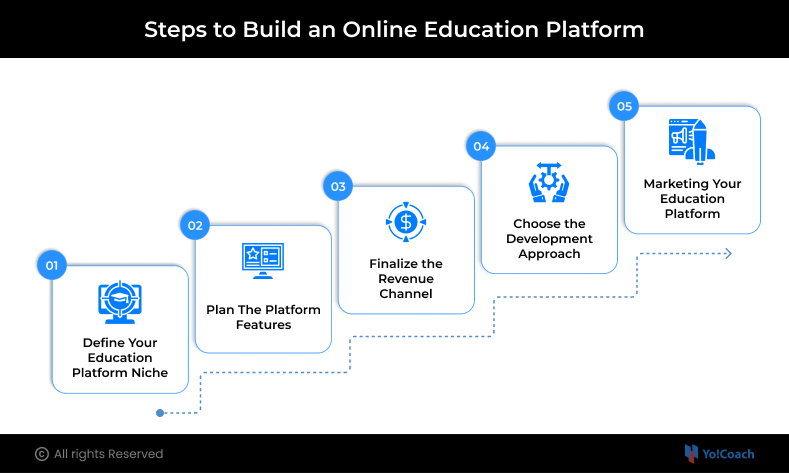
Step 1: Define Your Education Platform Niche
One of the most common mistakes founders make is trying to serve everyone’s needs. A well-defined niche helps you position your platform strongly, reduce competition, target marketing effectively, and attract the right tutors and learners.
Choose a niche where you understand the audience, can confirm real demand, and see clear revenue potential. In 2026, strong niches include K-12 tutoring, language learning, coding bootcamps, professional certifications, corporate training, music coaching, and competitive exam preparation.
Before you start building, validate your idea through competitor research, small ad campaigns, surveys, or a waitlist page. Clarity in your niche leads to clearer and faster growth.
Step 2: Plan The Platform Features
A successful online education platform must create a balanced ecosystem for students, tutors, and administrators. Each panel should be designed to ensure smooth interaction, seamless transactions, and efficient management. Thoughtful feature planning not only improves user experience but also ensures your platform can scale as demand grows. Below is a breakdown of essential features:
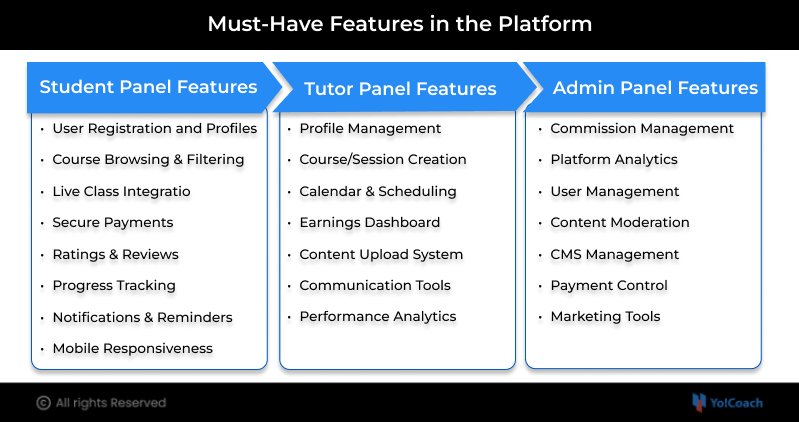
Student Panel Features
- User Registration and Profiles: Easy sign-up with profile customization allows students to manage personal details, track learning history, and personalize their experience.
- Course Browsing and Filtering: Advanced search and filtering options help students quickly find relevant courses or tutors based on subject, price, rating, language, or availability.
- Live Class Integration: Built-in live video functionality enables real-time interaction, screen sharing, and collaborative learning without relying on third-party tools.
- Secure Payments: Integrated payment gateways ensure safe transactions, supporting multiple currencies and payment methods.
- Ratings & Reviews: Students can provide feedback on courses and tutors, building trust and helping others make informed decisions.
- Progress Tracking: Dashboards that display completed sessions, performance reports, and learning milestones improve engagement and motivation.
- Notifications & Reminders: Automated alerts for upcoming sessions, payments, or updates reduce missed classes and improve user experience.
- Mobile Responsiveness: A mobile-friendly interface ensures smooth access across devices, increasing engagement and accessibility.
Tutor Panel Features
- Profile Management: Tutors can create detailed profiles highlighting expertise, qualifications, availability, and pricing.
- Course/Session Creation: Tools to create, edit, and manage courses or live sessions allow tutors to structure their offerings effectively.
- Calendar & Scheduling: Smart scheduling systems help manage availability, bookings, and time zones efficiently.
- Earnings Dashboard: Transparent tracking of earnings, commissions, and payouts builds trust and financial clarity.
- Content Upload System: Tutors can upload study materials, recorded sessions, assignments, or additional resources.
- Communication Tools: Messaging and notification systems enable smooth communication between tutors and students.
- Performance Analytics: Insights into ratings, session completion rates, and student feedback help tutors improve their services.
Admin Panel Features
- Commission Management: Admins can set platform commission rates and manage revenue distribution.
- Platform Analytics: Comprehensive reports on revenue, user growth, bookings, and performance support strategic decision-making.
- User Management: Control over student and tutor accounts ensures platform safety and compliance.
- Content Moderation: Admins can review and approve courses, materials, and profiles to maintain quality standards.
- CMS Management: Built-in content management allows easy updates to website pages, banners, and announcements.
- Payment Control: Allows monitoring transactions and managing refunds to ensure financial transparency.
- Marketing Tools: Integrated tools for discounts, coupons, referral programs, and email campaigns help drive user acquisition and retention.
Carefully planning these features ensures your online education platform operates smoothly, delivers value to users, and scales efficiently in 2026.
Start Building a Feature-Rich Learning Marketplace
Step 3: Finalize the Revenue Channel
Your revenue model is the foundation of your online education platform. It not only determines how you generate income but also influences your platform architecture, payment structure, user flow, and long-term scalability. A well-chosen monetization strategy helps you generate predictable revenue, improve user retention, and manage finances more efficiently.
Before finalizing your revenue channel, evaluate your niche behavior, competitor pricing, target audience spending capacity, and the value you are offering. In 2026, flexibility in monetization is often the key to sustainable growth.
Popular Monetization Models
a. Commission-Based Model: In this model, the platform earns a percentage from every transaction between students and tutors. The commission can vary based on session type, tutor level, or pricing tier.
Advantages:
- Scales naturally as bookings increase
- Aligns platform growth with revenue growth
Best for: Multi-tutor marketplaces and service-based platforms.
b. Subscription Model: Users pay a monthly or yearly fee to access courses or platform features. This model ensures predictable recurring revenue.
Advantages:
- Stable income stream
- Higher user retention
Best for: Course libraries, recorded content platforms, and learning communities.
c. Pay-Per-Session Model: Students pay for individual live classes or sessions. Pricing can vary based on tutor expertise or session duration.
Advantages:
- Flexible for learners
- Attractive for premium tutors.
Best for: Coaching platforms and one-on-one tutoring services.
d. Membership Model: Users pay a recurring fee to access exclusive content, premium features, or priority booking options.
Advantages:
- Builds loyalty
- Increases customer lifetime value.
Best for: Niche expert communities and specialized learning platforms.
e. Hybrid Model: A combination of commission, subscription, and/or membership fees. For example, charging tutors a subscription to join the platform and a commission per session.
Advantages:
- Reduce dependency on a single revenue stream
- Stable and predictable income
Best for: Scalable education marketplaces aiming for diversified revenue streams.
Step 4: Choose the Development Approach
Choosing the right development approach is one of the most critical decisions when launching your online education platform. The approach you select directly impacts your budget, time-to-market, scalability, maintenance costs, and overall risk. Choosing wisely can help you enter the market faster and allocate resources more efficiently.
1. Custom Development
Custom development involves building your online education platform from scratch with the help of a dedicated development team. Every feature, workflow, and integration is tailored according to your unique business requirements, giving you complete control over the platform.
Pros:
- Fully customizable
- Unique feature flexibility
Cons:
- Extremely High Cost: Custom builds can cost 3-5x more than ready-made software solutions.
- Long Development Timeline: It may take 6-12 months to launch.
- Continuous Maintenance Cost: Ongoing development, bug fixes, server upgrades.
- Dependency on Developers: If your developer leaves, your project may stall.
- High Risk of Delays: Scope creep, miscommunication, and feature changes increase cost.
- Uncertain Scalability: Without experienced architecture planning, scalability becomes expensive.
Best Suited For: Businesses with substantial funding, strong technical expertise, a long runway, and a clearly defined product vision.
However, it is important to note that for many startups, it can significantly delay market entry.
2. Readymade Software
Readymade software provides a pre-built, customizable solution that allows you to launch your education platform quickly without starting from the ground up. These solutions come with essential features like student dashboards, tutor management, payment integration, and admin controls already developed and tested.
Pros:
- Faster Go-To-Market: Allows you to deploy the platform within weeks instead of months.
- Cost-Effective: Offers one-time payment or structured pricing.
- Proven Architecture: Already tested in real-world markets.
- Built-In Monetization: Supports various revenue channels, such as commission, subscription, and more. Additionally, equipped with secure payment systems.
- Lower Risk: Fewer technical uncertainties.
- Scalable Infrastructure: Designed for growth from day one.
- Ongoing Support: Provides ongoing technical support.
Cons:
- To leverage a self-hosted solution, you need to meet the minimum server requirements.
However, compared to custom development, readymade software offers a far better ROI for most startups. Thus, for entrepreneurs aiming to build an online education platform efficiently, this is the smarter choice.
Why Yo!Coach is the Best Readymade Software to Build an Education Platform
When evaluating readymade solutions, it’s important to understand that not all platforms are built with the same vision. Some are generic LMS systems designed only for selling recorded courses, while others lack true marketplace capabilities. Choosing the right foundation is critical because it directly affects your scalability, monetization options, and user experience.
Yo!Coach stands out as a purpose-built online tutoring and coaching marketplace solution created specifically for entrepreneurs who want to launch and scale multi-tutor education platforms. It is designed to support real-time learning, structured monetization, and long-term scalability, not just course hosting, making it suitable for businesses aiming for long-term growth rather than a basic course website.
Key Advantages of Yo!Coach
a. Built Specifically for Education Marketplaces: Designed around the multi-tutor model, Yo!Coach supports tutor onboarding, commissions, scheduling, and live session management, the core components of a scalable tutoring business.
b. One-Time Payment Model: Yo!Coach follows a lifetime license model, meaning you pay once and retain ownership. There are no recurring commissions on your revenue, allowing you to maximize profitability as your platform grows.
c. Advanced Live Learning Tools: The platform includes integrated live video functionality, interactive whiteboard, session recording, scheduling management, and real-time collaboration tools, creating a seamless learning environment.
d. Multi-Language & Multi-Currency Support: If you plan to target a global user base, Yo!Coach allows you to operate across regions without technical limitations, supporting international expansion from day one.
e. Fully Customizable & White-Label: You get complete branding control along with customizable source code ownership. This ensures flexibility for future feature enhancements and business scaling.
f. Scalable Architecture: Built with growth in mind, Yo!Coach supports increasing users, tutors, and transactions without performance compromise.
g. Strong Admin Control & Analytics: From commission management and payout control to detailed analytics and reporting, the admin panel provides full operational visibility.
h. Dedicated Technical Support: Professional support ensures smooth implementation, customization guidance, and reduced operational stress, especially valuable for non-technical founders.
See Yo!Coach in Action
Step 5: Marketing Your Education Platform
Launching your online education platform is only the beginning; consistent growth depends on a structured marketing approach. Start with pre-launch activities to build anticipation and validate demand through a landing page, early ads, and social media engagement. Once live, focus on organic growth using SEO, valuable content, and community building to establish credibility and attract steady traffic.
To scale faster, invest in targeted ads, influencer collaborations, and retargeting campaigns. At the same time, prioritize retention because long-term success comes from keeping users engaged. Additionally, use email automation, referral programs, loyalty rewards, and active communities to increase lifetime value and encourage repeat learning.
Conclusion
Launching an online education platform in 2026 offers a high-potential opportunity, but long-term success depends on a clear strategy and seamless execution. Focus on understanding the market, choosing a profitable niche, planning scalable features, choosing the right revenue model, and implementing effective marketing.
While custom development can be time-consuming, complex, and costly, readymade solutions offer faster and more scalable growth. Yo!Coach provides a purpose-built solution to launch efficiently and grow confidently in the expanding digital education market.
FAQs
Q 1. Do I need technical knowledge to launch an online education platform?
Ans. No, you don’t necessarily need technical expertise to launch an online education platform, if you choose a ready-made solution like Yo!Coach. This solution is designed for entrepreneurs and education businesses, allowing them to manage operations, onboard tutors, and control monetization without deep coding knowledge.
Q 2. Can I launch a multi-tutor marketplace instead of teaching myself?
Ans. Yes, you can launch a multi-tutor marketplace. Yo!Coach is specifically built for multi-tutor and coaching marketplaces. It allows you to onboard multiple instructors, define commission structures, and manage bookings without being an educator yourself.
Q 3. Is Yo!Coach suitable for niche-specific platforms?
Ans. Yes, Yo!Coach is suitable for niche-specific platforms. Whether you want to launch a language learning website, a coding academy, or a corporate training marketplace, it supports full customization and white-label branding to align with your niche positioning.
Q 4. Can I scale my platform globally in the future using Yo!Coach?
Ans. Yes, you can scale your platform globally in the future using Yo!Coach. It supports multi-language and multi-currency functionality, making it easier to expand into international markets without rebuilding your platform infrastructure.
Q 5. How secure is Yo!Coach for payments and user data?
Ans. Yo!Coach comes integrated with secure payment gateways and follows industry-standard security practices to protect transactions and user information, ensuring trust and compliance.
Q 6. Can I integrate third-party tools and APIs with Yo!Coach?
Ans. Yes, you can integrate third-party tools and APIs with Yo!Coach. With customizable source code ownership and customization flexibility, you can integrate third-party tools such as CRM systems, marketing automation tools, analytics software, and additional payment gateways.
Enter the EdTech Industry With a Platform Designed for Growth
Get Started