
Building a STEM eLearning platform is a specialized venture that requires a deep understanding of how technical subjects are taught through practice, examination, and problem-solving. In 2026, the focus has shifted from simple video hosting to creating high-performance, interactive environments for Science, Technology, Engineering, and Mathematics.
This blog offers a comprehensive roadmap for entrepreneurs and educators who want to build a robust STEM learning ecosystem, focusing on hands-on engagement, advanced tools, and scalable strategies rather than generic eLearning trends.
Table of Contents
Understanding the STEM eLearning Market
STEM learners approach online education with a fundamentally different mindset from an average online student. They are not just looking for information; they want to apply concepts, test ideas, and solve real problems. For them, learning happens through experimenting and iterating, not passive consumption.
What Makes STEM Different from General eLearning?
Most of the general eLearning platforms focus on memorization, theory, and comprehension. STEM education, however, requires logical manipulation and quantitative reasoning. You cannot learn structural engineering just by watching a video; you must calculate forces, test models, and validate assumptions through practice.
- Interactive Learning Requirements:-
A true STEM platform must enable active participation through dynamic tools and responsive environments, such as:- Variable Manipulation: Sliders that change gravity in a physics simulation, to observe cause and effect.
- Data Visualization: Real-time graphs and models that update instantly as a student changes parameters in a math equation.
- Simulations & Virtual Labs
The laboratory experience is central to STEM learning, yet physical labs are expensive and often inaccessible. Virtual labs solve this gap by providing safe, cost-effective sandbox environments where students can conduct experiments, test hypotheses, and learn from trial and error without real-world risks.
- Coding Environments
For technology and engineering disciplines, an Integrated Development Environment (IDE) is mandatory. Students should be able to write, compile, and debug programs directly in the browser using languages like Python, C++, or Java. Eliminating the need to switch between tools reduces cognitive load and keeps students focused on problem-solving.
- Real-Time Assessments
In STEM, immediate feedback is critical. If a student makes a mistake in calculus or physics problems, they need to know at that exact moment where their logic failed. This requires sophisticated assessment engines that can analyze mathematical notation using LaTeX for precision.
Build a STEM Platform Designed for Hands-On Learning
Steps to Build an eLearning Platform for STEM
Creating a successful STEM eLearning platform requires more than assembling courses. It demands a deliberate strategy that aligns pedagogy, technology, and business goals. The steps below outline how to move from concept to a scalable, high-impact STEM ecosystem. Let’s have a look at them:
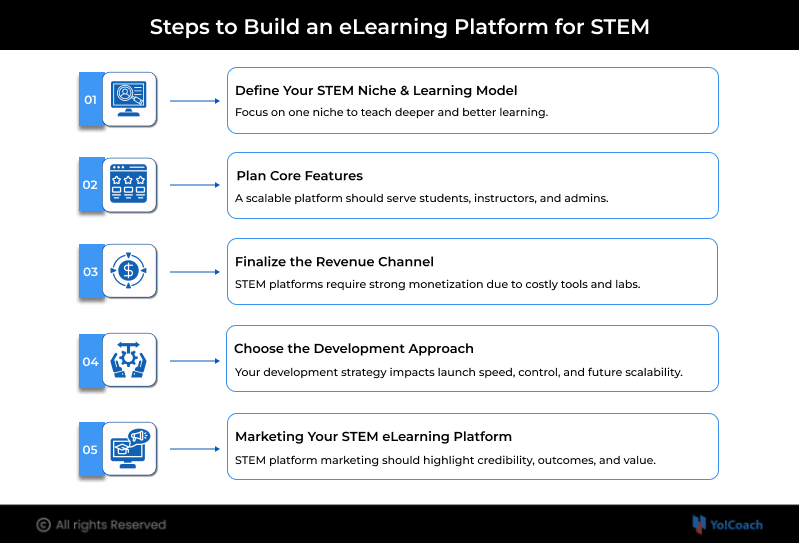
Step 1: Define Your STEM Niche & Learning Model
Avoid trying to teach everything at once. Focus on a specific domain where you can deliver exceptional value and depth. Specialization not only clarifies your brand positioning but also helps attract a highly motivated learner base.
- Choose Your Focus Area:
- Applied Mathematics: Statistics, Calculus, and Finite Math tailored for professionals and advanced learners.
- Robotics & Hardware: Practical training in Arduino, Raspberry Pi, and circuit design.
- Software Development: Full-stack engineering, cybersecurity, or data structures.
- Traditional Sciences: Biology, Chemistry, or Physics programs targeted at K-12, test preparation, or university-level study.
- Identify Your Unique Value Proposition (USP): Define what sets your platform apart. This could be a specialized virtual environment for aerodynamics experiments or personalized math tutoring powered by an advanced digital whiteboard. A strong USP gives learners a clear reason to choose you over generic alternatives.
Step 2: Plan Core Features
To scale effectively, your platform must serve three key stakeholders: the student seeking mastery, the instructor delivering knowledge, and the admin managing the business. Given below are the feature sets essential for these user types:
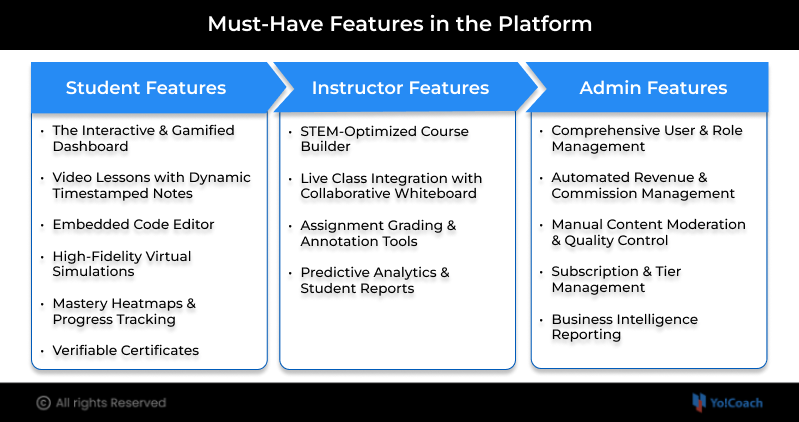
1. Student Features
For students, the platform should feel immersive and motivating rather than transactional. In STEM education, engagement is directly tied to the ability to do rather than just view.
- The Interactive & Gamified Dashboard: Replace static course lists with a dynamic mission control hub. A visual skill tree shows how mastering foundational topics unlocks advanced concepts, while countdowns for lab deadlines and achievement badges encourage consistent practice.
- Video Lessons with Dynamic Timestamped Notes: Dense technical lectures become easier to revisit when students can pin notes to exact moments in a video. Clicking a note instantly returns students to that explanation. Moreover, support for mathematical notation allows complex formulas to be recorded alongside the lesson.
- Embedded Code Editor: A browser-based coding workspace that supports syntax highlighting for Python, C++, and Java. It includes instant compilation and a side-by-side output window so students can test their logic without leaving the browser.
- High-Fidelity Virtual Simulations (WebGL): Interactive 3D models allow learners to explore the system visually, from inspecting mechanical components to examining biological structures layer by layer, making abstract concepts tangible.
- Mastery Heatmaps & Progress Tracking: Instead of a simple percentage bar, visual heatmaps reveal strength and weak areas across sub-topics. This targeted feedback helps students allocate effort where it matters most.
- Verifiable Certificates: Secure credentials with QR-based verification add professional value and can be shared with employers or integrated into digital portfolios, reinforcing the platform’s credibility.
2. Instructor Features
STEM instructors are not just lecturers. They are guides who help learners explore, experiment, and solve complex problems. To do this effectively, they need powerful teaching tools that minimize administrative tasks and maximize time spent on meaningful instruction and mentorship.
- STEM-Optimized Course Builder: An intuitive drag-and-drop builder designed for technical subjects allows teachers to embed technical content seamlessly. It supports native LaTeX for mathematical notation, structured documentation, and interactive elements ensures complex concepts, equations, and models are presented clearly and accurately.
- Live Class Integration with Collaborative Whiteboard: Go beyond basic screen sharing with a real-time workspace tailored for technical teaching. Built-in libraries of geometric shapes, electrical circuit symbols, and chemical bond templates allow for multi-user interaction where students can step up to the board to solve a proof in real-time.
- Assignment Grading & Annotation Tools: Advanced evaluation tools streamline feedback. Instructors can pinpoint where a student’s code diverges from the expected logic or annotate mathematical proofs directly using stylus input. This level of precision helps learners understand mistakes and improve faster.
- Predictive Analytics & Student Reports: Instructors receive data-driven reports flagging students who are falling behind based on their time-to-solve on specific lab modules. This allows for timely manual intervention and personalized support.
3. Admin Features
The admin shapes the platform’s structure, sustainability, and compliance. Their toolkit must support smooth operations, financial transparency, and quality assurance while enabling long-term growth.
- Comprehensive User & Role Management: Admins manage the hierarchy of users, including individual students, independent tutors, and Flexible role controls make it easy to manage permissions, onboard organizations, and support bulk enrollments for schools or corporate partners.
- Automated Revenue & Commission Management: A robust system to handle complex financial flows. This includes automated split-payments between the platform and tutors, tax calculations, such as VAT/GST based on student location, and multi-currency support.
- Manual Content Moderation & Quality Control: Tools for admins to audit course quality, verify instructor credentials, and monitor community forums. It includes keyword-based filters and a reporting system to ensure academic integrity.
- Subscription & Tier Management: Admins can create and modify access levels, such as a Basic tier for video content, a Pro tier that includes Virtual Labs, and an Enterprise tier for corporate partnerships.
- Business Intelligence Reporting: Comprehensive analytics provide visibility into growth metrics such as acquisition costs, retention rates, engagement levels, and top-performing subject areas, enabling informed strategic decisions.
Empower Educators with the Right Feature Set
Step 3: Finalize the Revenue Channel
In the STEM education space, monetization must reflect the high value of technical knowledge and the infrastructure required to deliver it. Unlike casual learning platforms, STEM ecosystems often rely on costly simulations, virtual labs, and specialized tools. Moreover, choosing the right revenue mix ensures long-term sustainability while keeping your platform accessible to different learner segments.
- Subscription Tiers: A tiered membership model offers steady and predictable recurring revenue. For instance, a basic tier might provide unlimited access to video lectures and PDF resources, while a pro tier could unlock the interactive code editors and virtual simulations. This structure encourages upgrades as learners progress.
- Pay-per-Course: Ideal for intensive, career-focused programs, this model allows learners to purchase specialized courses individually. High-impact certifications in areas like programming, engineering, or cybersecurity often justify premium pricing because they directly enhance employability and earning potential.
- School & Enterprise Partnerships: The most scalable revenue stream often comes from institutional partnerships. By partnering with high schools, universities, or corporate departments, you can provide bulk access for classrooms or workforce training programs in high-demand fields like Data Science, Renewable Energy, or Cybersecurity.
- The Freemium Model: To build a massive user base, you can offer foundational courses, such as Intro to Algebra or Basic HTML, for free. This serves as a powerful funnel, showcasing the quality of your interactive tools and virtual labs.
- The Commission-Based Marketplace Model: Inviting independent experts to publish courses expands your content library rapidly without hiring full-time faculty. The platform earns a commission on each transaction while benefiting from diverse, specialized expertise.
Step 4: Choose the Development Approach
Your development strategy determines how quickly you can enter the market, how much control you retain, and how easily the platform can evolve. The right choice depends on your budget, timeline, technical resources, and long-term vision.
- Option A: Custom Development
Building the platform from the ground up using technologies like React, Node.js, and PostgreSQL gives you full ownership and flexibility to design unique STEM experiences tailored to your niche.
Pros: Complete control over features, user experience, and scalability. Ideal for creating proprietary tools such as custom virtual labs or advanced assessment engines.
Cons: Requires significant investment and a longer development cycle, often several months before launch, along with ongoing maintenance and technical oversight.
- Option B: Readymade eLearning Software
Using a white-label solution enables a faster, more cost-efficient launch while still providing essential capabilities for tutoring and course delivery.
Pros:
- Launch in as little as 2-4 weeks.
- Significant cost savings are usually under $10k for a license.
- Built-in security and payment gateways.
Cons: You are working within an existing framework, though the best ones, such as Yo!Coach are highly customizable.
Yo!Coach: The Best Readymade Software for STEM
For entrepreneurs planning to launch a competitive STEM learning platform in 2026, choosing the right technological foundation can determine how fast and effectively you scale. While many traditional LMS solutions were designed for passive video delivery or corporate training, Yo!Coach stands out as the most strategic and technologically sound choice for entrepreneurs. It is built around live interaction, collaboration, and hands-on discovery, core requirements for teaching science and technology subjects online.
Why Yo!Coach Excels for STEM Education:
- Advanced Collaborative Whiteboards: Complex problem-solving in subjects like calculus, physics, or circuit design requires more than screen sharing. The integrated whiteboards include grid systems, scientific symbols, and structured drawing tools, enabling instructors and students to work through equations and diagrams together in real time.
- Seamless Technical Integrations: One of the platform’s greatest strengths is its ability to connect smoothly with elite STEM tools. It seamlessly integrates with specialized APIs like Lessonspace and AtomChat. These integrations eliminate the need for external downloads and keep learners focused within a single, distraction-free workspace.
- Sophisticated Multi-Role Functionality: A STEM marketplace involves students, instructors, and administrators operating simultaneously. Dedicated dashboards for each role streamline scheduling, communication, file sharing, and session management, ensuring a cohesive experience across the ecosystem.
- True Mobile-First Architecture: Learners often switch between devices throughout the day. A responsive architecture allows them to review lessons, interact with simulations, or participate in sessions from desktops, tablets, or smartphones without losing performance or usability.
- Data Ownership and Control: A self-hosted structure provides full control over platform data, customization, and future development. This flexibility is especially valuable for startups planning to introduce proprietary tools such as custom virtual labs or specialized assessment systems.
- Scalable Payouts & Commission Logic: Built-in financial systems automate tutor payments, commission calculations, and multi-currency transactions. This makes it easier to grow from a small network of educators to a large global marketplace without operational complexity.
Schedule Your One-on-One Live Demo of Yo!Coach
Step 5: Marketing Your STEM eLearning Platform
In a competitive EdTech landscape, marketing a STEM platform requires the same precision and strategy as solving a complex equation. Your messaging should highlight credibility, real outcomes, and the practical value of your learning experience.
- Content Marketing for Experts: Write in-depth and technically rich articles that address real challenges faced by learners and professionals, such as mastering thermodynamics or navigating emerging cybersecurity careers. High-quality content positions your platform as a trusted authority rather than just another course provider.
- Targeted Partnerships: Partner with high school science clubs, robotics teams, university engineering societies, and technical communities. These partnerships give you direct access to motivated learners who are already invested in STEM fields.
- YouTube Integration: Create Mini-Lessons on YouTube that solve a specific problem, for example, solving a complex differential equation step by step, and link back to your platform for the full course.
- Social Proof: Showcase success stories of students who secured engineering jobs after completing your curriculum. Authentic outcomes build trust and reduce hesitation for prospective learners.
Conclusion
Building a STEM eLearning platform involves high-stakes and high-reward, where success depends on your ability to bridge the gap between theoretical knowledge and practical application. By focusing on interactive tools, virtual labs, and a robust technical foundation, you can create a platform that goes beyond explaining concepts and enables students to actively experiment, solve, and innovate.
As the technical world in 2026 is waiting for better ways to learn, the opportunities lie in delivering hands-on discovery at scale. Whether you choose a custom solution or leverage a readymade solution like Yo!Coach, the key is to start with the learner’s need for hands-on discovery.
Frequently Asked Questions (FAQs)
Q 1. What makes a STEM eLearning platform different from a general LMS?
Ans. A general LMS platforms focus on video hosting and quizzes, whereas a STEM eLearning platform requires advanced interactive capabilities such as virtual labs, real-time assessments, LaTeX equation rendering, embedded coding environments, and simulation tools. Thus, STEM platforms must support active learning, experimentation, and logical problem-solving.
Q 2. What essential features are required to build a STEM eLearning platform?
Ans. To successfully build a STEM eLearning platform, the following features are required:
- Interactive simulations and virtual labs
- Browser-based coding environments (IDEs)
- Real-time assessment engines
- LaTeX support for mathematical notation
- Collaborative whiteboards
- Advanced analytics and reporting
- Multi-role functionality for student, instructor, and admin
- Secure payment and commission management
These features ensure students can learn by doing rather than just consuming video content.
Q 3. Can I build a STEM platform without custom development?
Ans. Yes, you can build a STEM platform without custom development. While developing the platform from scratch offers complete control, it is expensive and time-consuming. On the other hand, a readymade solution like Yo!Coach allows you to launch within weeks, reduce upfront costs, and provide access to advanced features such as live classes, whiteboards, commission management, and multi-role dashboards.
Q 4. How much does it cost to develop a STEM eLearning platform?
Ans. Costs to develop a STEM eLearning platform vary depending on the approach you select:
- Custom Development takes 6 to 9 months or even more and costs $80,000 – $150,000+.
- Readymade Software, on the other hand, allows you to launch within a timeline of 2-4 weeks and cost usually under $10,000.
Therefore, for startups and edupreneurs, a white-label solution (Yo!Coach) provides faster ROI and significantly lower risk.
Q 5. Why are virtual labs important in STEM education?
Ans. Virtual labs replicate real-world experimentation in a safe and cost-effective digital environment. They allow students to manipulate variables, visualize data in real time, and experiment without physical risks or expensive equipment. Additionally, for STEM learning, this hands-on experience is critical for a deeper understanding.
Q 6. Does Yo!Coach support technical integrations for STEM learning?
Ans. Yes, Yo!Coach supports integrations with tools like browser-based code editors, collaborative whiteboards, and third-party APIs. It allows real-time interaction between students and instructors, making it ideal for mathematics, engineering, programming, and science tutoring platforms.
Q 7. Can I create a marketplace for STEM tutors using Yo!Coach?
Ans. Yes, you can create a marketplace for STEM tutors using Yo!Coach. It supports a commission-based marketplace model where independent tutors can register, create profiles, schedule sessions, and receive automated payouts. The built-in wallet system manages multi-currency transactions and commission calculations seamlessly.
Q 8. Is Yo!Coach suitable for schools and enterprise partnerships?
Ans. Yes, Yo!Coach allows bulk user management, institute accounts, subscription tier control, and detailed reporting. This makes it suitable for high schools, universities, corporate training departments, and enterprise partnerships.
Q 9. What revenue models work best for a STEM eLearning platform?
Ans. Common and profitable revenue models for a STEM eLearning platform include:
- Subscription tiers
- Pay-per-course
- Commission-based marketplace
- Freemium model
- School and enterprise licensing
Yo!Coach supports multiple monetization models, allowing you to diversify and scale revenue streams efficiently.
Q 10. How long does it take to launch a STEM tutoring platform with Yo!Coach?
Ans. With Yo!Coach, you can launch your STEM eLearning platform in as little as 2-4 weeks, depending on customization requirements. Since it is a self-hosted solution, you get full ownership and control from day one.
Want to Start Your Own Science & Tech Learning Hub?
Get In Touch