The global demand for English fluency and real-time language practice continues to grow, driven by international students, professionals, remote workers, and immigrants adapting to new environments. Platforms like Cambly have successfully capitalized on this demand by offering flexible, one-to-one English conversations with native and fluent speakers through live video sessions.
This success has encouraged many entrepreneurs and EdTech businesses to launch a platform like Cambly that targets specific regions, learner segments, or language niches.
In this guide, you will explore how Cambly-like platforms work, the essential features required, development costs, the ideal technology stack, and the most efficient approach to launch and scale a global online tutoring marketplace.
Table of Contents
- What is Cambly and How Does it Work?
- Cambly Success Story: Year-Wise Growth Timeline
- Why Entrepreneurs are Building Platforms Like Cambly
- Business Model of a Cambly-Like Platform
- Core Features Required to Build a Platform Like Cambly
- Cost to Build a Platform Like Cambly
- How Yo!Coach Helps You Build a Platform Like Cambly
- Conclusion
- FAQs
What is Cambly and How Does it Work?
Cambly is a global online English learning platform that helps learners improve their speaking and listening skills through live, one-to-one conversations with fluent English tutors. Instead of following a fixed curriculum, Cambly emphasizes real-world communication, making it appealing to professionals, students, travelers, and non-native speakers preparing for international environments.
At its core, Cambly operates as an on-demand tutoring marketplace. It connects learners with tutors from different parts of the world, enabling flexible learning without geographical or time-zone limitations.
How Does Cambly Work?
The platform follows a simple workflow designed for ease of use on both sides of the marketplace:
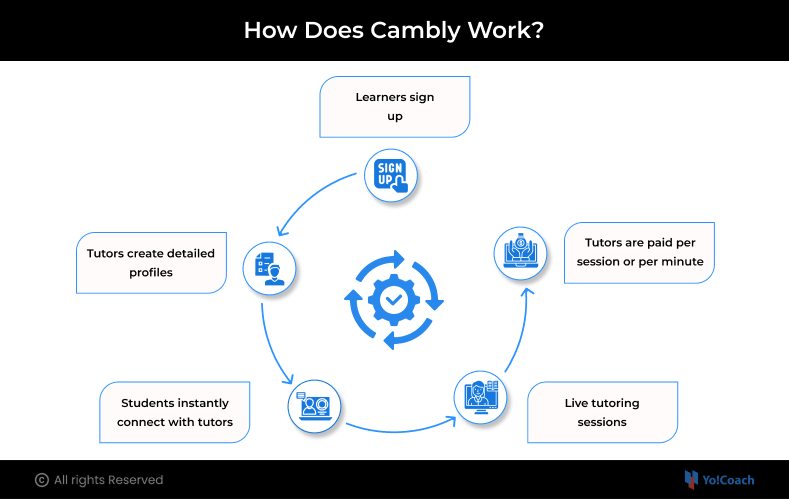
- Learners sign up and choose a subscription or lesson credit plan based on their learning needs and availability
- Tutors create detailed profiles, highlight their experience, accent, and availability, and get approved by the platform
- Students browse or instantly connect with tutors using filters such as availability, rating, price, or specialization
- Live tutoring sessions take place via built-in video conferencing, allowing real-time interaction and conversation practice.
- Tutors are paid per session or per minute, while the platform generates revenue through subscriptions and commissions.
This streamlined process removes traditional barriers to language learning, such as rigid schedule geographicalica limitations, and long-term course commitments.
Why this Model Works Globally
Cambly’s success is driven by its flexibility and accessibility. Learners can practice English anytime, tutors can work remotely from anywhere in the world, and the platform scales efficiently by acting as a facilitator rather than a service provider.
This marketplace-driven, video-first model is what makes Cambly so effective and widely appealing, and why many entrepreneurs and EdTech businesses are now looking to build similar platforms to serve global audiences.
Cambly Success Story: Year-Wise Growth Timeline
Cambly’s growth highlights how a simple, conversation-first idea can evolve into a global EdTech benchmark. Its journey offers valuable lessons for entrepreneurs looking to build scalable, on-demand tutoring platforms focused on real interaction and learner flexibility.
1. 2013: The Idea Takes Shape
Cambly was founded with a simple but powerful idea: enable English learners to practice real conversations with fluent English speakers through live video calls. While other platforms focused on recorded lessons or rigid courses, Cambly chose a conversation-first approach, setting the foundation for its long-term differentiation.
2. 2014-2015: Product Development and Early Validation
During its initial years, Cambly focused on:
- Building a stable one-to-one video communication system
- Testing the on-demand tutoring model
- Attracting early learners and tutors
These efforts helped validate market demand and refine the platform based on early learners’ and tutors’ feedback.
3. 2016-2017: Mobile Apps and Market Expansion
Cambly launched its mobile applications, making it easier for learners to practice English anytime and anywhere. This move significantly increased user engagement and retention.
Key highlights:
- Growth in international users
- Increased tutor participation
- Expansion beyond desktop learning
Mobile accessibility played a major role in Cambly’s global adoption.
4. 2018-2019: Subscription Model and Brand Strengthening
Cambly strengthened its subscription-based revenue model, offering flexible plans for different learner needs. This shift provided predictable recurring revenue and improved long-term sustainability.
During this phase:
- Tutor discovery and scheduling features were refined
- User trust and brand recognition increased
- Cambly positioned itself as a premium conversation practice platform
- 2020: Surge in Demand During Remote Learning Boom
The global shift toward remote learning accelerated Cambly’s growth. As travel restrictions and remote work increased, learners turned to online platforms to improve communication skills.
Cambly benefited from:
- Higher demand for remote English practice
- Increased daily active users
- Greater acceptance of live video learning
This period validated the scalability of Cambly’s marketplace model.
5. 2021-2022: Product Diversification and Kids Segment
Cambly expanded its offerings by introducing Cambly Kids, targeting young learners with age-appropriate tutors and structured sessions.
This expansion helped:
- Broaden the platform’s audience
- Increase lifetime customer value
- Strengthen Cambly’s position in the EdTech market
- 2023-Present: Global Brand and Market Benchmark
Today, Cambly is recognized as a global leader in live English conversation platforms. It serves learners across multiple regions and continues to evolve through product improvements, personalization, and platform optimization.
Cambly’s journey has become a reference model for entrepreneurs looking to build scalable online tutoring marketplaces.
Build a Tutoring Platform Inspired by Proven Growth
Why Entrepreneurs are Building Platforms Like Cambly
The rapid growth of remote learning and the global demand for English fluency have made platforms like Cambly highly attractive to entrepreneurs and EdTech businesses. Instead of offering traditional course-based learning, Cambly introduced a conversation-first, on-demand tutoring model that aligns perfectly with how modern learners prefer to learn. Furthermore, mentioned-below are the reasons that explain why entrepreneurs are building platforms like Cambly:
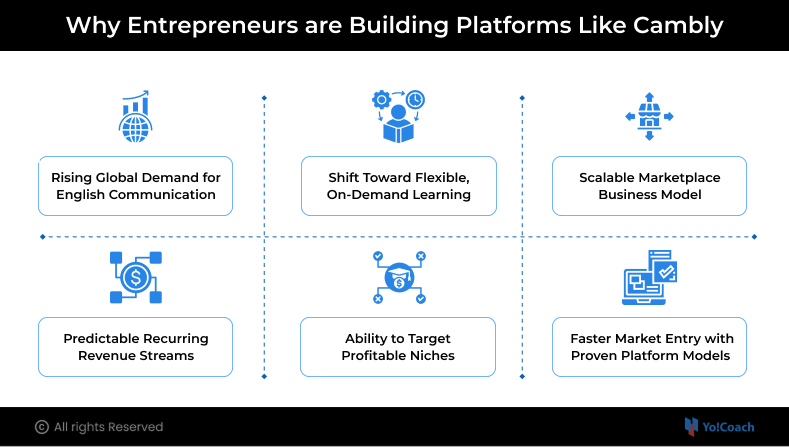
1. Rising Global Demand for English Communication
English has become the primary language for international business, higher education, travel, and remote work. Millions of learners around the world are no longer looking for certificates alone. They want confidence in real conversations, and platforms like Cambly address this demand directly by offering instant access to live tutors.
2. Shift Toward Flexible, On-Demand Learning
Today’s learners value flexibility over fixed schedules. Cambly-like platforms allow users to learn:
- Without long-term commitments
- At their own pace
- Across different time zones
This on-demand approach significantly increases user adoption and retention compared to rigid classroom or course-based models.
3. Scalable Marketplace Business Model
From a business perspective, Cambly operates on an asset-light marketplace model. Tutors are independent professionals, not full-time employees, allowing the platform to:
- Scale internationally with lower operational overhead
- Expand supply without geographic limitations
- Focus on technology, quality control, and user experience
This model is especially appealing to startups aiming for global reach.
4. Predictable Recurring Revenue Streams
Subscription-based pricing creates recurring monthly revenue, which is highly valued by investors and founders alike. Combined with commission-based tutor payouts, this model offers:
- Stable cash flow
- High lifetime customer value
- Opportunities for upselling and plan upgrades
5. Ability to Target Profitable Niches
Entrepreneurs are not limited to general English learning. Cambly-like platforms can be tailored to:
- Business English for professionals
- IELTS and exam preparation
- Kids’ learning platforms
- Region-specific or accent-focused tutoring
This flexibility allows founders to enter the market with a focused value proposition rather than competing head-on with established brands.
6. Faster Market Entry with Proven Platform Models
Building a Cambly-like platform from scratch is time-consuming and costly. As a result, many entrepreneurs are turning to ready-made and customizable tutoring marketplace solutions that allow them to validate their ideas quickly, launch faster, and scale efficiently, without compromising on quality or control.
Suggested Read: How Does Cambly Make Money? Revenue Model Explained
Business Model of a Cambly-Like Platform
The success of platforms like Cambly lies in a flexible, marketplace-driven business model that balances learner affordability, tutor earnings, and predictable platform revenue. Rather than relying on one income stream, Cambly-style platforms use multiple monetization layers to maximize lifetime value and scalability. Some of the popular models are given below:
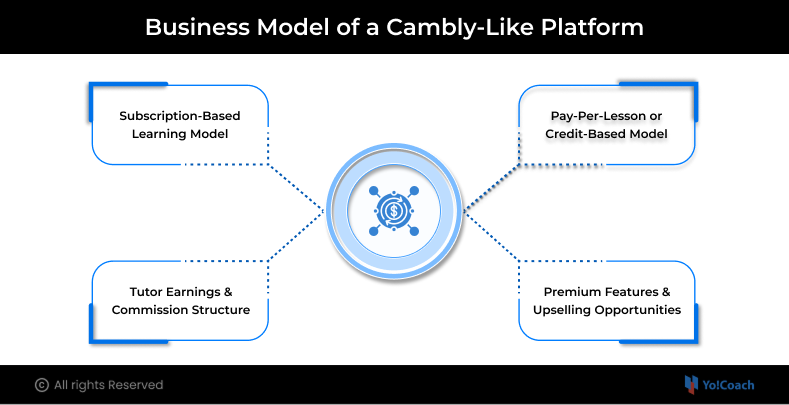
1. Subscription-Based Learning Model
The primary revenue driver is a subscription model, where learners pay monthly or annual fees for access to a defined number of tutoring minutes or sessions.
Why subscriptions work well globally:
- Predictable recurring revenue for the platform
- Lower entry barrier for learners compared to expensive language courses
- Higher retention through continuous engagement
- Easier revenue forecasting and growth planning
Subscriptions are often tiered, such as basic, standard, and premium, allowing platforms to cater to different learner needs and budgets.
2. Pay-Per-Lesson or Credit-Based Model
In addition to subscriptions, many Cambly-like platforms offer a credit-based system, where learners purchase lesson credits and redeem them for sessions.
Benefits of this model:
- Appeals to casual, trial, or first-time users
- Ideal for learners who prefer flexibility over long-term commitment
- Supports upselling and conversion into subscriptions
This hybrid approach of subscriptions and credits helps increase conversion rates and reduce churn.
3. Tutor Earnings & Commission Structure
Tutors are paid per minute or per session, while the platform retains a commission on each completed lesson.
Key advantages:
- Tutors earn based on availability and performance
- Platform revenue scales automatically with usage
- No fixed salary or employment overhead
Commission rates can be adjusted by tutor type, experience level, specialization, or demand, giving platforms full control over profit margins.
4. Premium Features & Upselling Opportunities
Beyond core tutoring, Cambly-like platforms unlock additional revenue through value-added services, such as:
- Priority access to top-rated tutors
- Specialized tutors for business English, exam prep, or kids
- Trial lesson packages for new users
- Corporate or team learning plans
These add-ons significantly increase average revenue per user (ARPU) without significantly increasing acquisition costs.
One of the biggest advantages of these models is their borderless scalability. Tutors and learners can join from anywhere, while the platform operates as a facilitator rather than a direct service provider. This enables businesses to expand into new regions quickly, support multiple currencies and time zones, and scale supply and demand independently.
Turn Your Tutoring Experience Into a Recurring Revenue Platform
Core Features Required to Build a Platform Like Cambly
To succeed in the global online tutoring market, a Cambly-like platform must deliver more than just video calls. It needs to deliver a seamless, reliable, and scalable experience for learners, tutors, and admin/s across different time zones, currencies, and regions.
Below are the essential feature sets that form the foundation of a successful Cambly-style tutoring marketplace. Let’s have a look at them:
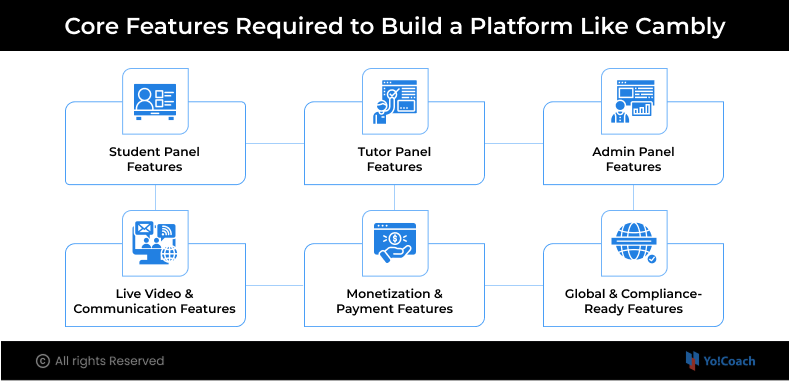
1. Student Panel Features
The student experience directly impacts engagement, retention, and subscription renewals. The platform must make it easy for learners to find tutors, book sessions, and track their learning progress.
Key features include:
- Advanced tutor search & filters such as availability, accent, rating, price, and specialization
- Time-zone-aware scheduling for global learners
- Instant and scheduled lesson booking
- One-to-one live video sessions with minimal latency
- Session history and recordings for revision
- Subscription, credits, and payment management
- Ratings, reviews, and a tutor feedback system
A frictionless student journey is critical, especially for international users who expect a consumer-grade experience.
2. Tutor Panel Features
Tutors are the backbone of the platform. A well-designed tutor dashboard helps attract, retain, and motivate quality educators worldwide.
Essential tutor features include:
- Profile creation and verification with bio, experience, accent, and intro video
- Availability and calendar management across time zones
- Session management and lesson history
- Earnings dashboard with clear and transparent payouts
- Multi-currency payout support
- Performance insights such as ratings and completed sessions
Empowering tutors with clear earnings visibility and scheduling flexibility leads to higher platform engagement and long-term retention.
3. Admin Panel Features (Platform Control & Scalability)
The admin panel is where operational efficiency and scalability are defined. A robust backend allows platform owners to manage growth without constant manual intervention.
Core admin features include:
- Student and tutor management
- Tutor approval and quality control workflows
- Commission and pricing configuration
- Subscription and transaction monitoring
- CMS for content, policies, and landing pages
- Reports and analytics on revenue, usage, and retention
- Fraud prevention and dispute management tools
Platforms like Yo!Coach includes dedicated admin dashboards, enabling founders to control monetization, tutor onboarding, and platform performance from a single interface.
4. Live Video & Communication Features
Since live conversation is the heart of a Cambly-like platform, video reliability is non-negotiable.
Must-have video capabilities:
- High-quality one-to-one video calls
- Low-latency performance across regions
- In-call chat and file sharing
- Session duration tracking
- Secure, encrypted communication
A stable video infrastructure is especially important for global platforms where users connect from different continents.
5. Monetization & Payment Features
A Cambly-style platform must support flexible and scalable monetization models to serve diverse learner needs.
Key payment features include:
- Monthly or annual subscription plans
- Credit-based or pay-per-lesson options
- Secure global payment gateways integration, such as Stripe, PayPal
- Automated tutor payouts
- Tax and invoice management
This flexibility allows platforms to adapt pricing strategies for different regions and learner segments.
6. Global & Compliance-Ready Features
For platforms targeting international audiences, additional features become essential. It includes:
- Multi-language interface support
- Multi-currency pricing and tutor payouts
- GDPR-compliant data handling
- Role-based access control
- Scalable cloud infrastructure
Modern tutoring marketplace solutions like Yo!Coach are built with global readiness in mind, allowing businesses to expand internationally without rebuilding core systems.
Cost to Build a Platform Like Cambly
The cost of building a platform like Cambly depends on several factors, including feature complexity, technology choices, video infrastructure, and the development approach you choose. For global platforms that rely heavily on real-time video communication, scalability and reliability play a major role in overall investment.
Below is a realistic breakdown to help you understand the development cost betterand how different approaches impact your budget.
1. Custom Development Cost (From Scratch)
Building a Cambly-like platform from the ground up requires a dedicated development team, extended timelines, and ongoing technical investment.
Estimated cost breakdown:
- UI/UX design: $10,000 – $20,000
- Frontend & backend development: $40,000 – $80,000
- Live video integration (WebRTC/APIs): $15,000 – $30,000
- Quality assurance & testing: $8,000 – $15,000
- Initial infrastructure & deployment: $5,000 – $10,000
Total estimated investment: $75,000 – $150,000+
Development timeline: 6-12+ months
Things to consider:
- Higher risk of delays and budget overruns
- Ongoing maintenance and feature upgrades increase long-term costs
- Requires in-house or outsourced technical management
Custom development is best suited for businesses with strong technical teams and long-term, highly customized product roadmaps.
2. Ongoing Operational & Scaling Costs
Beyond development, global tutoring platforms must account for recurring operational expenses, such as:
- Cloud hosting and global CDN (Content Delivery Network) usage
- Video usage costs based on session minutes
- Payment gateway and transaction fees
- Security updates and regulatory compliance maintenance
- Customer support and platform monitoring
These costs grow as user activity increases, making efficient infrastructure choices critical from the start.
3. Cost-Effective Alternative: Using a Cambly Clone Solution
For many startups and education businesses, using a ready-made and customizable Cambly clone platform offers a faster, more practical, and cost-efficient path to launch.
Benefits of this approach include:
- Significantly lower upfront investment
- Faster time to market (weeks instead of months)
- Pre-built, tested features for students, tutors, and admin/s
- Reduced technical and operational risk
Solutions like Yo!Coach are designed to eliminate unnecessary development overhead while still allowing full customization and scalability.
Cost Comparison: Custom Build vs Clone Platform
| Aspect | Custom Development | Cambly Clone Solution |
| Initial Cost | High | Predictable & lower |
| Time to Launch | 6-12 months | 2-6 weeks |
| Feature Readiness | Built from scratch | Pre-built & tested |
| Technical Risk | High | Significantly reduced |
| Scalability | Depends on build quality | Designed for growth |
Which Option Makes Financial Sense?
If your goal is to validate the market quickly, launch with core features, and scale based on real user feedback, a clone-based approach is often more cost-efficient and strategically sound.
While custom development may still be suitable for enterprises with complex, highly specific requirements. For most global founders, solutions like Yo!Coach strike strikesght balance between cost, speed, and long-term flexibility.
How Yo!Coach Helps You Build a Platform Like Cambly
Building a platform like Cambly requires more than just video calling. It demands a well-structured tutoring marketplace that seamlessly balances learner experience, tutor engagement, monetization, and long-term scalability. This is where Yo!Coach provides a practical advantage for entrepreneurs and EdTech businesses.
Instead of developing everything from scratch, Yo!Coach offers a ready-to-launch, fully customizable tutoring marketplace framework. It closely aligns with the Cambly business model while still giving businesses the flexibility to differentiate their platform to target specific learner segments or regions.
1. Purpose-Built for Live Tutoring Marketplaces
Yo!Coach is designed specifically for one-to-one and group online tutoring, making it well-suited for conversation-based language learning platforms. It supports real-time video sessions, smart scheduling, subscription management, and tutor payouts, which are core requirements for any Cambly-like platform.
2. Faster Time to Market Without Compromising Control
Launching a custom-built platform can take months of planning, development, and testing. With Yo!Coach, businesses can significantly reduce this timeline and focus on growth. It allows edupreneurs to:
- Launch in weeks instead of months
- Start with a proven, production-ready feature set
- Avoid common early-stage technical challenges
At the same time, Yo!Coach is self-hosted and white-label, giving platform owners full control over branding, data, and future enhancements.
3. Flexible Monetization Models
Yo!Coach supports multiple revenue strategies, allowing businesses to adapt pricing strategies as they scale. These include:
- Subscription-based learning plans
- Credit-based or pay-per-session models
- Tutor commission management
- Premium plans and add-on services
This flexibility allows businesses to test and refine pricing strategies based on regional markets and learner behavior, which is essential for global platforms.
4. Designed for Global Expansion
For platforms targeting international audiences, Yo!Coach includes features that support global scalability, such as:
- Multi-language interface readiness
- Multi-currency pricing and tutor payouts
- Time-zone-aware scheduling
- Integration with global payment gateways
- GDPR-ready data handling
These capabilities make Yo!Coach suitable for launching and scaling tutoring platforms across the US, UK, Europe, the Middle East, and beyond.
5. Customizable Yet Cost-Efficient
Unlike rigid SaaS-based tools, Yo!Coach can be customized to match unique business requirements, whether that means focusing on a specific learner segment, tutor type, or niche market. The solution adapts without the high cost and risk of full custom development. This balance of customization and cost efficiency makes it an attractive option for startups as well as established education businesses.
Book a Yo!Coach Demo to Evaluate its Capabilities
Conclusion
Building a platform like Cambly represents a proven and scalable opportunity in today’s global EdTech landscape. The rapid success of conversation-based, live tutoring platforms shows that learners value real interaction, flexibility, and personalized learning over rigid, pre-recorded course structures.
However, turning this idea into a successful platform depends on choosing the right features, technology foundation, and development approach. While custom development offers full control, it often comes with high costs, long timelines, and increased technical risk.
Thus, for entrepreneurs and education businesses looking to launch faster and scale confidently, customizable Cambly clone solutions like Yo!Coach offer aofferstical and future-ready alternative. By reducing development complexity and enabling global readiness from day one, Yo!Coach allows edupreneurs to focus on what truly matters: building a strong tutor network, delivering value to learners, and growing the platform sustainably.
FAQs
Q 1. How much does it cost to build a platform like Cambly?
Ans. The cost to build a Cambly-like platform depends on the development approach you select. To build the platform from scratch typically costs $75,000 to $150,000+, depending on features and complexity. Whereas, using a ready-made solution like Yo!Coach can significantly reduce the initial investment.
Q 2. How long does it take to launch a Cambly-like platform?
Ans. To build the platform using custom development may take 6-12 months or even more, whereas platforms built using customizable solutions like Yo!Coach can launch within a few weeks.
Q 3. Is a Cambly clone platform profitable?
Ans. Yes, with the right subscription model, tutor quality, and learner retention strategy, Cambly-like platforms can generate recurring and scalable revenue. However, success depends on attracting quality tutors, delivering a seamless learner experience, and maintaining strong retention through flexible plans and reliable live video sessions.
Q 4. Can I build a Cambly-like platform without technical expertise?
Ans. Yes, you can build a Cambly-like platform without technical expertise. Self-hosted tutoring marketplace software such as Yo!Coach handles the technical foundation, allowing non-technical founders to launch and manage the platform effectively.
Q 5. Is Yo!Coach suitable for international tutoring businesses?
Ans. Yes, Yo!Coach supports multi-currency payments, global tutor management, and provides a stable infrastructure, making it suitable for platforms targeting learners worldwide.
Q 6. Can Yo!Coach be customized for niches other than English learning?
Ans. Yes, while it works well for English conversation platforms, Yo!Coach can also be customized for niches like exam preparation, business language training, kids’ tutoring, and other education niches.
Want to Build a Language Learning Platform Similar to Cambly?
Get In Touch