
The education sector has gone through a massive transformation in the last decade. With the rise of digital learning, students are no longer restricted by location, timing, or the availability of nearby teachers. From language learning to exam preparation and professional upskilling, learners are becoming more comfortable connecting with tutors online.
At the same time, tutors are also shifting from traditional coaching centers to digital platforms. Teaching online gives them flexibility, global reach, and the ability to earn more while managing their schedule independently. A tutoring marketplace bridges the gap between students and tutors by enabling students to find the right tutor, book sessions, and take lessons seamlessly through video calls.
With more parents and students preferring personalized 1-to-1 learning over passive classroom tutoring, the demand for scalable tutoring platforms is higher than ever. Whether your goal is to build a global online learning marketplace like Preply, a regional tutor platform, or a niche tutoring website for subjects such as coding, music, or exam prep, the opportunity is huge.
However, the success requires more than just a website. It involves thoughtful business planning, the right features, tutor acquisition, student trust-building, and an ongoing growth strategy. This guide will walk you through each stage, from planning to launch, and also introduce you to Yo!Coach, a powerful white-label software that enables entrepreneurs to build and manage an online tutoring marketplace efficiently.
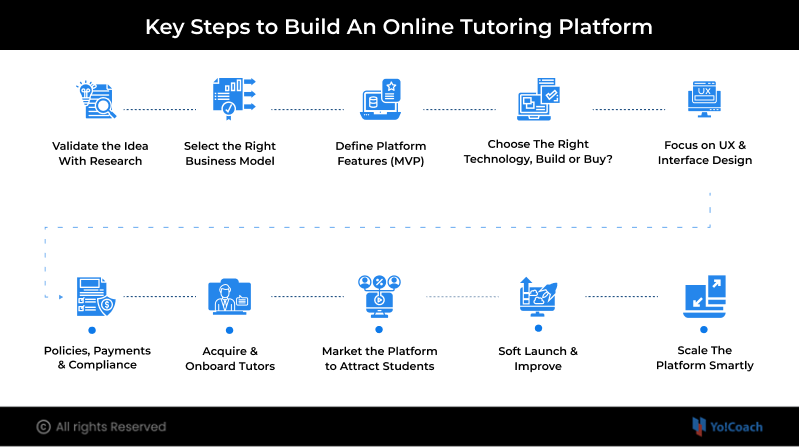
Key Steps to Build An Online Tutoring Platform
Building an online tutoring platform requires a balance of business strategy, technology, and user experience. From validating your niche and selecting the right development approach to onboarding qualified tutors and scaling with marketing, each step plays a crucial role in long-term success. Moreover, the right foundation ensures seamless learning, secure payments, and sustainable marketplace growth. Further, let’s go through the key steps to build an online tutoring platform:
Step 1: Validate the Idea With Research
Before investing in development, confirm that real demand exists for your tutoring marketplace. Research the audience segment you want to serve and identify which subjects, languages, or learning categories are trending.
Start by identifying your target learner group. Given below are some of the popular learner groups:
- K-12 students
- College/university students
- Exam prep aspirants (IELTS, GRE, GMAT, SAT, NEET, etc.)
- Language learners
- Job seekers & professionals learning new skills
- Hobby learners (music, art, fitness, public speaking)
Next, evaluate competition, analyze platforms like Preply, Wyzant, Varsity Tutors, TutorMe, and niche regional players. Identify what they offer, what they charge, and what learners complain about. Learner feedback is most important for understanding real pain points and covering the existing gap.
Step 2: Select the Right Business Model
The next crucial step is to decide on your revenue model. It decides how your platform makes money from tutors and students. Before deciding, evaluate whether a commission system, subscription plan, featured listings, or a hybrid combination will best match your target audience.
A clear and sustainable business model boosts trust among tutors because they know how earnings and payouts will work from day one. Given below are some popular revenue models opted for by most of the tutoring platforms:
| Model | Revenue Source |
| Commission | Take % from each booked session |
| Subscription | Monthly plans for tutors/students |
| Lead Pricing | Tutors pay per student lead |
| Featured Listings | Tutors pay to be highlighted |
| Bundle Packages | Students purchase course bundles |
| Hybrid | A combination of multiple models |
Most new tutoring platforms start with a commission model because it is simple and scalable, and tutors earn only when you earn.
Step 3: Define Platform Features (MVP)
Start with the must-have features that enable tutors and students to interact smoothly, including tutor profiles, search filters, booking, payments, reviews, and video learning.
Moreover, it is recommended to build an MVP to ensure you go to market quicker without unnecessary spending, while collecting real user feedback for future improvements. Mentioned below are some of the important features that your tutoring platform must incorporate:
Core features
- Tutor & student profiles
- Advanced search and subject filters
- Booking calendar with timezone sync
- Secure payment and tutor payout system
- Video calling for live lessons
- Ratings & reviews
- Real-time messaging
- Admin dashboard
Future upgrades
- Session recording & whiteboard
- Mobile app versions
- Gamification/reward systems
- AI tutor recommendation
- Student performance analytics
Step 4: Choose The Right Technology, Build or Buy?
Next, decide whether you want to build your platform from scratch or opt for a ready-made white-label software that speeds up launch. Custom development offers flexibility but requires a high budget and long timelines, whereas white-label solutions save months of coding and reduce risk.
If you build from scratch, you will have:
- Maximum control
- Higher cost & development time (6-12 months)
- Constant maintenance required
On the other hand, using a white-label tutoring marketplace solution offers:
- Launch in weeks, not months
- Customizable and scalable
- Cost-effective
One such white label solution is Yo!Coach. It is a white-label online tutoring and consultation software solution with built-in features for:
- 1-to-1 and group lessons
- Booking & time-zone management
- Multiple payment gateways
- Notifications, messaging & reviews
- Secure live video learning
- Tutor onboarding and verification
- Pre-Integrated with 25+ APIs
- Full branding control with your logo, colors & domain
Beyond core functionality, Yo!Coach offers a robust admin panel to manage tutors, students, commissions, payouts, and platform settings. The software is fully customizable, scalable, and backed by a scalable architecture tailored specifically for tutoring and consultation businesses. With Yo!Coach, you avoid months of backend development and technical complexity, allowing you to focus on growth, marketing, and delivering quality learning experiences.
Want to Start Your Tutoring Marketplace With a Proven Technology?
Step 5: Focus on UX & Interface Design
UX (User Experience) plays a critical role in the success of an online tutoring platform. Your tutoring website should make finding and booking a tutor effortless for learners of all ages. A clean layout, visible CTAs, and fast navigation build trust and encourage conversions.
For tutors, the interface should simplify tasks, such as scheduling, lesson delivery, and payments. A frictionless experience encourages tutors to stay active and engaged on the platform.
Student flow should be smooth:
- Search → Choose tutor → Book slot → Pay → Attend lesson → Rate and review the tutor
Tutor flow should be hassle-free:
- Register → Create profile → Add schedule & price → Deliver lessons → Receive payout
Other than that, make sure your website is:
- Mobile-responsive
- Fast-loading
- Trust-building with badges, reviews, profiles, and ratings
- Easy to navigate
A well-designed user interface reduces drop-offs, improves retention, and creates a positive learning experience for everyone involved.
However, with a readymade tutoring software like Yo!Coach, these UX practices are already built into the solution, allowing you to offer a polished and user-friendly experience from day one without custom design efforts.
Step 6: Policies, Payments & Compliance
Trust and transparency are the foundation of a successful online tutoring business. Clearly outline your terms, refund policy, and privacy standards to assure both tutors and students that the platform is secure and professionally managed.
Apart from it, integrate secure online payment gateways and methods that automatically split funds between tutors and the platform, ensuring friction-free payouts.
Key policies to prepare:
- Terms of service
- Privacy policy
- Refund & cancellation policy
- Age-sensitive protection rules (if minors are allowed)
Set up a payment system that handles:
- Online payments from students
- Automatic payouts to tutors
Payment gateways, such as Stripe Connect and PayPal, are commonly used to manage multi-party transactions efficiently and securely.
While using a readymade solution like Yo!Coach, payment workflows and payout mechanisms are already structured and tested, significantly reducing setup time while ensuring compliance and operational reliability from the start.
Step 7: Acquire and Onboard Tutors
The success of your tutoring website depends heavily on the quality, reliability, and availability of tutors. Start outreach early by connecting with subject experts, coaching institutes, language schools, and independent educators who align with your platform’s vision.
Simplify the onboarding process by providing clear profile setup guidelines, demo recording tips, and built-in verification features. A smooth onboarding experience helps tutors go live faster and start earning with minimal friction through your platform.
A structured onboarding and quality control process builds trust, improves learner satisfaction, and strengthens the long-term credibility of your marketplace.
Step 8: Market the Platform to Attract Students
Use a balanced mix of digital marketing tactics to build visibility and generate student sign-ups. Content-led approaches such as SEO-focused blogs, educational videos, and social media campaigns help attract organic traffic over time.
Moreover, to gain early momentum, paid ads, referral discounts, first-lesson offers, and influencer collaborations can be used to accelerate early traction and boost conversions.
Organic strategies include:
- SEO-optimized blog content
- YouTube demo lessons
- Student success stories
- Email campaigns & newsletters
Paid strategies include:
- Google Search Ads
- Instagram & Facebook ads for parents & learners
- Influencer partnerships
- Free workshops & webinars
Offering a “First lesson free” or “trial price for new users” can significantly improve initial conversion rates.
Suggested Read: How To Market Your Online Tutoring Business
Step 9: Soft Launch & Improve
Instead of going live to the masses instantly, begin with a soft launch to test core workflows, such as booking lessons, payments, video sessions, and customer support with a limited group of early users.
Gather feedback from both tutors and students to refine pricing, UI/UX, and onboarding before investing heavily in marketing.
Monitor key insights such as:
- Conversion rate
- Booking completion rate
- Video lesson experience
- Student feedback
- Tutor satisfaction
Use these insights to fix friction points, optimize pricing, user flow, and onboarding to ensure a smooth platform experience before the official launch.
Step 10: Scale The Platform Smartly
Once the website begins gaining traction, focus on strategic and sustainable expansion. Growth becomes easier when you enhance user experience, increase tutor visibility, and create strong reasons for students to return.
Growth boosters:
- Loyalty rewards and discounts for repeat students
- Tutor badges, levels, and gamification to motivate performance
- Student progress dashboards and learning insights
- Mobile apps for iOS & Android to increase convenience and engagement
- Expansion into new markets, subjects, and languages
A stable tutoring platform grows by retaining users, not just acquiring them. Continuously improving the learning experience, rewarding active users, and simplifying the journey from discovery to booking to build long-term loyalty.
Ready to Build, Launch, and Scale Your Own Tutoring Marketplace?
Final Thoughts
Building a tutoring marketplace is an excellent business opportunity, but long-term success requires smart planning, the right technology, and consistent growth. Instead of investing months into development, entrepreneurs today are choosing white-label tutoring software like Yo!Coach that enables fast launch, reduces risk, and focuses on scaling the business.
With built-in video learning, scheduling, secure payments, and full branding control, Yo!Coach provides a ready foundation to start with confidence. Its customizable and scalable architecture allows you to manage tutors, students, and operations efficiently from day one, helping you bring your tutoring platform to market quickly and grow it sustainably.
Launch Your Own Online Tutoring Marketplace
Get Started